Mark Wasiuta - Böcker
Visar alla böcker från författaren Mark Wasiuta. Handla med fri frakt och snabb leverans.
4 produkter
4 produkter
388 kr
Kommande
Frederick Kiesler: Vision Machines explores the work of Austrian architect, theater designer, and theorist Frederick Kiesler (1890 1965), with a special focus on his iconic but unrealized Mobile Home Library, which will be fabricated for the first time and photographed for the publication. Built around a speculative essay by Mark Wasiuta tracing Kiesler s visionary interest in sight, dreams, looking, and reading, the book covers Kiesler s research and teaching at Columbia University s School of Architecture in the late 1930s and 1940s, highlighting his projects at the Design Correlation Laboratory, including the Mobile Home Library and the Vision Machine. The Vision Machine was imagined as a device to visualize human sight from optics and nerve stimuli to dream content and hallucinations while the Mobile Home Library was conceived as a dynamic, modular object combining device and furniture, with rotating, spinning movements enabling variable interactions with readers. Though these projects appear distinct, together they exemplify Kiesler s correalism, blending his biotechnique design aimed at fostering human health and techno-oneiric surrealism. Published alongside an exhibition at the Graham Foundation in Chicago in Fall 2024, this stand-alone volume presents Wasiuta s research, numerous photographs, drawings, documents, film stills, pedagogical experiments from Kiesler s laboratory, and images of the Mobile Home Library s (re)construction. Kiesler, born in Czernowitz, Austria-Hungary (now Ukraine) in 1890 and deceased in New York in 1965, was briefly a member of De Stijl, partnered with Adolf Loos in the 1920s, and associated with avant-garde artists including Man Ray and Fernand Leger.
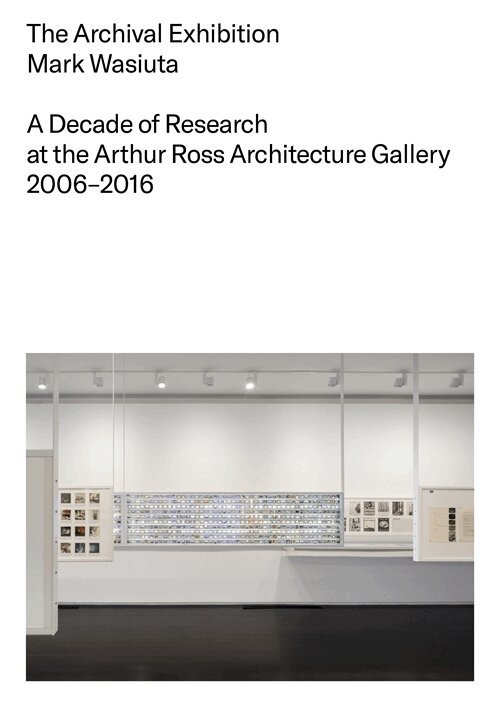
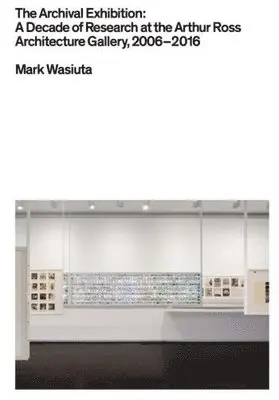
The Archival Exhibition - A Decade of Research at the Arthur Ross Architecture Gallery, 2006-2016
Häftad, Engelska, 2028
309 kr
Tillfälligt slut
The Archival Exhibition
A Decade of Research at the Arthur Ross Architecture Gallery, 2006–2016
Häftad, Engelska, 2026
610 kr
Kommande
Just as information and media are products of design, they themselves leave indelible marks on the environments in which they circulate and help structure. Architecture has irrevocably been altered by the proliferation and advancement of new media technologies and forms of communication, but architecture, too, is capable of mediating these forms of mediation—their materiality, their transmission, and the motivations they carry. From 2006–2016, the Arthur Ross Architecture Gallery under the directorship of Mark Wasiuta at Columbia University's Graduate School of Architecture, Planning, and Preservation was the center of a sustained research practice experimenting with these intersections. As the title suggests, The Archival Exhibition: A Decade of Research at the Arthur Ross Architecture Gallery, 2006–2016 both records the possibilities of the archival exhibition as a mode, method, and problem of architecture, and is itself a record of a decade-long curatorial project that sought to reframe the documents, authors, environments produced by and producing architecture.This book thus collects thirteen exhibitions that read architecture as a field coordinated by documents with distinct historical, mediatic, and disciplinary registers. The book, and the exhibitions it presents, recognize that architectural documents take shape according to different discursive and institutional exigencies. Yet, in these exhibitions the architectural archive is hardly stable or uniform. Rather, the archive appears as a term, process, mode of organization, underwriting architecture’s media, histories, and effects.With contributions from Martin Beck, Caitlin Blanchfield, Craig Buckley, Glen Cummings, Keller Easterling, Noam M. Elcott, James Graham, Branden W. Joseph, Adrian Lahoud, Leah Meisterlin, Felicity D. Scott, Anthony Vidler, Mark Wasiuta, Ines Weizman, and Mark Wigley.
384 kr
Skickas inom 7-10 vardagar
Dan Graham, one of America's most important contemporary artists, is best known today for his sculptural works and installations. His photographic works are generally not so well known, despite the fact that he first became famous for his photographic series, Homes for America, pictures of typical American suburbia. To this day the theme of architecture and its surfaces represents an extremely important facet of his work, as does the question of what role it plays in postmodern society and in the context of everyday culture. This publication presents new photographs by Dan Graham, taken in the context of a study trip with the architecture faculty of Columbia University, together with a selection of original photographs from the Homes for America series. The new images exhibit stark similarities to the old pictures, because they were taken in the same locations, in the same deserts of suburban streets and housing that Graham had photographed in the 1960s. This creates a fascinating reference system of repetitions and differences, in terms of both the temporal and the spatial, that asks questions of the viewer about architecture, public space, and their function in society.