Mark Weisbrot - Böcker
Visar alla böcker från författaren Mark Weisbrot. Handla med fri frakt och snabb leverans.
3 produkter
3 produkter
342 kr
Skickas inom 5-8 vardagar
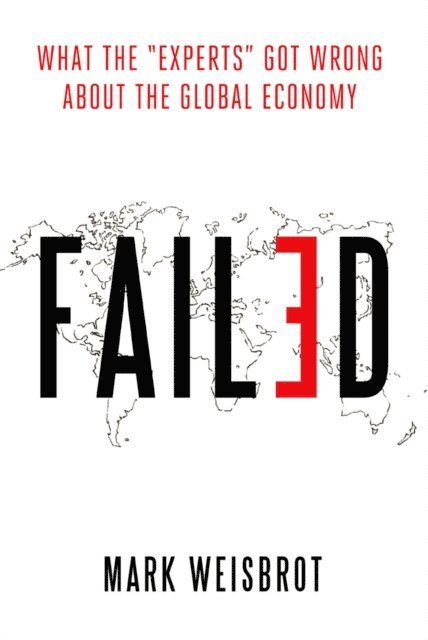
Why has the Eurozone ended up with an unemployment rate more than twice that of the United States more than six years after the collapse of Lehman Brothers? Why did the vast majority of low- and middle-income countries suffer a prolonged economic slowdown in the last two decades of the 20th century? What was the role of the International Monetary Fund in these economic failures? Why was Latin America able to achieve substantial poverty reduction in the 21st century after more than two decades without any progress? Failed analyzes these questions, explaining why these important economic developments of recent years have been widely misunderstood and in some cases almost completely ignored. First, in the Eurozone, Mark Weisbrot argues that the European authorities' political agenda, which included shrinking the welfare state, reducing health care, pension, and other social spending, and reducing the bargaining power of labor played a very important role in prolonging the Eurozone's financial crisis and pushing it into years of recession and mass unemployment. This conclusion is based not only on public statements of European officials, but also on thousands of pages of documentation from consultations between the IMF and European governments after 2008.The second central theme of Failed is that there are always practical alternatives to prolonged economic failure. Drawing on the history of other financial crises, recessions, and recoveries, Weisbrot argues that regardless of initial conditions, there have been and remain economically feasible choices for governments of the Eurozone to greatly reduce unemployment-including the hardest hit, crisis-ridden country of Greece.The long-term economic failure of developing countries, its social consequences, as well as the subsequent recovery in the first decade of the 21st century, constitute the third part of the book's narrative, one that has previously gotten too little attention. We see why the International Monetary Fund has lost influence in middle income countries. Failed also examines the economic causes and consequences of Latin America's "second independence" and rebound in the twenty-first century, as well as the challenges that lie ahead.
372 kr
Tillfälligt slut
Is it true that the Social Security system is in serious trouble and must be repaired? As baby boomers begin to retire, will they inevitably, by force of their sheer numbers, bankrupt the system? Is Social Security a big Ponzi scheme that will leave future generations with little to show for their lifetime of contributions? Is the only way to solve the Social Security crisis through radical changes like privatization or bolstering it with massive new taxes? According to the authors of this study, the answer to these questions is a resounding no. Economists Dean Baker and Mark Weisbrot argue that there is no economic, demographic or actuarial basis for the widespread belief that the programme needs to be fixed. As the authors emphasize, there is virtually no disagreement about the facts of Social Security's finances, or even the projections for its future. Rather, the Social Security debate has been foundering on misconceptions, confusion and lack of agreement on the meaning of crucial terms.The authors also take on related issues: that privatization would help save Social Security, that America has a pressing need to increase its national savings, and that future generations will suffer from the costs - especially for health care - of supporting a growing elderly population.
215 kr
Skickas inom 7-10 vardagar
Is it true that the Social Security system is in serious trouble and must be repaired? As baby boomers begin to retire, will they inevitably, by force of their sheer numbers, bankrupt the system? Is Social Security a big Ponzi scheme that will leave future generations with little to show for their lifetime of contributions? Is the only way to solve the Social Security crisis through radical changes like privatization or bolstering it with massive new taxes? According to the authors of this study, the answer to these questions is a resounding no. Economists Dean Baker and Mark Weisbrot argue that there is no economic, demographic or actuarial basis for the widespread belief that the programme needs to be fixed. As the authors emphasize, there is virtually no disagreement about the facts of Social Security's finances, or even the projections for its future. Rather, the Social Security debate has been foundering on misconceptions, confusion and lack of agreement on the meaning of crucial terms.The authors also take on related issues: that privatization would help save Social Security, that America has a pressing need to increase its national savings, and that future generations will suffer from the costs - especially for health care - of supporting a growing elderly population.