• Fri frakt över 249 kr
  • •
  • Snabba leveranser
  • •
  • Billiga böcker
Kundservice

Du är på sajten för privatpersoner.

Företag, bibliotek eller offentlig verksamhet?

Du handlar på classic.bokus.com, där alla dina funktioner finns intakta.
Till classic.bokus.com
Bokus logotyp. Gå till startsidan.
  • Erbjudanden
  • Nyheter
  • Student
  • Topplistor
  • Barn & ungdom
  • Bokus Play
  • E-böcker
  • Pocketböcker
  • Spel & pussel

10% rabatt på allt med kod: NYSTART10 →

Sidfot

Mina sidor

    Hjälp

    • Kundservice
    • Vanliga frågor och svar
    • Frakt och leverans
    • Retur vid ångerrätt
    • Reklamera vara
    • Betalning
    • Köpvillkor
    • Allmänna villkor
    • Information om webbplatsens tillgänglighet

    Om Bokus

    • Om oss
    • Pressrum
    • För studenter
    • För företag
    • För bibliotek och offentlig verksamhet
    • För leverantörer
    • Hållbarhet

    Populärt

    • Aktuella erbjudanden
    • Presentkort
    • Studentlitteratur
    • Nya böcker
    • Topplistor
    • Signerade böcker
    • Engelska böcker

    Inspiration

    • Boktips
    • BookTok
    • Populära bokserier
    • Barnbokskaraktärer
    • Populära författare
    Logotyp för Bokus
    Följ oss på Facebook (extern länk)Följ oss på Instagram (extern länk)Följ oss på YouTube (extern länk)Följ oss på TikTok (extern länk)
    bokus @ CookiesAnpassa cookiesIntegritetspolicyKöpvillkor
    Till Citymail hemsida (extern länk)Till Budbee hemsida (extern länk)Till Postnord hemsida (extern länk)Till Schenker hemsida (extern länk)Till Early Bird hemsida (extern länk)Till Walleys hemsida (extern länk)
    1. Ekonomi och Ledarskap
    2. Nationalekonomi

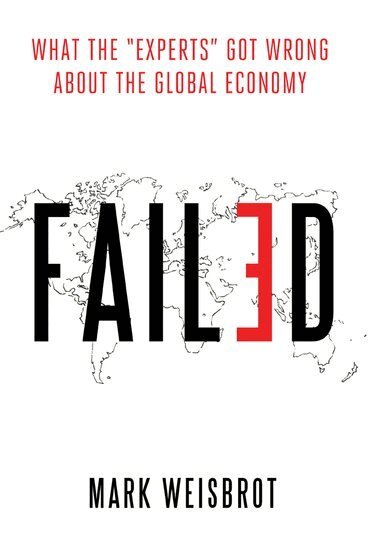
    Failed

    What the "Experts" Got Wrong about the Global Economy

    AvMark Weisbrot

    Inbunden, Engelska, 2015

    655 kr

    Beställningsvara. Skickas inom 3-6 vardagar. Fri frakt över 249 kr.

    Fler format och utgåvor

    E-bok

    407 kr

    E-bok

    407 kr

    Beskrivning

    Why has the Eurozone ended up with an unemployment rate more than twice that of the United States more than six years after the collapse of Lehman Brothers? Why did the vast majority of low- and middle-income countries suffer a prolonged economic slowdown in the last two decades of the 20th century? What was the role of the International Monetary Fund in these economic failures? Why was Latin America able to achieve substantial poverty reduction in the 21st century after more than two decades without any progress? Failed analyzes these questions, explaining why these important economic developments of recent years have been widely misunderstood and in some cases almost completely ignored. First, in the Eurozone, Mark Weisbrot argues that the European authorities' political agenda, which included shrinking the welfare state, reducing health care, pension, and other social spending, and reducing the bargaining power of labor played a very important role in prolonging the Eurozone's financial crisis and pushing it into years of recession and mass unemployment. This conclusion is based not only on public statements of European officials, but also on thousands of pages of documentation from consultations between the IMF and European governments after 2008.The second central theme of Failed is that there are always practical alternatives to prolonged economic failure. Drawing on the history of other financial crises, recessions, and recoveries, Weisbrot argues that regardless of initial conditions, there have been and remain economically feasible choices for governments of the Eurozone to greatly reduce unemployment-including the hardest hit, crisis-ridden country of Greece.The long-term economic failure of developing countries, its social consequences, as well as the subsequent recovery in the first decade of the 21st century, constitute the third part of the book's narrative, one that has previously gotten too little attention. We see why the International Monetary Fund has lost influence in middle income countries. Failed also examines the economic causes and consequences of Latin America's "second independence" and rebound in the twenty-first century, as well as the challenges that lie ahead.

    Produktinformation

    • Utgivningsdatum:2015-11-26
    • Mått:142 x 211 x 27 mm
    • Vikt:454 g
    • Format:Inbunden
    • Språk:Engelska
    • Antal sidor:312
    • Förlag:OUP USA
    • ISBN:9780195170184

    Utforska kategorier

    • Nationalekonomi inom Ekonomi och Ledarskap
    • Ekonomisk historia inom Ekonomi och Ledarskap
    • Finanskriser inom Ekonomi och Ledarskap

    Mer om författaren

    Mark Weisbrot is Co-Director of the Center for Economic and Policy Research in Washington, D.C. He received his Ph.D. in economics from the University of Michigan. He is co-author, with Dean Baker, of Social Security: The Phony Crisis, and has written numerous research papers on economic issues and policy. His columns, commentary, and op-eds have appeared in almost all major U.S. newspapers, and in many in other countries, and he appears frequently on national and international television and radio programs. He is also president of Just Foreign Policy.

    Recensioner i media

    For those who wish to understand the global economy of the past generation, the shocking failures and impressive successes, this is the book to read. With careful scholarship and lucid analysis, Weisbrot reveals the pernicious effects of the neoliberal assault on the world's population, from wealthy and developed Europe to the global south, and exposes the dominant political-economic doctrines, rooted in a harsh attack on democracy and undermining of social policies that benefit the vast majority. He also shows how rejection of these doctrines has led to impressive achievements. All of this is consistent with actual economic history, if not prevailing illusion. The critique is harsh and incisive, but prospects are bright if the lessons of history and the logic of policy are viewed with care, as in this timely, authoritative, and very valuable study.

    Innehållsförteckning

    • Chapter 1 - Troubles in Euroland: When the Cures Worsen the Disease ; Chapter 2 - This Time Could Be Different: The Aftermath of Financial Crises ; Bibliography ; Chapter 3 - Untold History, Unsolved Mystery: The Long-Term Economic Growth Failure ; Chapter 4 - The Misunderstood Role of the International Monetary Fund ; Chapter 5 - The Latin American Spring ; Chapter 6 - Conclusion: Looking Ahead