Martin Ravallion - Böcker
Visar alla böcker från författaren Martin Ravallion. Handla med fri frakt och snabb leverans.
5 produkter
5 produkter
2 379 kr
Skickas inom 7-10 vardagar
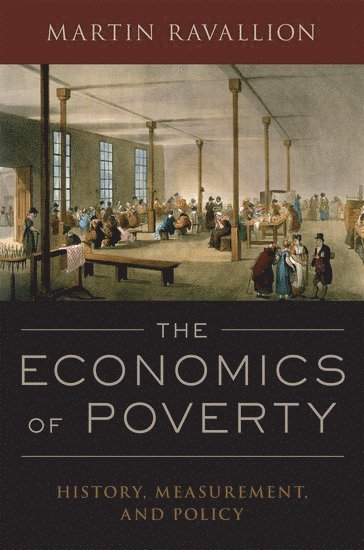
While there is no denying that the world has made huge progress against absolute poverty over the last 200 years, until recent times the bulk of that progress had been made in wealthy countries only. The good news is that we have seen greater progress against poverty in the developing world in recent times-indeed, a faster pace of progress against extreme poverty than the rich world saw over a period of 100 years or more of economic development. However, continuing progress is far from assured. High and rising inequality has stalled progress against poverty in many countries. We are seeing generally rising relative poverty in the rich world as a whole over recent decades. And even in the developing world, there has been less progress in reaching the poorest, who risk being left behind, and a great many people in the emerging middle class remain highly vulnerable to falling back into poverty.The Economics of Poverty strives to support well-informed efforts to put in place effective policies to assure continuing success in reducing poverty in all its dimensions. The book reviews critically the past and present debates on the central policy issues of economic development everywhere. How much poverty is there? Why does poverty exist? What can be done to eliminate poverty? Martin Ravallion provides an accessible new synthesis of current knowledge on these issues. It does not assume that readers know economics already. Those new to economics get a lot of help along the way in understanding its concepts and methods. Economics lives though its relevance to real world problems, and here the problem of global poverty is both the central focus and a vehicle for learning.
747 kr
Skickas inom 5-8 vardagar
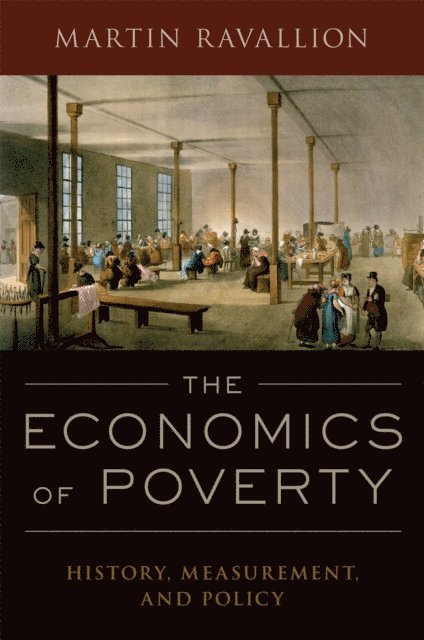
While there is no denying that the world has made huge progress against absolute poverty over the last 200 years, until recent times the bulk of that progress had been made in wealthy countries only. The good news is that we have seen greater progress against poverty in the developing world in recent times-indeed, a faster pace of progress against extreme poverty than the rich world saw over a period of 100 years or more of economic development. However, continuing progress is far from assured. High and rising inequality has stalled progress against poverty in many countries. We are seeing generally rising relative poverty in the rich world as a whole over recent decades. And even in the developing world, there has been less progress in reaching the poorest, who risk being left behind, and a great many people in the emerging middle class remain highly vulnerable to falling back into poverty.The Economics of Poverty strives to support well-informed efforts to put in place effective policies to assure continuing success in reducing poverty in all its dimensions. The book reviews critically the past and present debates on the central policy issues of economic development everywhere. How much poverty is there? Why does poverty exist? What can be done to eliminate poverty? Martin Ravallion provides an accessible new synthesis of current knowledge on these issues. It does not assume that readers know economics already. Those new to economics get a lot of help along the way in understanding its concepts and methods. Economics lives though its relevance to real world problems, and here the problem of global poverty is both the central focus and a vehicle for learning.
2 088 kr
Skickas inom 10-15 vardagar
First published in 1994. Drawing on a personal network, an economist can still relatively easily stay well informed in the narrow field in which he works, but to keep up with the development of economics as a whole is a much more formidable challenge. Economics are confronted with difficulties associated with the rapid development of their discipline. There is a risk of ‘balkanization’ in economics, which may not be favorable to its development. Fundamentals of Pure and Applied Economics has been created to meet this problem. Poverty comparisons — such as assessments of whether poverty has increased, or where it is greatest — are typically clouded in conceptual and methodological uncertainties. How should individual4 well-being’ be assessed in deciding who is poor? Is a household survey a reliable guide? Where should the poverty line be drawn, and does the choice matter? What poverty measure should be used in aggregating data on individual well-being? Does that choice matter? This monograph surveys the issues that need to be considered in answering these questions.
227 kr
Skickas inom 10-15 vardagar
India's 2005 National Rural Employment Guarantee Act creates a justiciable 'right to work' by promising up to 100 days of wage employment per year to all rural households whose adult members volunteer to do unskilled manual work. Work is provided in public works projects at the stipulated minimum wage.This study asks: Are the conditions stipulated by the Act met in practise? How much impact on poverty do the earnings from the scheme have? Why might that impact fall short of its potential? How can the scheme bridge that gap? The bulk of the study focuses on the scheme's performance in one of India's poorest states, Bihar, where one would hope that a scheme such as this would help reduce poverty.The study finds that the scheme is falling well short of its potential impact on poverty in Bihar. Analysis of the study's survey data points to a number of reasons. Workers are not getting all the work they want, they are not getting the full wages due and participation in the scheme is far from costless to them. Many report that they had to give up some other income-earning activity when they took up work. The unmet demand for work is the single most important policy-relevant factor in accounting for the gap between actual performance and the scheme's potential impact on poverty.The study finds that there is very low public awareness of what needs to be done to obtain work. The study uses a randomised control trial of an awareness intervention - a specially designed fictional movie - to show how knowledge of rights and processes can be enhanced, as a key step toward better performance. While the movie was effective in raising awareness, it had little discernible effect on actions such as seeking employment when needed.This suggests that supply-side constraints must also be addressed in addition to raising public awareness. A number of specific supply-side constraints to work provision are identified, including poor implementation capacity, weak financial management and monitoring systems.
671 kr
Skickas inom 10-15 vardagar
First published in 1994. Drawing on a personal network, an economist can still relatively easily stay well informed in the narrow field in which he works, but to keep up with the development of economics as a whole is a much more formidable challenge. Economics are confronted with difficulties associated with the rapid development of their discipline. There is a risk of ‘balkanization’ in economics, which may not be favorable to its development. Fundamentals of Pure and Applied Economics has been created to meet this problem. Poverty comparisons — such as assessments of whether poverty has increased, or where it is greatest — are typically clouded in conceptual and methodological uncertainties. How should individual4 well-being’ be assessed in deciding who is poor? Is a household survey a reliable guide? Where should the poverty line be drawn, and does the choice matter? What poverty measure should be used in aggregating data on individual well-being? Does that choice matter? This monograph surveys the issues that need to be considered in answering these questions.