Martina Urban – författare
Visar alla böcker från författaren Martina Urban. Handla med fri frakt och snabb leverans.
6 produkter
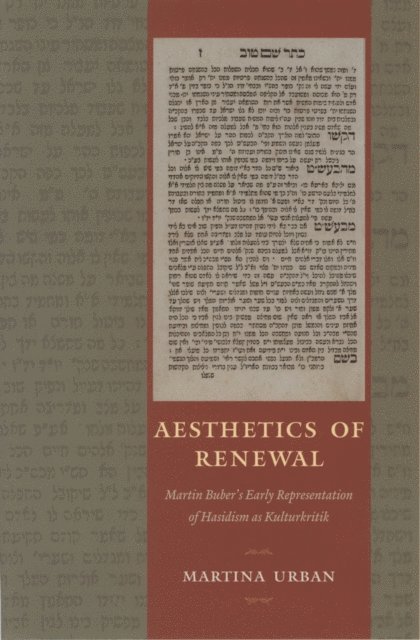
Aesthetics of Renewal
Martin Buber''s Early Representation of Hasidism as Kulturkritik
E-bok, 2009
834 kr
Lägg i varukorg
Martin Buber’s embrace of Hasidism at the start of the twentieth century was instrumental to the revival of this popular form of Jewish mysticism. Hoping to instigate a Jewish cultural and spiritual renaissance, he published a series of anthologies of Hasidic teachings written in German to …
Theodicy of Culture and the Jewish Ethos
David Koigen’s Contribution to the Sociology of Religion
Inbunden, 2012
2321 kr
Lägg i varukorg
This volume presents the theory of culture of the Russian‑born German Jewish social philosopher David Koigen (1879–1933). Heir to Hermann Cohen’s neo‑Kantian interpretation of Judaism, he transforms the religion of reason into an ethical Intimitätsreligion. He draws upon a great variety of …
Theodicy of Culture and the Jewish Ethos
David Koigen’s Contribution to the Sociology of Religion
E-bok, 2012
2295 kr
Lägg i varukorg
This volume presents the theory of culture of the Russian‑born German Jewish social philosopher David Koigen (1879–1933). Heir to Hermann Cohen’s neo‑Kantian interpretation of Judaism, he transforms the religion of reason into an ethical Intimitätsreligion. He draws upon a great variety of …
German-Jewish Thought Between Religion and Politics
Festschrift in Honor of Paul Mendes-Flohr on the Occasion of His Seventieth Birthday
Av Christian Wiese, Martina Urban
Inbunden, 2012
2842 kr
Lägg i varukorg
Since the Enlightenment period, German-Jewish intellectuals have been prominent voices in the multi-facetted discourse on the reinterpretation of Jewish tradition in light of modern thinking. Paul Mendes-Flohr, one of the towering figures of current scholarship on German-Jewish intellectual …
German-Jewish Thought Between Religion and Politics
Festschrift in Honor of Paul Mendes-Flohr on the Occasion of His Seventieth Birthday
Av Martina Urban, Christian Wiese
E-bok, 2012
2818 kr
Lägg i varukorg
Since the Enlightenment period, German-Jewish intellectuals have been prominent voices in the multi-facetted discourse on the reinterpretation of Jewish tradition in light of modern thinking. Paul Mendes-Flohr, one of the towering figures of current scholarship on German-Jewish intellectual …
Aesthetics of Renewal
Martin Buber's Early Representation of Hasidism as Kulturkritik
Inbunden, 2008
383 kr
Tillfälligt slut
Martin Buber's embrace of Hasidism at the start of the twentieth century was instrumental to the revival of this popular form of Jewish mysticism. Hoping to instigate a Jewish cultural and spiritual renaissance, he published a series of anthologies of Hasidic teachings written in German to …