Mary Jo Nye – författare
Visar alla böcker från författaren Mary Jo Nye. Handla med fri frakt och snabb leverans.
7 produkter
7 produkter
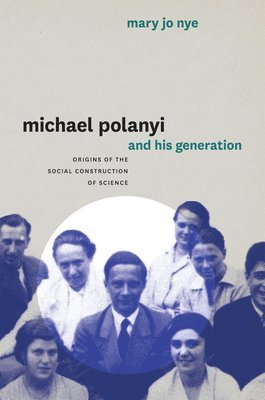
Michael Polanyi and His Generation
Origins of the Social Construction of Science
Häftad, Engelska, 2013
276 kr
Skickas inom 7-10 vardagar
In Michael Polanyi and His Generation, Mary Jo Nye investigates the role that Michael Polanyi and several of his contemporaries played in the emergence of the social turn in the philosophy of science. This turn involved seeing science as a socially based enterprise that does not rely on empiricism and reason alone but on social communities, behavioral norms, and personal commitments. Nye argues that the roots of the social turn are to be found in the scientific culture and political events of Europe in the 1930s, when scientific intellectuals struggled to defend the universal status of scientific knowledge and to justify public support for science in an era of economic catastrophe, Stalinism and Fascism, and increased demands for applications of science to industry and social welfare. At the center of this struggle was Polanyi, who Nye contends was one of the first advocates of this new conception of science.Nye reconstructs Polanyi's scientific and political milieus in Budapest, Berlin, and Manchester from the 1910s to the 1950s and explains how he and other natural scientists and social scientists of his generation and the next forged a politically charged philosophy of science, one that newly emphasized the social construction of science.
Michael Polanyi and His Generation
Origins of the Social Construction of Science
Inbunden, Engelska, 2011
574 kr
Tillfälligt slut
In "Michael Polanyi and His Generation", Mary Jo Nye investigates the role that Michael Polanyi and several of his contemporaries played in the emergence of the social turn in the philosophy of science. This turn involved seeing science as a socially based enterprise that does not rely on empiricism and reason alone but on social communities, behavioral norms, and personal commitments. Nye argues that the roots of the social turn are to be found in the scientific culture and political events of Europe in the 1930s, when scientific intellectuals struggled to defend the universal status of scientific knowledge and to justify public support for science in an era of economic catastrophe, Stalinism and Fascism, and increased demands for applications of science to industry and social welfare. At the center of this struggle was Polanyi, who Nye contends was one of the first advocates of this new conception of science. Nye reconstructs Polanyi's scientific and political milieus in Budapest, Berlin, and Manchester from the 1910s to the 1950s and explains how he and other natural scientists and social scientists of his generation - including J.D.Bernal, Ludwik Fleck, Karl Mannheim, and Robert K. Merton - and the next, such as Thomas Kuhn, forged a politically charged philosophy of science, one that newly emphasized the social construction of science.
From Chemical Philosophy to Theoretical Chemistry
Dynamics of Matter and Dynamics of Disciplines, 1800-1950
Inbunden, Engelska, 1994
1 089 kr
Skickas inom 3-6 vardagar
How did chemistry and physics acquire their separate identities, and are they on their way to losing them again? Mary Jo Nye has written a graceful account of the historical demarcation of chemistry from physics and subsequent reconvergences of the two, from Lavoisier and Dalton in the late eighteenth century to Robinson, Ingold, and Pauling in the mid-twentieth century. Using the notion of a disciplinary "identity" analogous to ethnic or national identity, Nye develops a theory of the nature of disciplinary structure and change. She discusses the distinctive character of chemical language and theories and the role of national styles and traditions in building a scientific discipline. Anyone interested in the history of scientific thought will enjoy pondering with her the question of whether chemists of the mid-twentieth century suspected chemical explanation had been reduced to physical laws, just as Newtonian mechanical philosophers had envisioned in the eighteenth century.
Science in the Provinces
Scientific Communities and Provincial Leadership in France, 1860 - 1930
Häftad, Engelska, 2022
811 kr
Skickas inom 3-6 vardagar
Science in the Provinces: Scientific Communities and Provincial Leadership in France, 1860–1930 by Mary Jo Nye reconceptualizes the Paris–provinces dichotomy by recovering the intellectual vitality and institutional ambition of five non-Parisian centers—Nancy, Grenoble, Toulouse, Lyon, and Bordeaux—across the late nineteenth and early twentieth centuries. Rather than treating provincial laboratories as derivative outposts, Nye situates them within national debates over centralization, educational reform in the early Third Republic, and the entwined growth of applied and fundamental sciences. Through closely textured portraits, she shows how local economies and civic politics fostered distinctive specialties: electrical science and metallurgy in Nancy; hydroelectric physics and, crucially, Raoult’s physical chemistry in Grenoble; catalytic chemistry and institute-building under Sabatier in Toulouse; organic synthesis anchored by Grignard in Lyon; and a conservative, Catholic-inflected scientific culture shaped by Duhem in Bordeaux. Episodes such as Blondlot’s N-ray scandal illuminate how town–gown alliances, professional rivalries, and press publicity could both energize and imperil scientific reputations, while World War I recast priorities and resources, leaving uneven legacies across the provinces.Methodologically, Nye critiques simple “center–periphery” models (à la Shils) by demonstrating a dialectical traffic of authority, talent, and technique between Paris and the provinces, where provincial initiatives often anticipated or pressured national structures later embodied in the CNRS and postwar engineering schools. The book weaves prosopography with institutional and disciplinary history to ask how examination regimes, salary scales, cumul practices, and ministerial patronage shaped research agendas; why mathematics retained epistemic primacy while chemistry and natural history struggled for status; and how regional industries and municipal pride underwrote laboratories that became international magnets for students and collaborators. By pairing social organization with the content of scientific work—physical chemistry’s emergence in “peripheral” Grenoble; organic synthesis in an industrial Lyon; Duhem’s skeptical philosophy within Bordeaux’s conservatism—Nye reframes “decline” narratives and demonstrates that French scientific modernity was co-produced in the provinces as much as in Paris.This title is part of UC Press's Voices Revived program, which commemorates University of California Press’s mission to seek out and cultivate the brightest minds and give them voice, reach, and impact. Drawing on a backlist dating to 1893, Voices Revived makes high-quality, peer-reviewed scholarship accessible once again using print-on-demand technology. This title was originally published in 1986.
Science in the Provinces
Scientific Communities and Provincial Leadership in France, 1860 - 1930
Inbunden, Engelska, 2022
758 kr
Skickas inom 7-10 vardagar
Science in the Provinces: Scientific Communities and Provincial Leadership in France, 1860–1930 by Mary Jo Nye reconceptualizes the Paris–provinces dichotomy by recovering the intellectual vitality and institutional ambition of five non-Parisian centers—Nancy, Grenoble, Toulouse, Lyon, and Bordeaux—across the late nineteenth and early twentieth centuries. Rather than treating provincial laboratories as derivative outposts, Nye situates them within national debates over centralization, educational reform in the early Third Republic, and the entwined growth of applied and fundamental sciences. Through closely textured portraits, she shows how local economies and civic politics fostered distinctive specialties: electrical science and metallurgy in Nancy; hydroelectric physics and, crucially, Raoult’s physical chemistry in Grenoble; catalytic chemistry and institute-building under Sabatier in Toulouse; organic synthesis anchored by Grignard in Lyon; and a conservative, Catholic-inflected scientific culture shaped by Duhem in Bordeaux. Episodes such as Blondlot’s N-ray scandal illuminate how town–gown alliances, professional rivalries, and press publicity could both energize and imperil scientific reputations, while World War I recast priorities and resources, leaving uneven legacies across the provinces.Methodologically, Nye critiques simple “center–periphery” models (à la Shils) by demonstrating a dialectical traffic of authority, talent, and technique between Paris and the provinces, where provincial initiatives often anticipated or pressured national structures later embodied in the CNRS and postwar engineering schools. The book weaves prosopography with institutional and disciplinary history to ask how examination regimes, salary scales, cumul practices, and ministerial patronage shaped research agendas; why mathematics retained epistemic primacy while chemistry and natural history struggled for status; and how regional industries and municipal pride underwrote laboratories that became international magnets for students and collaborators. By pairing social organization with the content of scientific work—physical chemistry’s emergence in “peripheral” Grenoble; organic synthesis in an industrial Lyon; Duhem’s skeptical philosophy within Bordeaux’s conservatism—Nye reframes “decline” narratives and demonstrates that French scientific modernity was co-produced in the provinces as much as in Paris.This title is part of UC Press's Voices Revived program, which commemorates University of California Press’s mission to seek out and cultivate the brightest minds and give them voice, reach, and impact. Drawing on a backlist dating to 1893, Voices Revived makes high-quality, peer-reviewed scholarship accessible once again using print-on-demand technology. This title was originally published in 1986.
The Cambridge History of Science: Volume 5, The Modern Physical and Mathematical Sciences
Inbunden, Engelska, 2002
2 921 kr
Skickas inom 7-10 vardagar
A narrative and interpretative history of the physical and mathematical sciences from the early nineteenth century to the close of the twentieth century. Drawing upon the most recent methods and results in historical studies of science, the authors of over thirty chapters employ strategies from intellectual history, social history, and cultural studies to provide unusually wide-ranging and comprehensive insights into developments in the public culture, disciplinary organization, and cognitive content of the physical and mathematical sciences. The sciences under study in the volume include physics, astronomy, chemistry and mathematics, as well as their extensions into geosciences and environmental sciences, computer science, and biomedical science. Scientific traditions and scientific changes are examined; the roles of instruments, languages, and images in everyday practice are analyzed; the theme of scientific 'revolution' is scrutinized; and the interactions of the sciences with literature, religion, and ideology are examined.
Del 139 - Boston Studies in the Philosophy and History of Science
Invention of Physical Science
Intersections of Mathematics, Theology and Natural Philosophy Since the Seventeenth Century Essays in Honor of Erwin N. Hiebert
Inbunden, Engelska, 1992
1 589 kr
Skickas inom 10-15 vardagar
Modern physical science is constituted by specialized scientific fields rooted in experimental laboratory work and in rational and mathematical representations. Contemporary scientific explanation is rigorously differentiated from religious interpretation, although scientists sometimes do the philosophical work of interpreting the metaphysics of space, time, and matter. However it is rare that either theologians or philosophers convincingly claim that they are doing the scientific work of physical scientists and mathematicians. The rigidity of these divisions and differentiations is relatively new. Modern physical science was invented slowly and gradually through interactions of the aims and contents of mathematics, theology, and natural philosophy since the 17th-century. In essays ranging in focus from 17th-century interpretations of heavenly comets to 20th-century explanations of tracks in bubble chambers, historians of science demonstrate metaphysical and theological threads continuing to underpin the epistemology and practice of the physical sciences and mathematics, even while they became disciplinary specialities during the last three centuries.This volume is prefaced by tributes to Erwin N. Hiebert.