Masha Fedorova – Författare
Visar alla böcker från författaren Masha Fedorova. Handla med fri frakt och snabb leverans.
4 produkter
4 produkter
Del 55 - School of Human Rights Research
Principle of Equality of Arms in International Criminal Proceedings
Häftad, Engelska, 2012
1 070 kr
Tillfälligt slut
This book studies the interpretation and application of the principle of equality of arms in proceedings before several international criminal courts. The coming of age of these institutions merits an evaluation of the application of one of the fundamental principles underlying a criminal procedure. The practice of these courts presents some substantial challenges to achieving a meaningful equality of arms in the context in which these courts operate. Before studying the law and jurisprudence of the International Criminal Tribunals for the former Yugoslavia and Rwanda, the Special Court for Sierra Leone, the International Criminal Court, and the Extraordinary Chambers in the Courts of Cambodia, the historical roots and the meaning of the principle of equality of arms are examined from two perspectives: the human rights perspective and the criminal process perspective. Subsequently, four themes that are central to understanding the principle of equality of arms in the international criminal context are discussed. First, the focus is on the investigation stage of the criminal process and the ability of the parties to prepare for trial.Next, the study takes a closer look at the system of disclosure of materials that were collected during investigations. Third, attention is paid to the issue of the perceived inequality in resources and facilities between the parties and the institutionally unequal positioning of the defence. Last, issues concerning the presentation of the case at the trial stage, such as the time and the number of witnesses the parties are allowed to present and the issues relating to the examination of witnesses and the admissibility of evidence, are examined. The book concludes with general observations on the scope and proper understanding of the principle of fairness, the right to a fair trial and the principle of equality of arms.
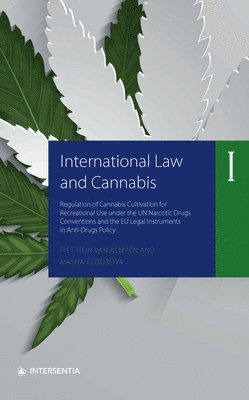
International Law and Cannabis I
Regulation of Cannabis Cultivation for Recreational Use under the UN Narcotic Drugs Conventions and the EU Legal Instruments in Anti-Drugs Policy
Häftad, Engelska, 2019
940 kr
Skickas inom 5-8 vardagar
What legal avenues do states have to regulate cannabis cultivations and trade for recreational use? This question has generated heated discussions in various societies, in political and academic discourses. Several states are considering adjusting or have adjusted their legal and policy approaches towards a more lenient regulation of cannabis cultivation and trade for the recreational user market.This book addresses the legal question to what extent domestic initiatives involving the regulation of cannabis cultivation for recreational use are compatible with the relevant UN narcotic drugs conventions and European Union law. To this end, the book provides a comprehensive and detailed analysis of the UN Single Convention on Narcotic Drugs (1961), as amended by the Protocol in 1972, and the UN Convention against Illicit Traffic in Narcotic Drugs (1988). The relevant European law is also considered, particularly the so-called Schengen acquis (1985 Agreement and 1990 Implementation Agreement), the Joint Action on illegal drug trafficking (1996) and the Framework Decision on Illegal Drug Trafficking (2004). This analysis forms the basis for an evaluative framework for various initiatives that have advanced the regulation of cannabis cultivation for reactional use in several states, such as the 'coffeeshop system' in the Netherlands, the steps towards legalization of cannabis in several states in the Americas and Canada and the phenomenon of Cannabis Social Clubs.
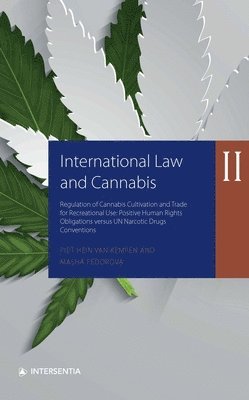
International Law and Cannabis II
Regulation of Cannabis Cultivation and Trade for Recreational Use: Positive Human Rights Obligations versus UN Narcotic Drugs Conventions
Häftad, Engelska, 2019
1 296 kr
Skickas inom 5-8 vardagar
What legal avenues do states have to regulate cannabis cultivations and trade for recreational use? This question has generated heated discussions in various societies, in political and academic discourses. Several states are considering adjusting or have adjusted their legal and policy approaches towards a more lenient regulation of cannabis cultivation and trade for the recreational user market.Seen from the perspective of relevant United Nations narcotic drugs conventions, the legal avenues for regulation are virtually non-existent. This book takes an innovative approach to this issue and approaches the possibility for regulation of cannabis for recreational use from the perspective of positive human rights obligations. To what extend can regulation of cannabis for recreational use, for the sake of health, safety and crime control, be considered a positive human rights obligation resulting from the right to health, the right to life, the right to physical and psychological integrity and the right to privacy? From the subsequent conclusions, a second pertinent question arises: what hierarchical relationship, if any, exists between these positive human rights obligations and the obligations arising from the UN drugs conventions? Through an in-depth and systematic analysis of relevant international human rights law and public international law, this book presents the steps, assumptions and conditions that are relevant if a state were to decide, on the basis of the incumbent positive human rights obligations, to permit cannabis cultivation and trade for the recreational user market under regulation.
1 538 kr
Tillfälligt slut