Masha Kirasirova – Författare
Visar alla böcker från författaren Masha Kirasirova. Handla med fri frakt och snabb leverans.
4 produkter
4 produkter
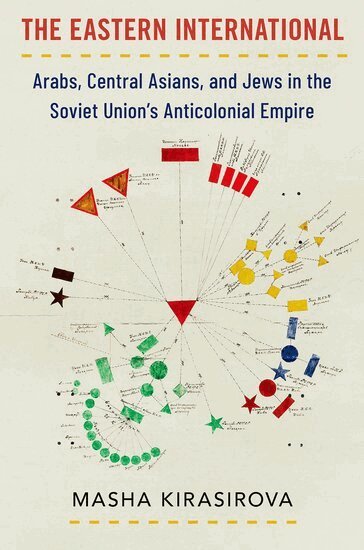
The Eastern International
Arabs, Central Asians, and Jews in the Soviet Union's Anticolonial Empire
Inbunden, Engelska, 2024
1 054 kr
Skickas inom 7-10 vardagar
In the first few years after the Russian Revolution, an ideological project coalesced to link the development of what Stalin demarcated as the internal "East"--primarily Central Asia and the Caucasus--with nation-building, the overthrow of colonialism, and progress toward socialism in the "foreign East"--the Third World. Support for anti-colonial movements abroad was part of the Communist Party platform and shaped Soviet foreign policy to varying degrees thereafter. The Eastern International explores how the concept of "the East" was used by the world's first communist state and its mediators to project, channel, and contest power across Eurasia. Masha Kirasirova traces how this policy was conceptualized and carried out by students, comrades, and activists--Arab, Jewish, and Central Asian. It drew on their personal motivations and gave them considerable access to state authority and agency to shape Soviet ideology, inform concrete decisions, and allocate resources. Contextualizing these Eastern mediators within a global frame, this book historicizes the circulation of peoples and ideas between the socialist and decolonizing world and reinscribes Soviet history into postcolonial studies and global history.
The Eastern International
Arabs, Central Asians, and Jews in the Soviet Union's Anticolonial Empire
Häftad, Engelska, 2024
300 kr
Skickas inom 5-8 vardagar
In the first few years after the Russian Revolution, an ideological project coalesced to link the development of what Stalin demarcated as the internal "East"--primarily Central Asia and the Caucasus--with nation-building, the overthrow of colonialism, and progress toward socialism in the "foreign East"--the Third World. Support for anti-colonial movements abroad was part of the Communist Party platform and shaped Soviet foreign policy to varying degrees thereafter. The Eastern International explores how the concept of "the East" was used by the world's first communist state and its mediators to project, channel, and contest power across Eurasia. Masha Kirasirova traces how this policy was conceptualized and carried out by students, comrades, and activists--Arab, Jewish, and Central Asian. It drew on their personal motivations and gave them considerable access to state authority and agency to shape Soviet ideology, inform concrete decisions, and allocate resources. Contextualizing these Eastern mediators within a global frame, this book historicizes the circulation of peoples and ideas between the socialist and decolonizing world and reinscribes Soviet history into postcolonial studies and global history.
707 kr
Skickas inom 10-15 vardagar
‘This extraordinary collection is a game-changer. Featuring the cutting-edge work of over forty scholars from across the globe, The Routledge Handbook of the Global Sixties is breathtaking in its range, incisive in analyses, and revolutionary in method and evidence. Here, fifty years after that iconic "1968," Western Europe and North America are finally de-centered, if not provincialized, and we have the basis for a complete remapping, a thorough reinterpretation of the "Sixties."’ —Jean Allman, J.H. Hexter Professor in the Humanities; Director, Center for the Humanities, Washington University in St. Louis‘This is a landmark achievement. It represents the most comprehensive effort to date to map out the myriad constitutive elements of the "Global Sixties" as a field of knowledge and inquiry. Richly illustrated and meticulously curated, this collection purposefully "provincializes" the United States and Western Europe while shifting the loci of interpretation to Africa, the Middle East, Asia, and Latin America. It will become both a benchmark reference text for instructors and a gateway to future historical research.’ —Eric Zolov, Associate Professor of History; Director, Latin American & Caribbean Studies, Stony Brook University‘This important and wide-ranging volume de-centers West-focused histories of the 1960s. It opens up fresh and vital ground for research and teaching on Third, Second, and First World transnationalism(s), and the many complex connections, tensions, and histories involved.’ —John Chalcraft, Professor of Middle East History and Politics, Department of Government, London School of Economics and Political Science‘This book globalizes the study of the 1960s better than any other publication. The authors stretch the standard narrative to include regions and actors long neglected. This new geography of the 1960s changes how we understand the broader transformations surrounding protest, war, race, feminism, and other themes. The global 1960s described by the authors is more inclusive and relevant for our current day. This book will influence all future research and teaching about the postwar world.’ —Jeremi Suri, Mack Brown Distinguished Chair for Leadership in Global Affairs; Professor of Public Affairs and History, The University of Texas at AustinAs the fiftieth anniversary of 1968 approaches, this book reassesses the global causes, themes, forms, and legacies of that tumultuous period. While existing scholarship continues to largely concentrate on the US and Western Europe, this volume will focus on Asia, Africa, the Middle East, and Eastern Europe. International scholars from diverse disciplinary backgrounds explore the global sixties through the prism of topics that range from the economy, decolonization, and higher education, to forms of protest, transnational relations, and the politics of memory.
3 435 kr
Skickas inom 10-15 vardagar
‘This extraordinary collection is a game-changer. Featuring the cutting-edge work of over forty scholars from across the globe, The Routledge Handbook of the Global Sixties is breathtaking in its range, incisive in analyses, and revolutionary in method and evidence. Here, fifty years after that iconic "1968," Western Europe and North America are finally de-centered, if not provincialized, and we have the basis for a complete remapping, a thorough reinterpretation of the "Sixties."’ —Jean Allman, J.H. Hexter Professor in the Humanities; Director, Center for the Humanities, Washington University in St. Louis‘This is a landmark achievement. It represents the most comprehensive effort to date to map out the myriad constitutive elements of the "Global Sixties" as a field of knowledge and inquiry. Richly illustrated and meticulously curated, this collection purposefully "provincializes" the United States and Western Europe while shifting the loci of interpretation to Africa, the Middle East, Asia, and Latin America. It will become both a benchmark reference text for instructors and a gateway to future historical research.’ —Eric Zolov, Associate Professor of History; Director, Latin American & Caribbean Studies, Stony Brook University‘This important and wide-ranging volume de-centers West-focused histories of the 1960s. It opens up fresh and vital ground for research and teaching on Third, Second, and First World transnationalism(s), and the many complex connections, tensions, and histories involved.’ —John Chalcraft, Professor of Middle East History and Politics, Department of Government, London School of Economics and Political Science‘This book globalizes the study of the 1960s better than any other publication. The authors stretch the standard narrative to include regions and actors long neglected. This new geography of the 1960s changes how we understand the broader transformations surrounding protest, war, race, feminism, and other themes. The global 1960s described by the authors is more inclusive and relevant for our current day. This book will influence all future research and teaching about the postwar world.’ —Jeremi Suri, Mack Brown Distinguished Chair for Leadership in Global Affairs; Professor of Public Affairs and History, The University of Texas at AustinAs the fiftieth anniversary of 1968 approaches, this book reassesses the global causes, themes, forms, and legacies of that tumultuous period. While existing scholarship continues to largely concentrate on the US and Western Europe, this volume will focus on Asia, Africa, the Middle East, and Eastern Europe. International scholars from diverse disciplinary backgrounds explore the global sixties through the prism of topics that range from the economy, decolonization, and higher education, to forms of protest, transnational relations, and the politics of memory.