Matthew D. Eddy – författare
Visar alla böcker från författaren Matthew D. Eddy. Handla med fri frakt och snabb leverans.
12 produkter
Natural Theology
Av William Paley, Matthew D. Eddy m. fl.
Häftad, 2008
123 kr
Lägg i varukorg
'The consciousness of knowing little, need not beget a distrust of that which he does not know.'In Natural Theology William Paley set out to prove the existence of God from the evidence of the beauty and order of the natural world. Famously beginning by comparing the world to a watch, whose design …
Natural Theology
Av William Paley, David Knight m. fl.
E-bok, 2006
102 kr
Lägg i varukorg
''The consciousness of knowing little, need not beget a distrust of that which he does not know.'' In Natural Theology William Paley set out to prove the existence of God from the evidence of the beauty and order of the natural world. Famously beginning by comparing the world to a watch, whose …
Natural Theology
Av William Paley, David Knight m. fl.
E-bok, 2006
102 kr
Lägg i varukorg
''The consciousness of knowing little, need not beget a distrust of that which he does not know.'' In Natural Theology William Paley set out to prove the existence of God from the evidence of the beauty and order of the natural world. Famously beginning by comparing the world to a watch, whose …
Science and Beliefs
From Natural Philosophy to Natural Science, 1700–1900
Av Matthew D. Eddy, David M. Knight
Inbunden, 2005
2519 kr
Lägg i varukorg
The years between 1700 and 1900 witnessed a fundamental transition in attitudes towards science, as earlier concepts of natural philosophy were replaced with a more modern conception of science. This process was by no means a simple progression, and the changing attitudes to science was marked by …
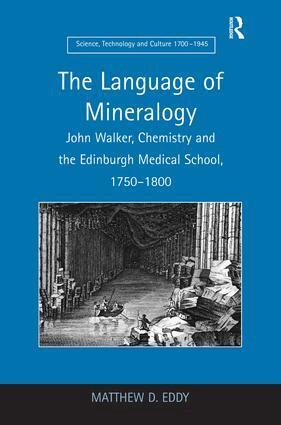
Language of Mineralogy
John Walker, Chemistry and the Edinburgh Medical School, 1750-1800
Inbunden, 2008
2519 kr
Lägg i varukorg
Classification is an important part of science, yet the specific methods used to construct Enlightenment systems of natural history have proven to be the bête noir of studies of eighteenth-century culture. One reason that systematic classification has received so little attention is that natural …
Science and Beliefs
From Natural Philosophy to Natural Science, 1700–1900
Av Matthew D. Eddy, David M. Knight
Häftad, 2017
868 kr
Lägg i varukorg
The years between 1700 and 1900 witnessed a fundamental transition in attitudes towards science, as earlier concepts of natural philosophy were replaced with a more modern conception of science. This process was by no means a simple progression, and the changing attitudes to science was marked by …
Language of Mineralogy
John Walker, Chemistry and the Edinburgh Medical School, 1750-1800
Häftad, 2016
922 kr
Lägg i varukorg
Classification is an important part of science, yet the specific methods used to construct Enlightenment systems of natural history have proven to be the bête noir of studies of eighteenth-century culture. One reason that systematic classification has received so little attention is that natural …
Language of Mineralogy
John Walker, Chemistry and the Edinburgh Medical School, 1750-1800
E-bok, 2016
1022 kr
Lägg i varukorg
Classification is an important part of science, yet the specific methods used to construct Enlightenment systems of natural history have proven to be the bête noir of studies of eighteenth-century culture. One reason that systematic classification has received so little attention is that natural …
Language of Mineralogy
John Walker, Chemistry and the Edinburgh Medical School, 1750-1800
E-bok, 2016
1022 kr
Lägg i varukorg
Classification is an important part of science, yet the specific methods used to construct Enlightenment systems of natural history have proven to be the bête noir of studies of eighteenth-century culture. One reason that systematic classification has received so little attention is that natural …
Science and Beliefs
From Natural Philosophy to Natural Science, 1700–1900
Av Matthew D. Eddy, David M. Knight
E-bok, 2017
1000 kr
Lägg i varukorg
The years between 1700 and 1900 witnessed a fundamental transition in attitudes towards science, as earlier concepts of natural philosophy were replaced with a more modern conception of science. This process was by no means a simple progression, and the changing attitudes to science was marked by …
Science and Beliefs
From Natural Philosophy to Natural Science, 1700–1900
Av Matthew D. Eddy, David M. Knight
E-bok, 2017
1022 kr
Lägg i varukorg
The years between 1700 and 1900 witnessed a fundamental transition in attitudes towards science, as earlier concepts of natural philosophy were replaced with a more modern conception of science. This process was by no means a simple progression, and the changing attitudes to science was marked by …
Osiris, Volume 29
Chemical Knowledge in the Early Modern World
Av Matthew D. Eddy, Seymour H. Mauskopf m. fl.
Häftad, 2015
290 kr
Tillfälligt slut
The last twenty-five years have witnessed some provocative transmutations in our understanding of early modern chemistry. The alchemist, once marginalized as a quack, now joins the apothecary, miner, humanist, and natural historian as a practitioner of "chymistry." In a similar vein, the chemical …