Matthew Rottnek - Böcker
Visar alla böcker från författaren Matthew Rottnek. Handla med fri frakt och snabb leverans.
3 produkter
3 produkter
1 188 kr
Skickas inom 10-15 vardagar
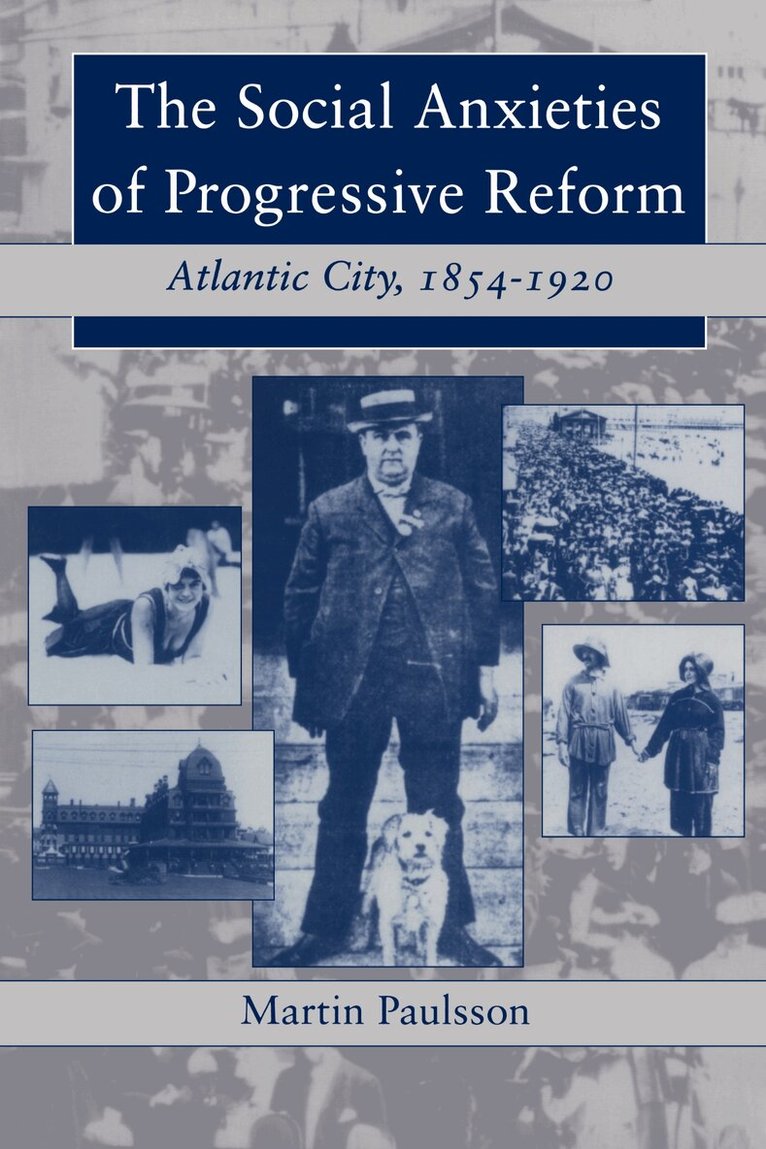
Tracing the evolution of Atlantic City from a miserable hamlet of fishermen's huts in 1854 to the nation's premier seaside resort in 1910, The Social Anxieties of Progressive Reform chronicles a bizarre political conflict that reaches to the very heart of Progressivism.Operating outside of the traditional constraints of family, church, and community, commercial recreation touched the rawest nerves of the reform impulse. The sight of young men and women frolicking in the surf and tangoing on the beach and the presence of unescorted women in boardwalk cafs and cabarets translated for many Progressives, secular and evangelical alike, into a wholesale rejection of socio-sexual restraints and portended disaster for the American family. While some viewed Atlantic City as a modern-day Sodom and Gomorrah, others considered the resort the triumph of American democracy and a healthy and innocent release from the drudgery and regimentation of industrial society.These conflicting currents resulted in a policy of strategic censorship that evolved in stages during the formative years of the city. Sunday drinking, gambling, and prostitution were permitted, albeit under increasingly stringent controls, but resort amusements were significantly restricted and shut down entirely on Sunday. This policy also segregated blacks from the beach and the boardwalk. By 1890, more than one in five residents of Atlantic City was black, a uniquely high ratio among northern cities. While the urban economies of the north depended on immigrant labor, the resort economy of Atlantic City rested on legions of black cooks, waiters, bellmen, and domestic workers. Paulsson's description of African-American life in Atlantic City provides a vivid and comprehensive picture of life in the North during the decades following the Civil War.Paulsson's work, and his focus on changing social values and growing racial tensions, brings to light an ongoing crisis in American society, namely the chasm between religion and mass culture as embodied by the indifference to the sanctity of the Sabbath. In Atlantic City, churches mounted a nationwide effort to preserve the Christian Sunday, a movement that grew steadily after the Civil War. Paullson's account of modern Sabbatarianism provides fresh insights into the nature of evangelical reform and its relationship to the Progressive movement.Filled with over forty delightful historical photographs that vividly depict the evolution of the resort's architecture, political scene, and even swimwear, The Social Anxieties of Progressive Reform is must reading for anyone interested in American mass culture, Progressivism, and reform movements. Paulsson has illustrated the story with over forty delightful historical photographs that vividly depict the evolution of the resort's architecture, political scene, and even swimwear.
914 kr
Skickas inom 10-15 vardagar
"[An] empathetic study of the meanings of cross-racial adoption to adoptees."—Law and Politics Book ReviewCan White parents teach their Black children African American culture and history? Can they impart to them the survival skills necessary to survive in the racially stratified United States? Concerns over racial identity have been at the center of controversies over transracial adoption since the 1970s, as questions continually arise about whether White parents are capable of instilling a positive sense of African American identity in their Black children.Through in-depth interviews with adult transracial adoptees, as well as with social workers in adoption agencies, Sandra Patton, herself an adoptee, explores the social construction of race, identity, gender, and family and the ways in which these interact with public policy about adoption. Patton offers a compelling overview of the issues at stake in transracial adoption. She discusses recent changes in adoption and social welfare policy which prohibit consideration of race in the placement of children, as well as public policy definitions of "bad mothers" which can foster coerced aspects of adoption, to show how the lives of transracial adoptees have been shaped by the policies of the U.S. child welfare system.Neither an argument for nor against the practice of transracial adoption, BirthMarks seeks to counter the dominant public view of this practice as a panacea to the so-called "epidemic" of illegitimacy and the misfortune of infertility among the middle class with a more nuanced view that gives voice to those directly involved, shedding light on the ways in which Black and multiracial adoptees articulate their own identity experiences.
362 kr
Skickas inom 7-10 vardagar
In 1973, homosexuality was officially depathologized with a revision in the Diagnostic and Statistical Manual of Psychiatry. In 1980, a new diagnosis appeared: Gender Identity Disorder of Childhood (GID). The shift separated gender from sexuality, while it simultaneously reinforced traditional concepts of "male" and "female" and made it possible for cross-gendered behavior and/or identification to be deemed psychiatric illness.What is the difference then between a child being called a sissy on the playground and being labeled with a disorder in a psychiatric hospital? Combining theory and personal narrative, this volume interrogates the meaning of "the normal" that pervades the literature on GID and investigates the theoretical underpinnings of the diagnosis. Sissies and Tomboys considers how the stigma of illness influences a child's development and what homosexual childhood, freed from the constraints of conventionally acceptable gender expression, might look like.