Matthew W. King – författare
Visar alla böcker från författaren Matthew W. King. Handla med fri frakt och snabb leverans.
4 produkter
4 produkter
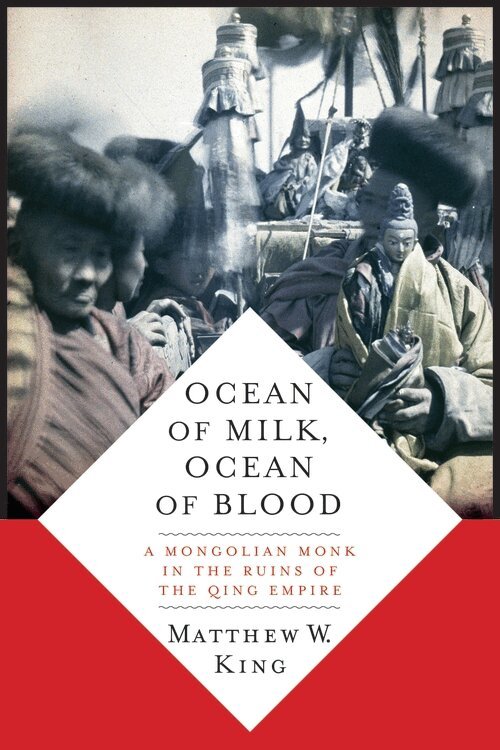
Ocean of Milk, Ocean of Blood
A Mongolian Monk in the Ruins of the Qing Empire
Inbunden, Engelska, 2019
521 kr
Skickas inom 7-10 vardagar
After the fall of the Qing empire, amid nationalist and socialist upheaval, Buddhist monks in the Mongolian frontiers of the Soviet Union and Republican China faced a chaotic and increasingly uncertain world. In this book, Matthew W. King tells the story of one Mongolian monk’s efforts to defend Buddhist monasticism in revolutionary times, revealing an unexplored landscape of countermodern Buddhisms beyond old imperial formations and the newly invented national subject.Ocean of Milk, Ocean of Blood takes up the perspective of the polymath Zava Damdin (1867–1937): a historian, mystic, logician, and pilgrim whose life and works straddled the Qing and its socialist aftermath, between the monastery and the party scientific academy. Drawing on contacts with figures as diverse as the Dalai Lama, mystic monks in China, European scholars inventing the field of Buddhist studies, and a member of the Bakhtin Circle, Zava Damdin labored for thirty years to protect Buddhist tradition against what he called the “bloody tides” of science, social mobility, and socialist party antagonism. Through a rich reading of his works, King reveals that modernity in Asia was not always shaped by epochal contact with Europe and that new models of Buddhist life, neither imperial nor national, unfolded in the post-Qing ruins. The first book to explore countermodern Buddhist monastic thought and practice along the Inner Asian frontiers during these tumultuous years, Ocean of Milk, Ocean of Blood illuminates previously unknown religious and intellectual legacies of the Qing and offers an unparalleled view of Buddhist life in the revolutionary period.
In the Forest of the Blind
The Eurasian Journey of Faxian's Record of Buddhist Kingdoms
Inbunden, Engelska, 2022
1 272 kr
Skickas inom 7-10 vardagar
The Record of Buddhist Kingdoms is a classic travelogue that records the Chinese monk Faxian’s journey in the early fifth century CE to Buddhist sites in Central and South Asia in search of sacred texts. In the nineteenth century, it traveled west to France, becoming in translation the first scholarly book about “Buddhist Asia,” a recent invention of Europe. This text fascinated European academic Orientalists and was avidly studied by Hegel, Schopenhauer, and Nietzsche. The book went on to make a return journey east: it was reintroduced to Inner Asia in an 1850s translation into Mongolian, after which it was rendered into Tibetan in 1917. Amid decades of upheaval, the text was read and reinterpreted by Siberian, Mongolian, and Tibetan scholars and Buddhist monks.Matthew W. King offers a groundbreaking account of the transnational literary, social, and political history of the circulation, translation, and interpretation of Faxian’s Record. He reads its many journeys at multiple levels, contrasting the textual and interpretative traditions of the European academy and the Inner Asian monastery. King shows how the text provided Inner Asian readers with new historical resources to make sense of their histories as well as their own times, in the process developing an Asian historiography independently of Western influence. Reconstructing this circulatory history and featuring annotated translations, In the Forest of the Blind models decolonizing methods and approaches for Buddhist studies and Asian humanities.
In the Forest of the Blind
The Eurasian Journey of Faxian's Record of Buddhist Kingdoms
Häftad, Engelska, 2022
323 kr
Skickas inom 7-10 vardagar
The Record of Buddhist Kingdoms is a classic travelogue that records the Chinese monk Faxian’s journey in the early fifth century CE to Buddhist sites in Central and South Asia in search of sacred texts. In the nineteenth century, it traveled west to France, becoming in translation the first scholarly book about “Buddhist Asia,” a recent invention of Europe. This text fascinated European academic Orientalists and was avidly studied by Hegel, Schopenhauer, and Nietzsche. The book went on to make a return journey east: it was reintroduced to Inner Asia in an 1850s translation into Mongolian, after which it was rendered into Tibetan in 1917. Amid decades of upheaval, the text was read and reinterpreted by Siberian, Mongolian, and Tibetan scholars and Buddhist monks.Matthew W. King offers a groundbreaking account of the transnational literary, social, and political history of the circulation, translation, and interpretation of Faxian’s Record. He reads its many journeys at multiple levels, contrasting the textual and interpretative traditions of the European academy and the Inner Asian monastery. King shows how the text provided Inner Asian readers with new historical resources to make sense of their histories as well as their own times, in the process developing an Asian historiography independently of Western influence. Reconstructing this circulatory history and featuring annotated translations, In the Forest of the Blind models decolonizing methods and approaches for Buddhist studies and Asian humanities.
798 kr
Skickas inom 7-10 vardagar
This rich collection focuses on the nexus between Buddhism and healing in the modern and contemporary world, highlighting the many ways Buddhists have adapted in response to and in dialogue with modern science, biomedicine, and other facets of modernity from the nineteenth century to today. Buddhist healing activities are much more diverse than the narrow range of mindfulness techniques that have dominated scholarly and popular focus. From the community-based healing practices of Asian American Buddhists and transnational Tantric sex therapy retreats to concerns about balancing being contemporary with being authentically Buddhist, contributors explore how Buddhists have rethought the mind-body relationship against the backdrop of the modernization and globalization of Buddhism. They examine Buddhists navigating the differences and commonalities that exist in their practice and modern systems of mental and physical healthcare, paying attention to how they have negotiated shifting configurations of legitimacy, authority, and authenticity. Through historical and ethnographic case studies, the work details these ruptures and reconciliations in Japan, Sri Lanka, Tibet, Korea, and the U.S., in addition to mapping the transnational pathways of exchange as knowledge about Buddhism and medicine has traveled between Asia and the West.Buddhism and Healing in the Modern World encompasses a wide range of Buddhist ideas about health and health-seeking practices that remain a vital part of the everyday practice of modern Buddhism across the globe.