Maurice Wiles - Böcker
Visar alla böcker från författaren Maurice Wiles. Handla med fri frakt och snabb leverans.
11 produkter
11 produkter
658 kr
Skickas inom 7-10 vardagar
Arianism has always been regarded as the archetypal heresy. It did affirm the divinity of Christ as the Son of God, but, unlike orthodoxy, it regarded the divinity as secondary and inferior to that of the Father, the one supreme God. Recently many scholars have presented a more positive view of the religious intentions of Arianism than has been customary in the past. Yet the Nicene Creed, which was designed explicitly to outlaw Arianism, remains one of the primary expressions of Christian orthodoxy. Maurice Wiles traces the history of how Arianism has been viewed in later Christian thought, particularly where scholars or religious groups have adopted broadly Arian views. The main example of a re-emergence of Arian ideas is among the leaders of new scientific Englightenment in the early eighteenth century, especially Sir Isaac Newton and his disciples, William Whiston and Samuel Clarke. The longest section of the book deals with how and why their beliefs took this form, and why this approach disappeared again around the end of the century. A final section considers the interaction of belief and cricital judgement in British Arian scholarship during the nineteenth and twentieth centuries.
311 kr
Skickas inom 5-8 vardagar
"In The Remaking of Christian Doctrine, I attempted a critical discussion of some of the central facets of traditional Christian doctrine. To some Christians that aim in itself seemed suspect. But many scholars who had no complaints to raise about the general aim were unhappy about the outcome. It appeared to them to be "negative" or "unconstructive", failing to do justice to the living character of Christian faith. However, that book had a limited role in that respect. I spoke of the need for further work to be done. But the problem of how that further work is to be done, how to spell out more fully and more richly the experienced content of Christian belief, is an acute one. In particular, how can the critical theologian show the relation of his critical studies and the faith as it is believed and practised, and do so responsibly in an age where we are so aware of the varieties both of imagery and of forms of faith. The answer has seemed to me to write more personally about Christian faith, as I apprehend it, than I would naturally have chosen to do. I have tried not merely to describe that faith, but to give some account of the grounds for my holding it. Despite the more personal approach, the book is still intended as a contribution to theology rather than as a piece of directly religious writing. Whether the result embodies that more "positive" or "constructive" approach that some of my critics have desiderated, I must leave to others to judge."
276 kr
Skickas inom 5-8 vardagar
'Maurice Wiles shows that it doesn't require a vast tome to present a penetrating challenge to traditional doctrinal positions . . . The great merit of this important study is that it both highlights the need for massive rethinking of the self-understanding of the Christian faith and challenges those who engage in such rethinking to pay strict attention to what the evidence demands. Doctrine done this way may replace some of the richness of imaginative speculation with a welcome "freedom from certain inevitably fruitless and frustrating lines of enquiry". This book is important. It deserves to be read carefully and its challenge profoundly considered' (David Pailin in The Expository Times).'This largely non-technical and text-free book is distinguished by its author's intellectual power (manifest in the rigour and brevity of every page) and by his courageous seriousness in tackling the greatest themes open to a theologian — on the person and work of Christ, the Holy Spirit, the eternal hope, the nature of doctrine itself. He is relentlessly honest in relying on his experience, study and thought. Before our eyes he is driven to faith and to agnosticism — and back again' (David L. Edwards in the Church Times).
325 kr
Skickas inom 5-8 vardagar
Professor Wiles has achieved what might almost be termed notoriety for his controversial studies The Making of Christian Doctrine and The Remaking of Christian Doctrine, which have raised far-reaching questions about the meaning and validity of much traditional Christian teaching. As he himself has pointed out, however, the early Christian Fathers are not well-known today, and anyone involved in a discussion of the value of the scheme of theology which they evolved needs at least to know what that scheme was. This book offers an account of patristic thinking which explores the way in which the Fathers considered the main questions of Christian belief: the image of God, the divine Christ, the incarnation, sin and salvation, the sacraments, the church and ethics. Professor Wiles' lucid and sympathetic account will show that he was far more than an iconoclast and provided one of the best available introductions to its theme.
241 kr
Skickas inom 5-8 vardagar
Does God act in the world? Does he affect what happens to us in the varied experiences of our daily life? If so, in what ways and by what means? In an age when so many of the particular cases in which communities or individuals find themselves led to speak of God's acting prove to be cases which appear to others both morally and spiritually unacceptable, we need to give thought to the deeper underlying issue. Can God be said to act in the world at all? Does God even exist? The nature of God's action is clearly of the utmost importance for Christians, because they claim that God does act in the world and has acted specifically in the life, death and resurrection of Jesus Christ. But how does his action here relate to his action elsewhere? How do we discern it? These questions lead Professor Wiles to discuss the nature of creation, the origin of evil, providence in public and private history and finally God's action in Christ and in us. Concerned to give a consistent overall interpretation, he provides answers which at the same time question much current Christian thinking.
347 kr
Skickas inom 7-10 vardagar
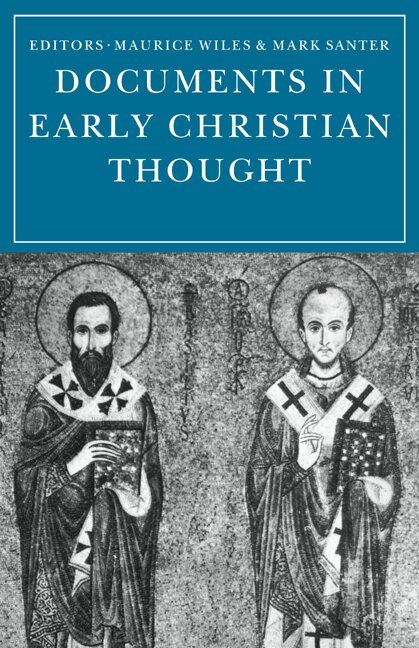
The purpose of this book is to bring within a single volume a representative selection of extracts from the writings of the Early Christian fathers, covering the main areas of Christian thought. The extracts, for the most part newly translated by the editors, are arranged by topic under the following headings: God, Trinity, Christ, Holy Spirit, Sin and Grace, Tradition and Scripture, Church, Sacraments, Christian Living, Church and Society, and Final Goal. Care has been taken to reflect the full range of writing on these themes - exposition and commentary, homily, epistle and polemic - and the extracts are of sufficient length to show the distinctive flavour of each individual writer. Annotation has been kept to a minimum, but each main section has a short introduction which places the extracts in their particular context within the development of Christian thought.
The Making of Christian Doctrine
A Study in the Principles of Early Doctrinal Development
Häftad, Engelska, 1975
534 kr
Skickas inom 7-10 vardagar
A paperback edition of this well-known study. Since its first publication in 1967 this book has aroused a lively debate among theologians and practicising clergy. The author had since returned to the discussion (The Remaking of Christian Doctrine, SCM Press 1974) and has stressed the contemporary need to define and develop Christian doctrine. In the earlier work Professor Wiles asks how the early Church fathers' doctrinal affirmations - expressed for example in the Nicene Creed and Chalcedonian Definition - remain valid today when the framework of the fathers' learning and discourse has disappeared. Doctrine was necessary, he argues, to answer objections to Christianity in a largely non-Christian world, to tackle the problem of heresy and to satisfy the desire of Christians to express their faith more deeply. He also considers the sources of doctrinal reasoning - Scripture, the practice of worship and the nature of salvation. These sources are still vital to any development of Christian doctrine today and the author concludes his study with a call for 'the continuation of the same task of interpreting the Church's Scriptures, her worship and her experience of salvation'.
460 kr
Skickas inom 3-6 vardagar
259 kr
Skickas inom 3-6 vardagar
276 kr
Skickas inom 3-6 vardagar
241 kr
Skickas inom 5-8 vardagar
Does God act in the world? Does he affect what happens to us in the varied experiences of our daily life? If so, in what ways and by what means? In an age when so many of the particular cases in which communities or individuals find themselves led to speak of God's acting prove to be cases which appear to others both morally and spiritually unacceptable, we need to give thought to the deeper underlying issue. Can God be said to act in the world at all? Does God even exist?The nature of God's action is clearly of the utmost importance for Christians, because they claim that God does act in the world and has acted specifically in the life, death and resurrection of Jesus Christ. But how does his action here relate to his action elsewhere? How do we discern it?These questions lead Professor Wiles to discuss the nature of creation, the origin of evil, providence in public and private history and finally God's action in Christ and in us. Concerned to give a consistent overall interpretation, he provides answers which at the same time question much current Christian thinking.