Max Garzon - Böcker
Visar alla böcker från författaren Max Garzon. Handla med fri frakt och snabb leverans.
4 produkter
4 produkter
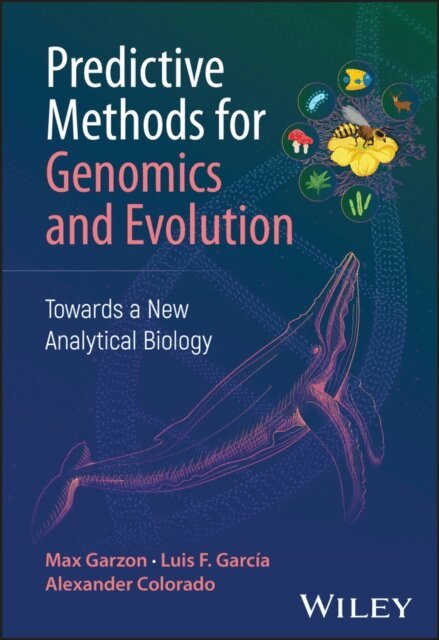
Predictive Methods for Genomics and Evolution
Towards a New Analytical Biology
Inbunden, Engelska, 2025
1 703 kr
Skickas inom 7-10 vardagar
Innovative title providing a systematic account of new alignment-free methods in genomics and bioinformatics, emphasizing their potential to add predictive capabilities to address major and current questions in the science of biologyPredictive Methods for Genomics and Evolution provides a cohesive overview of major alignment-based and alignment-free methods in genomics and bioinformatics, primarily based on DNA/RNA. Throughout the book, contrasts between current conventional methods and novel alignment-free methods are presented and evaluated across a wide range of topics.Written by a team of experienced academics with significant research experience in the field, Predictive Methods for Genomics and Evolution discusses major topics including: Major unresolved problems in biology including the most fundamental concept of species, the nature of evolution and speciation, phylogenetic inference, pathogenicity, and the origin of lifeNovel interpretations of current hypotheses from a biological perspective with wide-ranging applications in bioinformatics and medicineInsights on the shift in the research status quo towards a wider application of more efficient alignment-free methodologies, fueled by the increased availability of data, deeper knowledge of DNA/RNA structure and powerful methods from the fields of machine learning and data science.Predictive Methods for Genomics and Evolution is an essential guide on the subject for professionals, academics, researchers, and students within the fields of genomics, evolutionary biology, phylogenetics and taxonomy, and computational biology and bioinformatics, as well as medical practitioners in related fields. A companion website for this text can be found here: bmc.memphis.edu/predBiology
718 kr
Skickas inom 10-15 vardagar
This book provides a practical and fairly comprehensive review of Data Science through the lens of dimensionality reduction, as well as hands-on techniques to tackle problems with data collected in the real world. State-of-the-art results and solutions from statistics, computer science and mathematics are explained from the point of view of a practitioner in any domain science, such as biology, cyber security, chemistry, sports science and many others. Quantitative and qualitative assessment methods are described to implement and validate the solutions back in the real world where the problems originated.The ability to generate, gather and store volumes of data in the order of tera- and exo bytes daily has far outpaced our ability to derive useful information with available computational resources for many domains.This book focuses on data science and problem definition, data cleansing, feature selection and extraction,statistical, geometric, information-theoretic, biomolecular and machine learning methods for dimensionality reduction of big datasets and problem solving, as well as a comparative assessment of solutions in a real-world setting.This book targets professionals working within related fields with an undergraduate degree in any science area, particularly quantitative. Readers should be able to follow examples in this book that introduce each method or technique. These motivating examples are followed by precise definitions of the technical concepts required and presentation of the results in general situations. These concepts require a degree of abstraction that can be followed by re-interpreting concepts like in the original example(s). Finally, each section closes with solutions to the original problem(s) afforded by these techniques, perhaps in various ways to compare and contrast dis/advantages to other solutions.
663 kr
Skickas inom 10-15 vardagar
This book provides a practical and fairly comprehensive review of Data Science through the lens of dimensionality reduction, as well as hands-on techniques to tackle problems with data collected in the real world. State-of-the-art results and solutions from statistics, computer science and mathematics are explained from the point of view of a practitioner in any domain science, such as biology, cyber security, chemistry, sports science and many others. Quantitative and qualitative assessment methods are described to implement and validate the solutions back in the real world where the problems originated.The ability to generate, gather and store volumes of data in the order of tera- and exo bytes daily has far outpaced our ability to derive useful information with available computational resources for many domains.This book focuses on data science and problem definition, data cleansing, feature selection and extraction,statistical, geometric, information-theoretic, biomolecular and machine learning methods for dimensionality reduction of big datasets and problem solving, as well as a comparative assessment of solutions in a real-world setting.This book targets professionals working within related fields with an undergraduate degree in any science area, particularly quantitative. Readers should be able to follow examples in this book that introduce each method or technique. These motivating examples are followed by precise definitions of the technical concepts required and presentation of the results in general situations. These concepts require a degree of abstraction that can be followed by re-interpreting concepts like in the original example(s). Finally, each section closes with solutions to the original problem(s) afforded by these techniques, perhaps in various ways to compare and contrast dis/advantages to other solutions.
Models of Massive Parallelism
Analysis of Cellular Automata and Neural Networks
Häftad, Engelska, 2012
538 kr
Skickas inom 10-15 vardagar
Locality is a fundamental restriction in nature. On the other hand, adaptive complex systems, life in particular, exhibit a sense of permanence and time lessness amidst relentless constant changes in surrounding environments that make the global properties of the physical world the most important problems in understanding their nature and structure. Thus, much of the differential and integral Calculus deals with the problem of passing from local information (as expressed, for example, by a differential equation, or the contour of a region) to global features of a system's behavior (an equation of growth, or an area). Fundamental laws in the exact sciences seek to express the observable global behavior of physical objects through equations about local interaction of their components, on the assumption that the continuum is the most accurate model of physical reality. Paradoxically, much of modern physics calls for a fundamen tal discrete component in our understanding of the physical world. Useful computational models must be eventually constructed in hardware, and as such can only be based on local interaction of simple processing elements.