Menachem Kellner - Böcker
Visar alla böcker från författaren Menachem Kellner. Handla med fri frakt och snabb leverans.
20 produkter
20 produkter
1 057 kr
Tillfälligt slut
Steven Schwarzschild-rabbi, socialist, pacifist, theologian, and philosopher-is both the last of the major medieval Jewish philosophers and the most modern. He is in the tradition of the Jewish thinking that began with Sa'adia Gaon and reached its highest expression in Maimonides. These thinkers believed that Judaism must confront some systematic view of the universe. Sa'adia did this with Kalam, ibn Gabirol with Neo-Platonism, and Maimonides with Aristotelianism. Schwarzschild does it with Neo-Kantianism. From this confrontation, Schwarzschild derives important insights into the nature and structure of contemporary Judaism and Jewish existence in the post-modern world.Menachem Kellner brings together thirteen of Schwarzschild's Jewish (as opposed to straightforwardly philosophical) writings. Included are important discussions of messianism, death of God theology, ethics, aesthetics, and politics. The common concerns underlying these essays are Neo-Kantian idealism and messianism. In an afterword written especially for this book, Schwarzschild shows that these two foci are really one.In an introductory essay, Menachem Kellner explores the philosophic underpinning of Schwarzschild's non-Marxist socialism, pacifism, and messianism; and of his critiques of Christianity, political conservatism, and Zionism.
402 kr
Tillfälligt slut
Steven Schwarzschild-rabbi, socialist, pacifist, theologian, and philosopher-is both the last of the major medieval Jewish philosophers and the most modern. He is in the tradition of the Jewish thinking that began with Sa'adia Gaon and reached its highest expression in Maimonides. These thinkers believed that Judaism must confront some systematic view of the universe. Sa'adia did this with Kalam, ibn Gabirol with Neo-Platonism, and Maimonides with Aristotelianism. Schwarzschild does it with Neo-Kantianism. From this confrontation, Schwarzschild derives important insights into the nature and structure of contemporary Judaism and Jewish existence in the post-modern world.Menachem Kellner brings together thirteen of Schwarzschild's Jewish (as opposed to straightforwardly philosophical) writings. Included are important discussions of messianism, death of God theology, ethics, aesthetics, and politics. The common concerns underlying these essays are Neo-Kantian idealism and messianism. In an afterword written especially for this book, Schwarzschild shows that these two foci are really one.In an introductory essay, Menachem Kellner explores the philosophic underpinning of Schwarzschild's non-Marxist socialism, pacifism, and messianism; and of his critiques of Christianity, political conservatism, and Zionism.
987 kr
Skickas inom 11-20 vardagar
Maimonides on Judaism and the Jewish People explores Maimonides' philosophical psychology, his ethics, his views on prophecy, providence, and immortality, his understanding of the place of gentiles in the Messianic area, his attitude toward proselytes, his answer to the question, "Who is a Jew?", his conception of the nature of Torah, and his arguments concerning the nature of the Chosen People. With respect to each of these issues, Kellner shows that Maimonides adopted positions that reflected his emphasis on nurture over nature and his insistence that it is intellectual perfection and not ethnic affiliation which is crucial.
376 kr
Tillfälligt slut
Maimonides on Judaism and the Jewish People explores Maimonides' philosophical psychology, his ethics, his views on prophecy, providence, and immortality, his understanding of the place of gentiles in the Messianic area, his attitude toward proselytes, his answer to the question, "Who is a Jew?", his conception of the nature of Torah, and his arguments concerning the nature of the Chosen People. With respect to each of these issues, Kellner shows that Maimonides adopted positions that reflected his emphasis on nurture over nature and his insistence that it is intellectual perfection and not ethnic affiliation which is crucial.
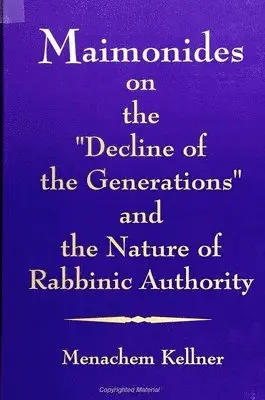
Maimonides on the "Decline of the Generations" and the Nature of Rabbinic Authority
Inbunden, Engelska, 1996
1 057 kr
Tillfälligt slut
Shows to what extent and in what fashion Jews are bound to accept the opinions and the pronouncements of religious authorities.Moses Maimonides, medieval Judaism's leading legist and philosopher, and a figure of central importance for contemporary Jewish self-understanding, held a view of Judaism which maintained the authority of the Talmudic rabbis in matters of Jewish law while allowing for free and open inquiry in matters of science and philosophy. Maimonides affirmed, not the superiority of the "moderns" (the scholars of his and subsequent generations) over the "ancients" (the Tannaim and Amoraim, the Rabbis of the Mishnah and Talmud) but the inherent equality of the two. The equality presented here is not equality of halakhic authority, but equality of ability, of essential human characteristics.In order to substantiate these claims, Kellner explores the related idea that Maimonides does not adopt the notion of "the decline of the generations," according to which each succeeding generation, or each succeeding epoch, is in some significant and religiously relevant sense inferior to preceding generations or epochs.
Maimonides on the "Decline of the Generations" and the Nature of Rabbinic Authority
Häftad, Engelska, 1996
524 kr
Skickas inom 3-6 vardagar
Shows to what extent and in what fashion Jews are bound to accept the opinions and the pronouncements of religious authorities.Moses Maimonides, medieval Judaism's leading legist and philosopher, and a figure of central importance for contemporary Jewish self-understanding, held a view of Judaism which maintained the authority of the Talmudic rabbis in matters of Jewish law while allowing for free and open inquiry in matters of science and philosophy. Maimonides affirmed, not the superiority of the "moderns" (the scholars of his and subsequent generations) over the "ancients" (the Tannaim and Amoraim, the Rabbis of the Mishnah and Talmud) but the inherent equality of the two. The equality presented here is not equality of halakhic authority, but equality of ability, of essential human characteristics.In order to substantiate these claims, Kellner explores the related idea that Maimonides does not adopt the notion of "the decline of the generations," according to which each succeeding generation, or each succeeding epoch, is in some significant and religiously relevant sense inferior to preceding generations or epochs.
1 223 kr
Skickas inom 5-8 vardagar
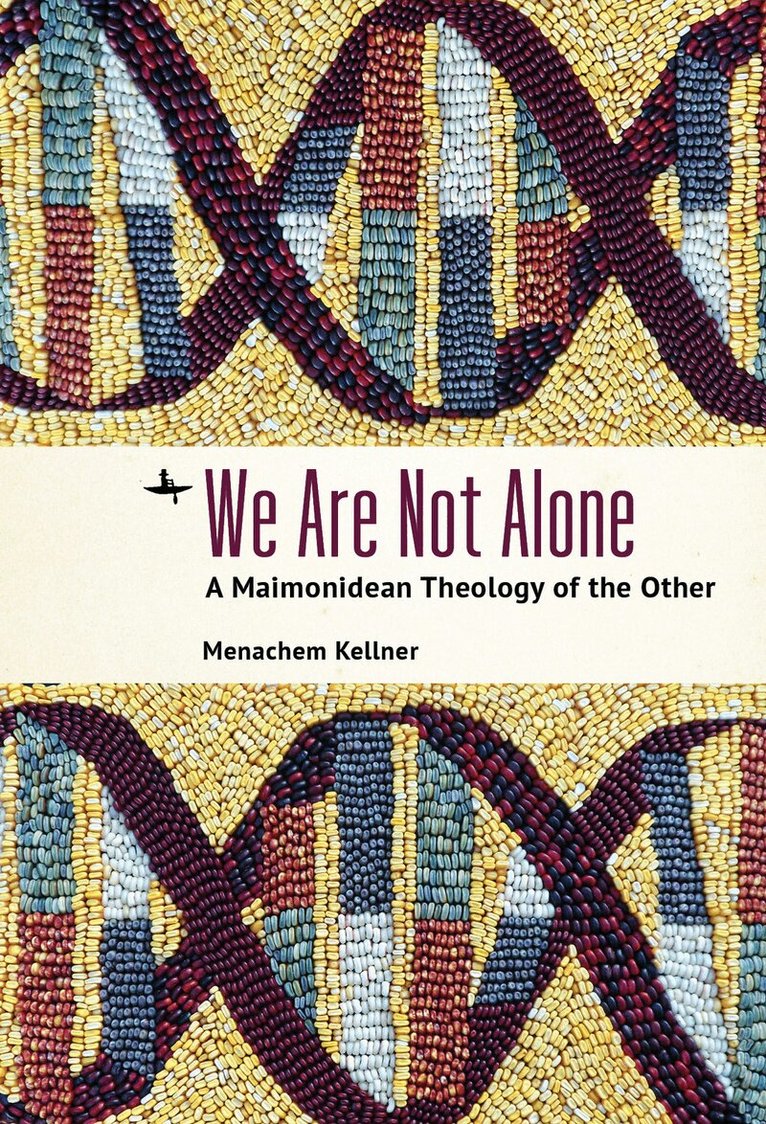
Maimonides’ Guide of the Perplexed addressed Jews of his day who felt challenged by apparent contradictions between Torah and science. We Are Not Alone: A Maimonidean Theology of the Other uses Maimonides’ writings to address Jews of today who are perplexed by apparent contradictions between the morality of the Torah and their conviction that all human beings are created in the image of God and are the object of divine concern, that other religions have value, that genocide is never justified, and that slavery is evil. Individuals who choose to emphasize the moral and universalist elements of Jewish tradition can often find support in positions explicitly held by Maimonides or implied by his teachings. We Are Not Alone offers an ethical and universalist vision of traditionalist Judaism.
386 kr
Skickas inom 5-8 vardagar
Maimonides’ Guide of the Perplexed addressed Jews of his day who felt challenged by apparent contradictions between Torah and science. We Are Not Alone: A Maimonidean Theology of the Other uses Maimonides’ writings to address Jews of today who are perplexed by apparent contradictions between the morality of the Torah and their conviction that all human beings are created in the image of God and are the object of divine concern, that other religions have value, that genocide is never justified, and that slavery is evil. Individuals who choose to emphasize the moral and universalist elements of Jewish tradition can often find support in positions explicitly held by Maimonides or implied by his teachings. We Are Not Alone offers an ethical and universalist vision of traditionalist Judaism.
502 kr
Skickas inom 7-10 vardagar
Maimonides ends each book of his legal code the Mishneh torah with a moral or philosophical reflection, in which he lifts his eyes, as it were, from purely halakhic concerns and surveys broader horizons. Menachem Kellner and David Gillis analyse these concluding paragraphs, examining their verbal and thematic echoes, their adaptation of rabbinic sources, and the way in which they coordinate with the Mishneh torah’s underlying structures, in order to understand how they might influence our interpretation of the code as a whole—and indeed our view of Maimonides himself and his philosophy. Taking this unusual cross-section of the work, Kellner and Gillis conclude that the Mishneh torah presents not only a system of law, but also a system of universal values. They show how Maimonides fashions Jewish law and ritual as a programme for attaining ethical and intellectual ends that are accessible to all human beings, who are created equally in the image of God.Many reject the presentation of Maimonides as a universalist. The Mishneh torah especially is widely seen as a particularist sanctuary. This study shows how profoundly that view must be revised.
502 kr
Skickas inom 7-10 vardagar
Every work on Jewish thought and law since the twelfth century bears the imprint of Maimonides. A. N. Whitehead’s famous dictum that the entire European philosophical tradition ‘consists of a series of footnotes to Plato’ could equally characterize Maimonides’ place in the Jewish tradition. The critical studies in this volume explore how Orthodox rabbis of different orientations—Shlomo Aviner, Naftali Zvi Yehudah Berlin (Netziv), Kalonymus Kalman Shapira, Joseph Kafih, Abraham Isaac Kook, Aaron Kotler, Joseph Soloveitchik, and Elhanan Wasserman—have read and provided footnotes to Maimonides in the long twentieth century. How well did they really understand Maimonides? And where do their arguments fit in the mainstream debates about him and his works? Each of the seven core chapters examines a particular approach. Some rabbis have tried to liberate themselves from the influence of his ideas. Others have sought to build on those ideas or expand them in ways which Maimonides himself did not pursue, and which he may well not have agreed with. Still others advance patently non-Maimonidean positions, while attributing them to none other than Maimonides. Above all, the essays published here demonstrate that his legacy remains vibrantly alive today.
277 kr
Skickas inom 5-8 vardagar
Moses Maimonides was the first medieval Jewish thinker to posit a set of dogmas for Judaism, his ‘Thirteen Principles of Faith’. His statement initiated an extensive discussion among other medieval Jewish thinkers on the subject of dogma, which had an important impact on subsequent Jewish thought. The reaction to Maimonides’ innovation was complex: some scholars accepted his position without reservation; others accepted the idea that Jewish beliefs could be reduced to a creed but disagreed with Maimonides’ formulation; still others rejected the project of creed formulation in Judaism altogether. The locus classicus of this last position is the Rosh Amanah of Isaac Abranavel (1437–1508).Abravanel’s ostensible aim in writing Rosh Amanah was to defend Maimonides’ creed from the attacks of its critics, notably Hasdai Crescas and Joseph Albo, and it contains the most exhaustive and systematic analysis of the Thirteen Principles ever written. After twenty-two chapters of sustained and zealous defence of Maimonides, however, Abravanel seems to contradict himself, arguing at the end of his book that in fact Judaism has no dogmas whatsoever and that all its beliefs are equally valid, fundamental, and precious.This is the first complete English translation of Abravanel’s classic work, and includes a comprehensive introduction and notes.
308 kr
Skickas inom 5-8 vardagar
Dogmain Medieval Jewish Thought is an essay in thehistory of ideas which traces the development of creed formation in Judaismfrom its inception with Moses Maimonides (1138-1204) to the beginning of thesixteenth century when systematic attention to the problem disappeared from theagenda of Jewish intellectuals. The dogmatic systems of Maimonides, Duran,Crescas, Albo, Bibago, Abravanel, and a dozen lesser-known figures aredescribed, analysed, and compared. Relevant texts are presented in Englishtranslation. For the most part these are texts which have never been criticallyedited and translated before.Among the theses defended in the book are thefollowing: that systematic attention to dogma qua dogma was a new feature in Jewish theology introduced byMaimonides (for reasons examined at length in the book); that the subjectlanguished for the two centuries after Maimonides’ death until it was revivedin fifteenth-century Spain in response to Christian attacks on Judaism; thatthe differing systems of dogma offered by medieval Jewish thinkers reflect notdifferent conceptions of what Judaism is, but different conceptions of what aprinciple of Judaism is; and that the very project of creed formation reflectsan essentially Greek as opposed to a biblical/rabbinic view of the nature ofreligious faith and that this accounts for much of the resistance whichMaimonides’ innovation aroused.
342 kr
Skickas inom 7-10 vardagar
The crucial question for today's Jewish world,Menachem Kellner argues, is not whether Jews will have Jewish grandchildren,but how many different sorts of mutually exclusive Judaisms those grandchildrenwill face. Kellner’s short, brisk, and accessible book examines how the splitthat threatens the Jewish future can be avoided.The first six chapters of this strongly arguedbook analyse what religious faith means in classical Judaism and will be ofinterest to anyone seeking lucid insights into the nature of Judaism. The finalchapter builds upon the conclusions of the first six in order to argue for anew way of construing the relationship of Orthodoxy to non-Orthodox Jews andinstitutions. Kellner argues that the Orthodox practice of framing the debatewith non-Orthodox movements in terms of dogmatic fidelity contrasted withheresy is not the traditional Jewish approach, and that the debate could wellbe framed in other ways, ways that would allow all Jews to work togethertowards a less polarized Jewish future.Undoubtedly, Musta Jew Believe Anything? has the potential to make a difference to howOrthodoxy understands itself and its relationship to other Jewish movements inthe modern world.For the second edition, the author has added asubstantial Afterword, reviewing his thinking on the subject and addressing thereactions to the original edition.
389 kr
Skickas inom 7-10 vardagar
Many books on Maimonides have been written andstill more will appear. Few present Maimonides, as Menachem Kellner doesagainst the actual religious background that informed his many innovative andinfluential choices. He not only analyses the thought of the great religiousthinker but contextualizes it in terms of the ‘proto-kabbalistic’ Judaism thatpreceded him. Kellner shows how the Judaism that Maimonides knew had come toconceptualize the world as an enchanted universe, governed by occultaffinities. He shows why Maimonides rejected this and how he went about doingit. Kellner argues that Maimonides’ attempted reformation failed, the clearestproof of that being the success of the kabbalistic counter-reformation whichhis writings provoked.Kellner showshow Maimonides rethought Judaism in different ways. It is in highlighting thisand identifying Maimonides as a religious reformer that this book makes its keycontribution. Maimonides created a new Judaism, ‘disenchanted’, depersonalized,and challenging; a religion that is at the same time elitist and universalist.Kellner’sanalysis also shows the deep configuration of Judaism in a new light. If, asMoshe Idel says in his Foreword, Maimonides was able to ‘reform so many aspectsof rabbinic Judaism single-handedly, to enrich it by importing suchdramatically different concepts, it shows that the profound structures of thisreligion are flexible enough to allow the emergence and success of astonishingreforms. The fact that, great as Maimonides was, he did not overcome thetraditional forms of proto-kabbalism shows that the dynamic of religion is muchmore complex than subscribing to authorities, however widely accepted.’
711 kr
Skickas inom 7-10 vardagar
Maimonides ends each book of his legal code the Mishneh torah with a moral or philosophical reflection, in which he lifts his eyes, as it were, from purely halakhic concerns and surveys broader horizons. Menachem Kellner and David Gillis analyse these concluding paragraphs, examining their verbal and thematic echoes, their adaptation of rabbinic sources, and the way in which they coordinate with the Mishneh torah’s underlying structures, in order to understand how they might influence our interpretation of the code as a whole—and indeed our view of Maimonides himself and his philosophy. Taking this unusual cross-section of the work, Kellner and Gillis conclude that the Mishneh torah presents not only a system of law, but also a system of universal values. They show how Maimonides fashions Jewish law and ritual as a programme for attaining ethical and intellectual ends that are accessible to all human beings, who are created equally in the image of God.Many reject the presentation of Maimonides as a universalist. The Mishneh torah especially is widely seen as a particularist sanctuary. This study shows how profoundly that view must be revised.
621 kr
Skickas inom 7-10 vardagar
Every work on Jewish thought and law since the twelfth century bears the imprint of Maimonides. A. N. Whitehead’s famous dictum that the entire European philosophical tradition ‘consists of a series of footnotes to Plato’ could equally characterize Maimonides’ place in the Jewish tradition. The critical studies in this volume explore how Orthodox rabbis of different orientations—Shlomo Aviner, Naftali Zvi Yehudah Berlin (Netziv), Kalonymus Kalman Shapira, Joseph Kafih, Abraham Isaac Kook, Aaron Kotler, Joseph Soloveitchik, and Elhanan Wasserman—have read and provided footnotes to Maimonides in the long twentieth century. How well did they really understand Maimonides? And where do their arguments fit in the mainstream debates about him and his works? Each of the seven core chapters examines a particular approach. Some rabbis have tried to liberate themselves from the influence of his ideas. Others have sought to build on those ideas or expand them in ways which Maimonides himself did not pursue, and which he may well not have agreed with. Still others advance patently non-Maimonidean positions, while attributing them to none other than Maimonides. Above all, the essays published here demonstrate that his legacy remains vibrantly alive today.
191 kr
Skickas inom 5-8 vardagar
1 440 kr
Skickas inom 5-8 vardagar
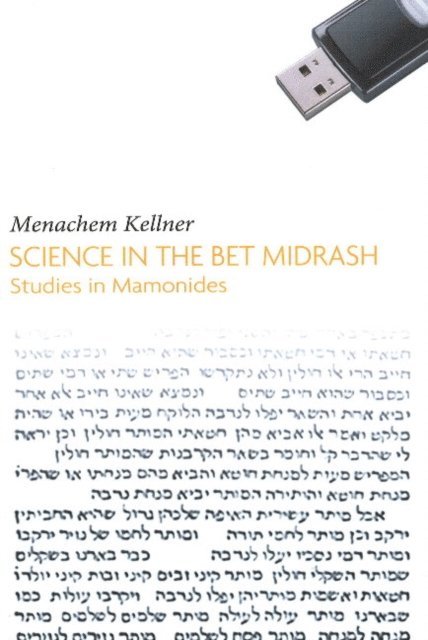
What is the secret that Maimonides hides? He himself tells us: the rabbis of the Talmud used the expression ma'aseh bereshit ("Account of Creation") for what the Greeks called physics and used the expression ma'aseh merkavah ("Account of the Chariot") for what the Greeks called metaphysics. So why is this important? The consequences of these equations are momentous. Maimonides imports what we today would call science into the heart of Torah. This is allied to his universalism and to his conception of the com-mandments of the Torah as tools (which could in principle have been different), whose importance lies in the end they serve, and not in themselves. That being the case, true reward and punish-ment are not connected to behaviour, no matter how saintly or how vile, but to proper conceptions of God, crystallised in the 'Thirteen Principles'. Maimonides hid these secrets from his fellow Jews, not out of fear of reprisal (protected as he was by his good friend, al-Qadi at-Facil, he had no reason to fear them), but out of noblesse oblige.Exposing simple Jews (and their philosophically no less simple rabbis) to these truths could only lead to perplexity (in the best of circumstances) or to falling away from observance (in the worst of circumstances), neither of which Maimonides had any interest in promoting. One God wrote two books, as it were: Torah and Cosmos. The truly devout Jew realises that he or she must study both books, or only have access to half of God's oeuvre.
1 440 kr
Skickas inom 5-8 vardagar
Rabbi Levi ben Gershom (Ralbag, Gersonides; 1288-1344), one of medieval Judaism's most original thinkers, wrote about such diverse subjects as astronomy, mathematics, Bible commentary, philosophical theology, 'technical' philosophy, logic, Halakhah, and even satire. In his view, however, all these subjects were united as part of the Torah. Influenced profoundly by Maimonides, Gersonides nevertheless exercised greater rigor Maimonides in interpreting the Torah in light of contemporary science, more conservative in his understanding of the nature of the Torah's commandments, and more optimistic about the possibility of wide-spread philosophical enlightenment. Gersonides was a witness to several crucial historical events, such as the expulsion of French Jewry of 1306 and the 'Babylonian Captivity' of the Papacy. Collaborating with prelates in his studies of astronomy and mathematics, he had an entree into the Papal court at Avignon. Revered among Jews as the author of a classic commentary on the latter books of the Bible, Kellner portrays Gersonides as a true Renaissance Man, whose view of Torah is vastly wider and more open than that held by many of those who treasure his memory.
483 kr
Skickas inom 10-15 vardagar
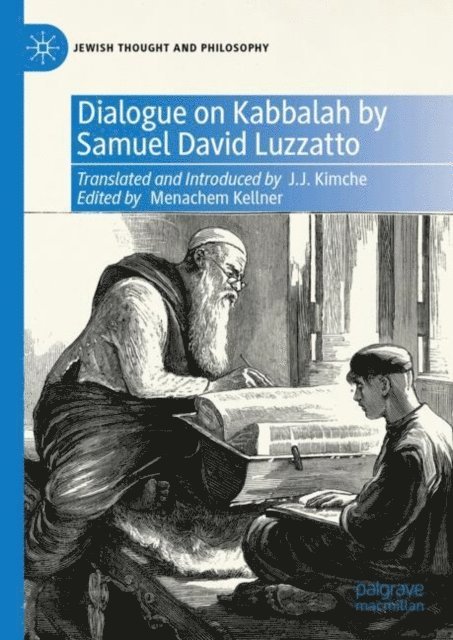
This is the first complete translation of Vikuah? 'al H?okhmat ha-Kabbalah, a literary-philosophical dialogue composed by the great Italian Jewish scholar Samuel David Luzzatto (1800-1865), also known as Shadal.