Michael Barzelay – Författare
Visar alla böcker från författaren Michael Barzelay. Handla med fri frakt och snabb leverans.
6 produkter
6 produkter
533 kr
Tillfälligt slut
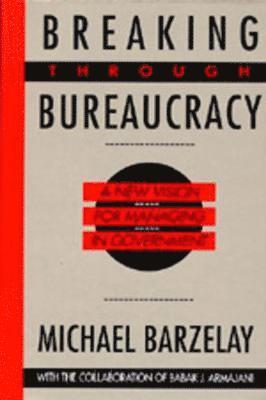
This book attacks the conventional wisdom that bureaucrats are bunglers and the system can't be changed. Michael Barzelay and Babak Armajani trace the source of much poor performance in government to the persistent influence of what they call the bureaucratic paradigm--a theory built on such notions as central control, economy and efficiency, and rigid adherence to rules. Rarely questioned, the bureaucratic paradigm leads competent and faithful public servants--as well as politicians--unwittingly to impair government's ability to serve citizens by weakening, misplacing, and misdirecting accountability. How can this system be changed? Drawing on research sponsored by the Ford Foundation/Harvard University program on Innovations in State and Local Government, this book tells the story of how public officials in one state, Minnesota, cast off the conceptual blinders of the bureaucratic paradigm and experimented with ideas such as customer service, empowering front-line employees to resolve problems, and selectively introducing market forces within government.The author highlights the arguments government executives made for the changes they proposed, traces the way these changes were implemented, and summarizes the impressive results. This approach provides would-be bureaucracy busters with a powerful method for dramatically improving the way government manages the public's business. Generalizing from the Minnesota experience and from similar efforts nationwide, the book proposes a new paradigm that will reframe the perennial debate on public management. With its carefully analyzed ideas, real-life examples, and closely reasoned practical advice, Breaking Through Bureaucracy is indispensable to public managers and students of public policy and administration.
835 kr
Skickas inom 3-6 vardagar
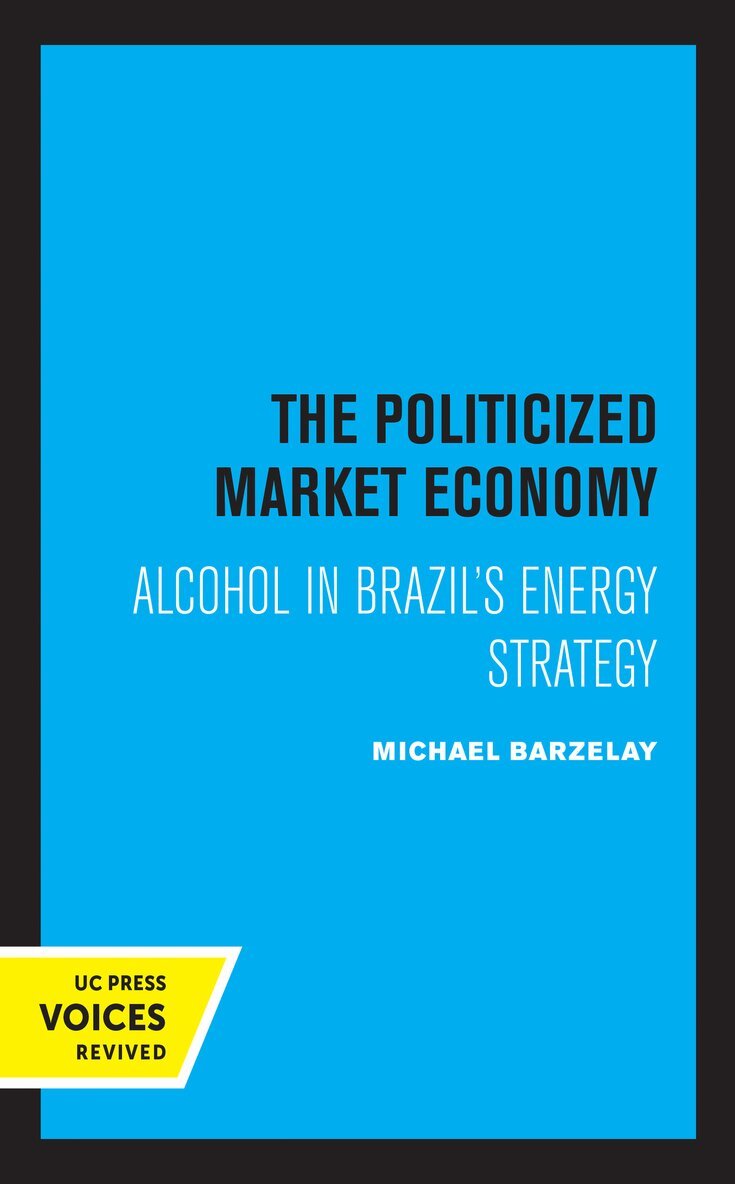
The Politicized Market Economy: Alcohol in Brazil's Energy Strategy examines Brazil's ambitious National Alcohol Program (Proalcool) as a case study in the interplay between government policies and market forces in a politicized market economy. The book develops a comprehensive model for understanding how state officials and private investors mutually adjust their decisions in systems where the government exerts significant control over resource allocation. By exploring Brazil's energy strategy, particularly the shift toward renewable alcohol fuel as a petroleum substitute, the study illuminates the complexities of coordinating economic policies and private sector actions amidst political and institutional challenges.The book situates Brazil's Proalcool initiative within the broader historical and political context of its late industrialization and the authoritarian regime that governed from 1964 to 1985. It highlights the challenges faced in aligning sector-specific policies, such as subsidies and regulations, with private investment incentives. The study also delves into the resistance of state entities like Petrobras and the financial bureaucracy, which created significant obstacles for the alcohol program despite national directives. Through its analysis, the book sheds light on the broader implications of Brazil's steered economy for understanding the dynamics of state-led development and offers a framework for comparative analysis of politicized market economies worldwide.This title is part of UC Press's Voices Revived program, which commemorates University of California Press’s mission to seek out and cultivate the brightest minds and give them voice, reach, and impact. Drawing on a backlist dating to 1893, Voices Revived makes high-quality, peer-reviewed scholarship accessible once again using print-on-demand technology. This title was originally published in 1986.
1 513 kr
Skickas inom 3-6 vardagar
The Politicized Market Economy: Alcohol in Brazil's Energy Strategy examines Brazil's ambitious National Alcohol Program (Proalcool) as a case study in the interplay between government policies and market forces in a politicized market economy. The book develops a comprehensive model for understanding how state officials and private investors mutually adjust their decisions in systems where the government exerts significant control over resource allocation. By exploring Brazil's energy strategy, particularly the shift toward renewable alcohol fuel as a petroleum substitute, the study illuminates the complexities of coordinating economic policies and private sector actions amidst political and institutional challenges.The book situates Brazil's Proalcool initiative within the broader historical and political context of its late industrialization and the authoritarian regime that governed from 1964 to 1985. It highlights the challenges faced in aligning sector-specific policies, such as subsidies and regulations, with private investment incentives. The study also delves into the resistance of state entities like Petrobras and the financial bureaucracy, which created significant obstacles for the alcohol program despite national directives. Through its analysis, the book sheds light on the broader implications of Brazil's steered economy for understanding the dynamics of state-led development and offers a framework for comparative analysis of politicized market economies worldwide.This title is part of UC Press's Voices Revived program, which commemorates University of California Press’s mission to seek out and cultivate the brightest minds and give them voice, reach, and impact. Drawing on a backlist dating to 1893, Voices Revived makes high-quality, peer-reviewed scholarship accessible once again using print-on-demand technology. This title was originally published in 1986.
310 kr
Skickas inom 10-15 vardagar
While the Clinton Administration and federal agencies were busy making government cost less and work better in the near-term, the United States Air Force was regularly visualizing the competencies needed to assure the organization's long-term effectiveness. As a result of steady efforts to prepare for the future conducted under successive secretaries and chiefs of staff, the Air Force has developed a distinctive approach to strategic planning. This approach is fundamentally concerned with ensuring that the organization's future capabilities support effective performance of future tasks. Such tasks are shaped by ever-changing policy objectives and circumstances of implementation. After eight years, the Air Force has not only successfully refined its distinctive approach to strategic planning, but has also leveraged change in programmatic decisions, human resource management, and operational technologies. This study provides an inside look at how the Air Force came to formulate and declare its ""strategic intent"" for developing the organization's capabilities over a timeline of more than twenty years. Air Force strategic intent is not a plan, but a shared commitment to strengthening specific core competencies and critical future capabilities. Michael Barzelay and Colin Campbell reveal how one of the nation's most significant public organizations has reassessed its own strategic intent. Drawing lessons from the Air Force experience, this book provides a significant contribution to public management research on innovation and executive leadership. One key lesson is that preparing for the future is a responsibility that organizations can discharge effectively if they combine insights with practical knowledge of executive leadership and the dynamics of policy change. Preparing for the Future provides a fresh argument about innovation and leadership in public management, while breaking new ground in the analysis of managerial practices, such as strategic v
1 435 kr
Skickas inom 7-10 vardagar
What, fundamentally, is public management? This question is rarely answered clearly and confidently, whether by students of public management or academics in the field. This book answers this question, as its readers come to know why and how public management is a design-oriented professional discipline.The argument of the book is grounded in Herbert Simon's ideas about design-oriented professional disciplines. However, Michael Barzelay's argument runs counter to the idea that public management is a design science. It envisions the discipline as a professional practice that requires the thoughtful and skillful use of purposive theories of public organizations, along with reverse-engineered design-precedents, in problem-solving for public programs and organizations. How professional knowledge about public management is to be expanded through research and analytical synthesis is therefore a major thrust of the book's overall argument.Michael Barzelay develops these arguments in a unique way, including guiding the reader through a fictional ''Public Management Gallery'' featuring key contributions to purposive theorizing about public management as a professional practice. The book is an essential resource for those wishing to strengthen the professional practice of public management - and the discipline - through education and research immediately and for years to come.
361 kr
Skickas inom 7-10 vardagar
What, fundamentally, is public management? This question is rarely answered clearly and confidently, whether by students of public management or academics in the field. This book answers this question, as its readers come to know why and how public management is a design-oriented professional discipline.The argument of the book is grounded in Herbert Simon's ideas about design-oriented professional disciplines. However, Michael Barzelay's argument runs counter to the idea that public management is a design science. It envisions the discipline as a professional practice that requires the thoughtful and skillful use of purposive theories of public organizations, along with reverse-engineered design-precedents, in problem-solving for public programs and organizations. How professional knowledge about public management is to be expanded through research and analytical synthesis is therefore a major thrust of the book's overall argument.Michael Barzelay develops these arguments in a unique way, including guiding the reader through a fictional ''Public Management Gallery'' featuring key contributions to purposive theorizing about public management as a professional practice. The book is an essential resource for those wishing to strengthen the professional practice of public management - and the discipline - through education and research immediately and for years to come.