Michael C.A. MacDonald – Författare
Visar alla böcker från författaren Michael C.A. MacDonald. Handla med fri frakt och snabb leverans.
6 produkter
6 produkter
Del 16 - Archaeological Reports
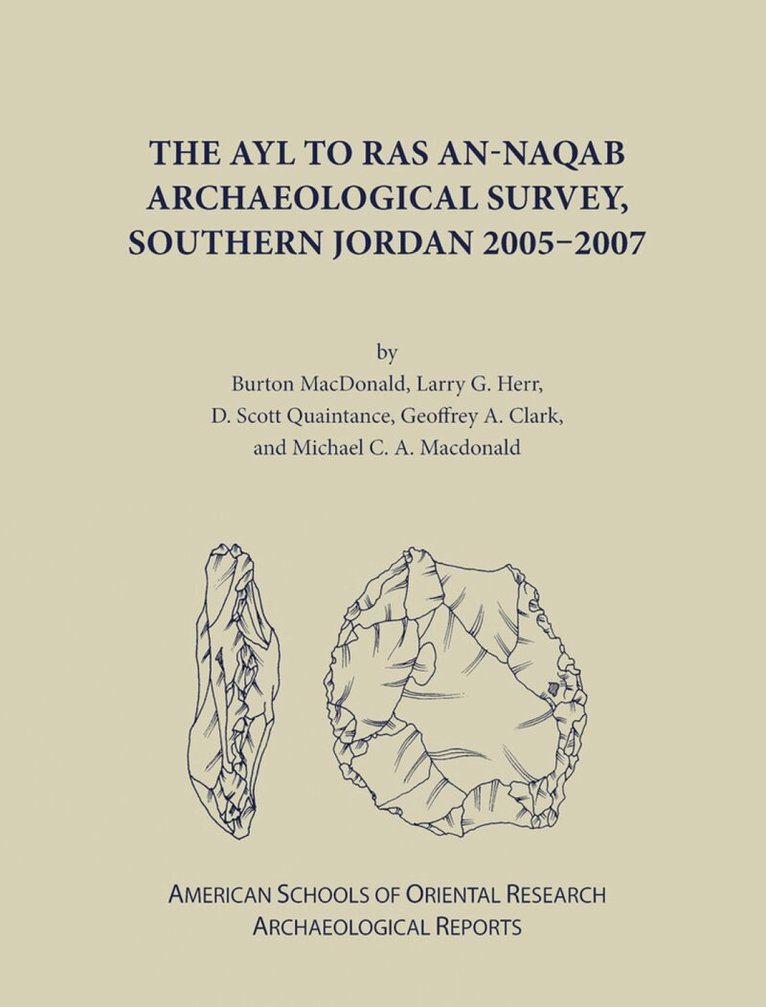
Ayl to Ras an-Naqab Archaeological Survey, Southern Jordan 2005-2007
Inbunden, Engelska, 2012
326 kr
Skickas inom 5-8 vardagar
Two volumes, with DVD. Includes 74 figures, 24 tables and 100+ lithic drawings. Although segments of the ARNAS territory have been investigated for the past one hundred years, a comprehensive and systematic survey of the area had never been undertaken prior to the work of the ARNAS team members. The main goal of the project was to discover, record, and interpret archaeological sites within the survey territory. Some other objectives included: the discovery, on the basis of the artifactual material identified, the area's settlement patterns from the Lower Paleolithic (ca. 1.4mya) to the end of the Late Islamic period (AD 1918); a study of surface trends to determine, on the basis of the number of sites and the amount of lithics and/or sherds collected, where in the territory "settlements" were concentrated in antiquity; an investigation of the Khatt Shabib or "Shabib's Wall," a low stone wall running in a generally north-south direction to the east, ca. 5-10 km, of the Via Nova Traiana (Trajan's road built between AD 111-114); and to document the rock art, tribal markings, and inscriptional material of the region. ARNAS team members accomplished the objectives of the project by transecting and recording the archaeological remains found in 140 randomly-chosen squares (500 x 500 m), covering around five percent of each of the three topographical zones of the survey territory. This resulted in a statistically valid sample of the archaeological materials of the area. In addition, team members recorded 389 archaeological sites encountered within, adjacent to, or on their way to-from the squares. Lithic archaeological periods/cultural-temporal units represented in the survey territory are: Lower Paleolithic; Lower Paleolithic/Middle Paleolithic; Middle Paleolithic; Middle Paleolithic/Upper Paleolithic; Upper Paleolithic; Upper Paleolithic/Epipaleolithic; Epipaleolithic; Pre-Pottery Neolithic; and Chalolithic/Early Bronze I. As is often the case in the deflated landscapes of Jordan, Middle Paleolithic and Middle/Upper Paleolithic combined samples are the most prevalent lithic analytical units identified in the survey. Ceramic archaeological periods/cultural-temporal units represented in the survey territory are: Chalcolithic-Early Bronze; Iron II; Nabataean; Roman; Byzantine; and Late Islamic. In addition, sherds, in small numbers and at only a few sites, from the Late Bronze, Iron I, Hellenistic, Early Islamic, and Middle Islamic are also represented. The types of sites recorded included: agriculture villages or hamlets; aqueducts; camps -probably seasonal and pastoralists; caves; cemeteries and individual tombs/graves; check dams and terraces; cisterns; farms; forts; inscriptions; knapping areas; lithic and sherd scatters; milestones; reservoirs; roads; rock art and/or tribal markings; walls; watchtowers; water catchment facilities; and winnowing areas. The accompanying DVD contains Random Square Descriptions and Images, Site Descriptions and Images, a table compiling all debitage, cores, and retouched pieces, and Settlement Pattern Maps for all of the Cultural-Temporal Unites represented at ARNAS sites.
Del 33 - Proceedings of the Seminar for Arabian Studies
Proceedings of the Seminar for Arabian Studies Volume 33 2003
Häftad, Engelska, 2003
635 kr
Tillfälligt slut
Proceedings of the Annual Meeting of the Seminar for Arabian Studies, 2002.
Del 35 - Proceedings of the Seminar for Arabian Studies
Proceedings of the Seminar for Arabian Studies Volume 35 2005
Häftad, Engelska, 2005
680 kr
Skickas
CONTENTS: (1) Saad A. al-Rashid, The development of archaeology in Saudi Arabia; (2) Laïla Nehmé, Towards an understanding of the urban space of Madāin Salih, ancient Hegra, through epigraphic evidence; (3) Diane Barker & Salah Ali Hassan, Aspects of east coast Hellenism and beyond: Late Pre-Islamic ceramics from Dibbā 76 and Dibbā al-MurabbaΚah, Fujairah, United Arab Emirates; (4) Mark Beech, Richard Cuttler, Derek Moscrop, Heiko Kallweit & John Martin, New evidence for the Neolithic settlement of Marawah Island, Abu Dhabi, United Arab Emirates; (5) Ali Tigani ElMahi & Nasser Said Al Jahwari, Graves at Mahleya in Wādī Κandām (Sultanate of Oman): a view of a late Iron Age and Samad period death culture; (6) Heiko Kallweit, Mark Beech & Walid Yasin Al-Tikriti, Kharimat Khor al-Manāhil and Khor Āl Manāhīl — New Neolithic sites in the south-eastern desert of the UAE; (7) Jürgen Schreiber, Archaeological survey at Ibrām in the Sharqīyah, Sultanate of Oman; (8) Donatella Usai, Chisels or perforators? The lithic industry of Ras al-Hamra 5 (Muscat, Oman); (9) Paul Yule, The Samad Culture — Echoes; (10) Soumyen Bandyopadhyay, Diversity in unity: an analysis of the settlement structure of Hārat al-Κaqr, Nizwā (Oman); (11) Abdulrahman Al-Salimi, Makramid rule in Oman; (12) Valeria Fiorani Piacentini, Sohar and the Daylamī interlude (356–443/967–1051); (12) Alessandra Avanzini & Alexander V. Sedov, The stratigraphy of Sumhuram: new evidence; (13) Lamya Khalidi, The prehistoric and early historic settlement patterns on the Tihāmah coastal plain (Yemen): preliminary findings of the Tihamah Coastal Survey 2003; (14) Krista Lewis, The Himyarite site of al-Adhla and its implications for the economy and chronology of Early Historic highland Yemen; (15) Joy McCorriston, Michael Harrower, Eric Oches & Abdalaziz Bin Κaqil, Foraging economies and population in the Middle Holocene highlands of southern Yemen; (16) Carl S. Phillips, A preliminary description of the pottery from al-Hāmid and its significance in relation to other pre-Islamic sites on the Tihāmah; (17) Eivind Heldaas Seland, Ancient South Arabia: trade and strategies of state control as seen in the Periplus Maris Erythraei; (18) Peter Stein, Once again, the division of the month in Ancient South Arabia; (19); Claire Hardy-Guilbert, The harbour of al-Shihr, Hadramawt, Yemen: sources and archaeological data on trade (20) Ingrid Hehmeyer, Diurnal time measurement for water allocation in southern Yemen; (20) Mikhail Rodionov, "Satanic matters": social conflict in Madūdah (Hadramawt), 1357/1938; (21) Axelle Rougeulle, The Sharma horizon: sgraffiato wares and other glazed ceramics of the Indian Ocean trade (c. AD 980–1140); (22) Yosef Tobi, An unknown study by Joseph Halévy on his journey to Yemen.
Del 2 - Taymā’: Multidisciplinary Series on the Results of the Saudi-German Archaeological Project
Taymāʾ II: Catalogue of the Inscriptions Discovered in the Saudi-German Excavations at Taymāʾ 2004–2015
Inbunden, Engelska, 2021
979 kr
Skickas
Taymāʾ II is a Catalogue which contains all the inscriptions discovered during the 24 seasons of the Saudi- German excavations at Taymāʾ from 2004–15 which were funded by the German Research Foundation (DFG). The 113 objects carry inscriptions in different languages and scripts, illustrating the linguistic diversity of the oasis through time. Although the majority are fragmentary, they provide an important source for the history of the oasis in ancient and mediaeval times.The Babylonian cuneiform inscriptions in this volume confirm for the first time the ten-year sojourn at Taymāʾ of the last Babylonian king Nabû-na’id (556–539 BC). In addition, Imperial Aramaic inscriptions dated by the reigns of Lihyanite kings, based at Dadan (modern al-ʿUlā), reveal for the first time that they ruled Taymāʾ at a period in the second half of the first millennium BC.As well as editing the volume, Michael C. A. Macdonald edited the Imperial Aramaic inscriptions found from 2010–15, plus those in the form of the Aramaic script which developed in Taymāʾ, and the Nabataean, Dadanitic, and Taymanitic texts. In addition, Hanspeter Schaudig edited the cuneiform inscriptions; Peter Stein, the Imperial Aramaic texts found from 2004–09; and Frédéric Imbert, the Arabic inscriptions. Arnulf Hausleiter and Francelin Tourtet provided archaeological contributions, while Martina Trognitz curated the virtual edition of many of the texts recorded by RTI. The indexes contain the words and names from all known texts from the oasis, including those in the Taymāʾ Museum and other collections which will be published as Taymāʾ III.
Del 3 - Taymā’: Multidisciplinary Series on the Results of the Saudi-German Archaeological Project
Taymāʾ III: Catalogue of the Inscriptions in the Taymāʾ Museum and Other Collections
Catalogue of the Inscriptions in the Tayma' Museum and Other Collections
Inbunden, Engelska, 2025
1 129 kr
Skickas
Taymāʾ III presents a catalogue of the inscriptions which were kept in the Taymāʾ Museum until 2017 as well as all known inscriptions from Taymāʾ in other collections, such as the National Museum in Riyāḏ and the Musée du Louvre in Paris. The catalogue contains 102 inscriptions from the Taymāʾ Museum in various languages and scripts, as well as 29 other inscriptions.Michael C.A. Macdonald has not only edited the volume, but also the inscriptions in Imperial Aramaic, Taymāʾ Aramaic, Nabataean, and the Taymanitic language and script. With Peter Stein’s updated reading of the Taymāʾ stone and Jérôme Norris’ new edition of the Qaṣr al-Ḥamrā stele, the two most important monuments for the religious history of Taymāʾ in the mid-1st millennium BC are also included in this volume. Frédéric Imbert has edited the Arabic inscriptions from the Taymāʾ Museum.The indices contain the words and names of all known texts from the Taymāʾ oasis, i.e. those discovered during the Saudi-German excavations between 2004 and 2015 (published in Taymāʾ II, including the cuneiform inscriptions of King Nabonidus of Babylon) and those edited in this volume.With these two volumes of the Taymāʾ excavation series, all currently accessible inscriptions that originate from this major north-west Arabian oasis, or very likely from there, are published in printed and digital form.
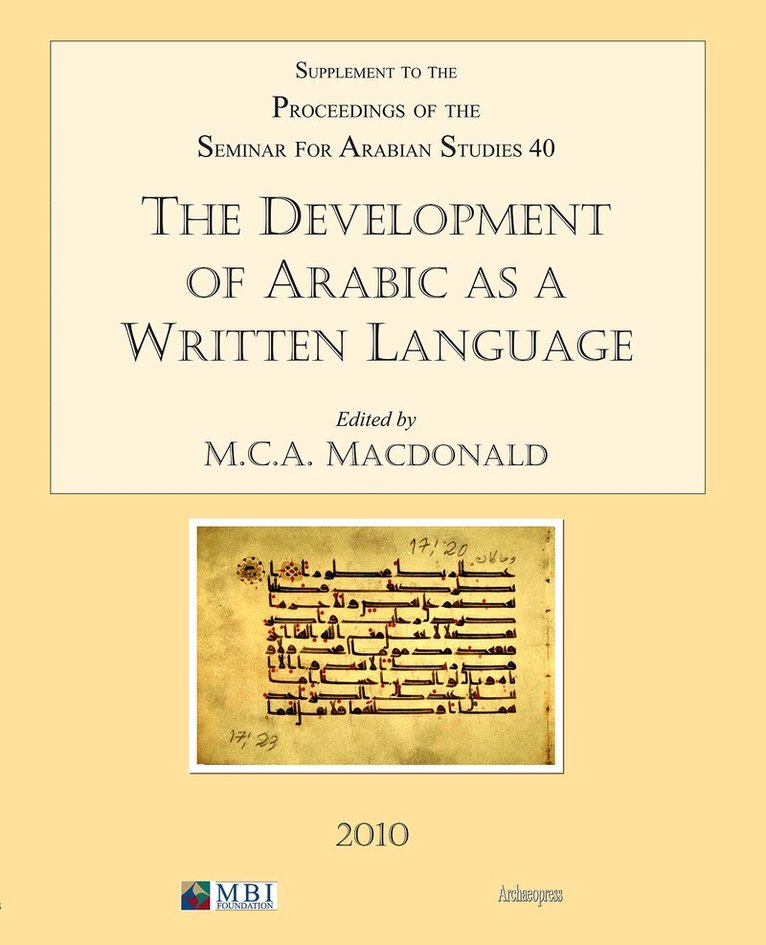
Development of Arabic as a Written Language
Supplement to the Proceedings of the Seminar for Arabian Studies Volume 40 2010
Häftad, Engelska, 2010
456 kr
Skickas
Contents: Introduction: The development of Arabic as a written language (Christian Julien Robin); Ancient Arabia and the written word (M.C.A. Macdonald); Mount Nebo, Jabal Ramm, and the status of Christian Palestinian Aramaic and Old Arabic in Late Roman Palestine and Arabia (Robert Hoyland); A glimpse of the development of the Nabataean script into Arabic based on old and new epigraphic material (Laïla Nehmé); The evolution of the Arabic script in the period of the Prophet MuΉammad and the Orthodox Caliphs in the light of new inscriptions discovered in the Kingdom of Saudi Arabia (‘Alī Ibrāhīm Al-Ghabbān); In search of a standard: dialect variation and New Arabic features in the oldest Arabic written documents (Pierre Larcher); The codex Parisino-petropolitanus and the Ήijāzī scripts (François Déroche); The relationship of literacy and memory in the second/eighth century (Gregor Schoeler); The Use of the Arabic script in magic (Venetia Porter); The Old Arabic graffito at Jabal Usays: A new reading of line 1 (M.C.A. Macdonald).