Michael J. Feuer - Böcker
Visar alla böcker från författaren Michael J. Feuer. Handla med fri frakt och snabb leverans.
6 produkter
6 produkter
538 kr
Tillfälligt slut
459 kr
Tillfälligt slut
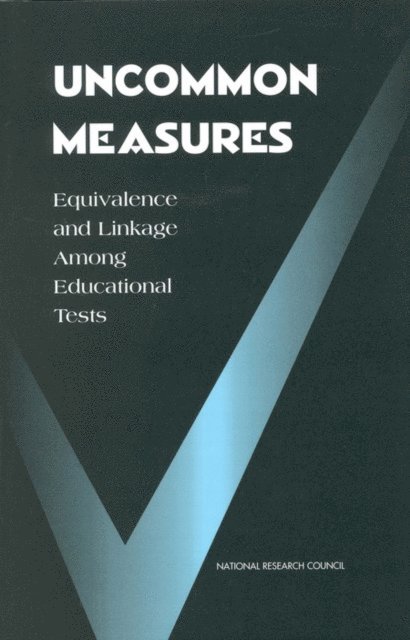
The issues surrounding the comparability of various tests used to assess performance in schools received broad public attention during congressional debate over the Voluntary National Tests proposed by President Clinton in his 1997 State of the Union Address. Proponents of Voluntary National Tests argue that there is no widely understood, challenging benchmark of individual student performance in 4th-grade reading and 8th-grade mathematics, thus the need for a new test. Opponents argue that a statistical linkage among tests already used by states and districts might provide the sort of comparability called for by the president's proposal. Public Law 105-78 requested that the National Research Council study whether an equivalency scale could be developed that would allow test scores from existing commercial tests and state assessments to be compared with each other and with the National Assessment of Education Progress. In this book, the committee reviewed research literature on the statistical and technical aspects of creating valid links between tests and how the content, use, and purposes of education testing in the United States influences the quality and meaning of those links.The book summarizes relevant prior linkage studies and presents a picture of the diversity of state testing programs. It also looks at the unique characteristics of the National Assessment of Educational Progress. Uncommon Measures provides an answer to the question posed by Congress in Public Law 105-78, suggests criteria for evaluating the quality of linkages, and calls for further research to determine the level of precision needed to make inferences about linked tests. In arriving at its conclusions, the committee acknowledged that ultimately policymakers and educators must take responsibility for determining the degree of imprecision they are willing to tolerate in testing and linking. This book provides science-based information with which to make those decisions.
508 kr
Tillfälligt slut
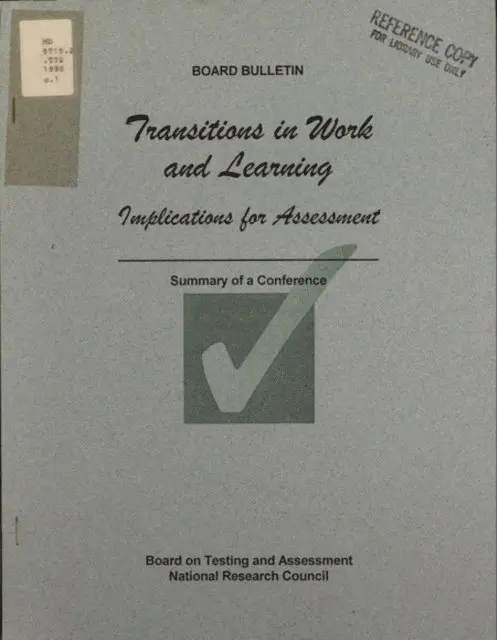
The dramatic shift in the American labor market away from manufacturing and the growing gap in earnings between high school and college graduates have contributed to a sense of alarm about the capacity of the nation's schools to supply adequately skilled graduates to the work force. The role that schools can or should play in preparing people to enter the world of work is hotly debated. In an effort to nurture the important and ongoing national dialogue on these issues, the Board on Testing and Assessment asked researchers and policymakers to engage in an interdisciplinary review and discussion of available data and implications for assessment policy. Transitions in Work and Learning considers the role of assessment in facilitating improved labor market transitions and life-long learning of American workers. It addresses the apparent mismatch between skill requirements of high-performance workplaces and skills acquired by students in school, the validity of existing assessment technologies to determine skills and competencies of persons entering various occupations, and ethical and legal issues in the implementation of new testing and certification programs.The book also examines the role of assessment in determining needed skills; developing ongoing education and training; and providing information to employers, prospective workers, and schools.
244 kr
Tillfälligt slut
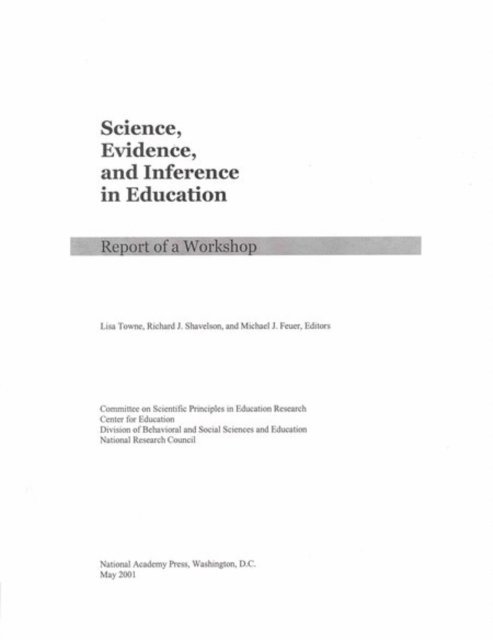
Research on education has come into the political spotlight as the demand grows for reliable and credible information for the guidance of policy and practice in the education reform environment. Many debates among the education research community feature questions concerning the nature of evidence and these questions have also appeared in broader policy and practice arenas. Inquiry has generally, over the past years, created bodies of scientific knowledge that have profound implications for education. Dramatic advances in understanding how people learn, how young children acquire early reading skills, and how to design and evaluate educational and psychological measurements is a good example of this. However, the highly contextualized nature of education and the wide range of disciplinary perspectives that rely on it have made the identification of reducible, generalizable principles difficult and slow to achieve. Due to this, the U.S. Department of Education's National Educational Research Policy and Priorities Board (NERPPB) has asked the NRC to establish a study committee to consider the scientific underpinnings of research in education.The committee consists of members with expertise in statistics, psychology, sociology, anthropology, philosophy of science, history of education, economics, chemistry, biology, and education practice. The committee worked with the three questions in mind: What are the principles of scientific quality in education research?, How can research-based knowledge in education cumulate?, and How can a federal research agency promote and protect scientific quality in the education research it supports?. A workshop was held on March 7-8, 2001 that was organized into three main sessions: Supporting Scientific Quality at the Federal level, The Interface of Research and Practice in Education, and Evidence and Inference. Science, Evidence, and Inference in Education: Report of a Workshop summarizes this workshop through these three ideas. The report also includes what the committee plans to do next, the workshop agenda, and information on the workshop's participants and speakers.
538 kr
Tillfälligt slut
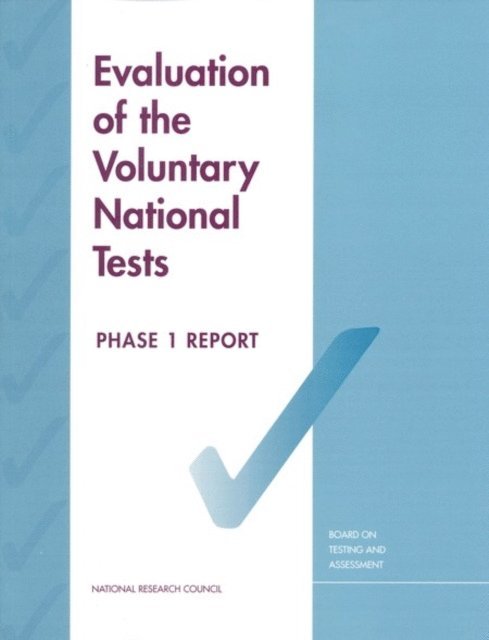
In his 1997 State of the Union address, President Clinton announced a federal initiative to develop tests of 4th-grade reading and 8th-grade mathematics that would provide reliable information about student performance at two key points in their educational careers. According to the U.S. Department of Education, the Voluntary National Tests (VNT) would create a catalyst for continued school improvement by focusing parental and community-wide attention on achievement and would become new tools to hold school systems accountable for their students' performance. The National Assessment Governing Board (NAGB) has responsibility for development of the VNT. Congress recognized that a testing program of the scale and magnitude of the VNT initiative raises many important technical questions and requires quality control throughout development and implementation. In P.L.105-78, Congress called on the National Research Council (NRC) to evaluate a series of technical issues pertaining to the validity of test items, the validity of proposed links between the VNT and the National Assessment of Educational Progress (NAEP), plans for the accommodation and inclusion of students with disabilities and English-language learners, plans for reporting test information to parents and the public, and potential uses of the tests. This report covers phase 1 of the evaluation (November 1997-July 1998) and focuses on three principal issues: test specifications and frameworks; preliminary evidence of the quality of test items; and plans for the pilot and field test studies, for inclusion and accommodation, and for reporting VNT results.
269 kr
Skickas inom 7-10 vardagar
How can education protect and strengthen democracy?In an era when democracy is at critical risk, is it reasonable to expect the education system—already buckling under the ordeal of a global pandemic—to solve the converging problems of inequality, climate change, and erosion of trust in government and science? Will more civics instruction help? In Can Schools Save Democracy? Michael J. Feuer offers a new approach to addressing these questions with a strategy for improving the process and substance of civic education.Although schooling alone cannot save democracy, it must play a part. Feuer introduces a framework for educator preparation that emphasizes collective action, experiential learning, and partnerships between schools and their complex constituencies. His proposed reform aims to equip teachers with an appreciation of the paradoxes of pluralism—in particular, the tensions between individual choice and social outcomes. And he offers practical suggestions for how to bring those concepts to life so that students in and out of the classroom acquire the skills, knowledge, and dispositions for enlightened democratic leadership.Adopting a definition of public education that celebrates the engagement between schools and their environments, Feuer argues for reinforced partnerships within the education system and between educators and their diverse constituents. He anticipates new collaborations between education faculty and their colleagues in the behavioral, social, and physical sciences and humanities; stronger links between schools and their complex outside environments; and improved mechanisms for global cooperation. Can Schools Save Democracy? includes lively examples of how theoretical principles can inform familiar problems and offers a hopeful path for progress toward a stronger democracy.