Michael L. Morrison - Böcker
Visar alla böcker från författaren Michael L. Morrison. Handla med fri frakt och snabb leverans.
9 produkter
9 produkter
1 265 kr
Skickas inom 7-10 vardagar
The essential text for ornithology courses, this book will leave students with a lifelong understanding and appreciation of the biology and ecology of birds.Aves, the birds, is the wildlife group that people most frequently encounter. With over 10,000 species worldwide, these animals are part of our everyday experience. They are also the focus of intense research, and their management and conservation is a subject of considerable effort throughout the world. But what are the defining attributes that make a bird a bird?Aimed at undergraduate and graduate students, Ornithology provides a solid modern foundation for understanding the life and development of birds. Written by renowned experts from around the globe, this comprehensive textbook draws on the latest research to create an innovative learning experience. Moving beyond bones, muscle, and feathers, it provides the core information needed to “build” the bird, linking anatomy and physiology with ecology and behavior.As it reviews the major orders of birds, the book highlights their wide diversity and critically evaluates ornithological concepts and theories. Incorporating brief biographies of leaders in the field, the text describes their contributions in the context of key historical events in bird science. Each chapter ends with a summary of the material covered, a discussion of potential management and conservation applications, and suggested study questions that will stimulate thought and discussion. Contributors: Peter Arcese, George E. Bentley, Lori A. Blanc, William M. Block, Alice Boyle, Leonard A. Brennan, Luke K. Butler, Zac Cheviron, Luis M. Chiappe, Melanie R. Colón, Caren B. Cooper, Robert J. Cooper, Jamie M. Cornelius, Carlos Martinez Del Rio, John Dumbacher, Shannon Farrell, Maureen Flannery, Geoffrey Geupel, Patricia Adair Gowaty, Thomas P. Hahn, Ashley M. Heers, Fritz Hertel, Geoffrey E. Hill, Matthew Johnson, Lukas F. Keller, Dylan C. Kesler, Pablo Sabat Kirkwood, John Klicka, Christopher A. Lepczyk, Ashley M. Long, Scott R. Loss, Graham R. Martin, John M. Marzluff, Susan B. McRae, Michael L. Morrison, Timothy J. O’Connell, Jen C. Owen, Marco Pavia, Jeffrey Podos, Lars Pomara, Jonathan F. Prather, Marco Restani, Alejandro Rico-Guevara, Amanda D. Rodewald, Vanya G. Rohwer, Matthias Starck, Michael W. Strohbach, S. Mažeika P. Sullivan, Diego Sustaita, Kerri T. Vierling, Gary Voelker, Margaret A. Voss, Jeff R. Walters, Paige S. Warren, Elisabeth B. Webb, Michael S. Webster, Eric M. Wood, Robert M. Zink, Benjamin Zuckerberg
1 064 kr
Skickas inom 10-15 vardagar
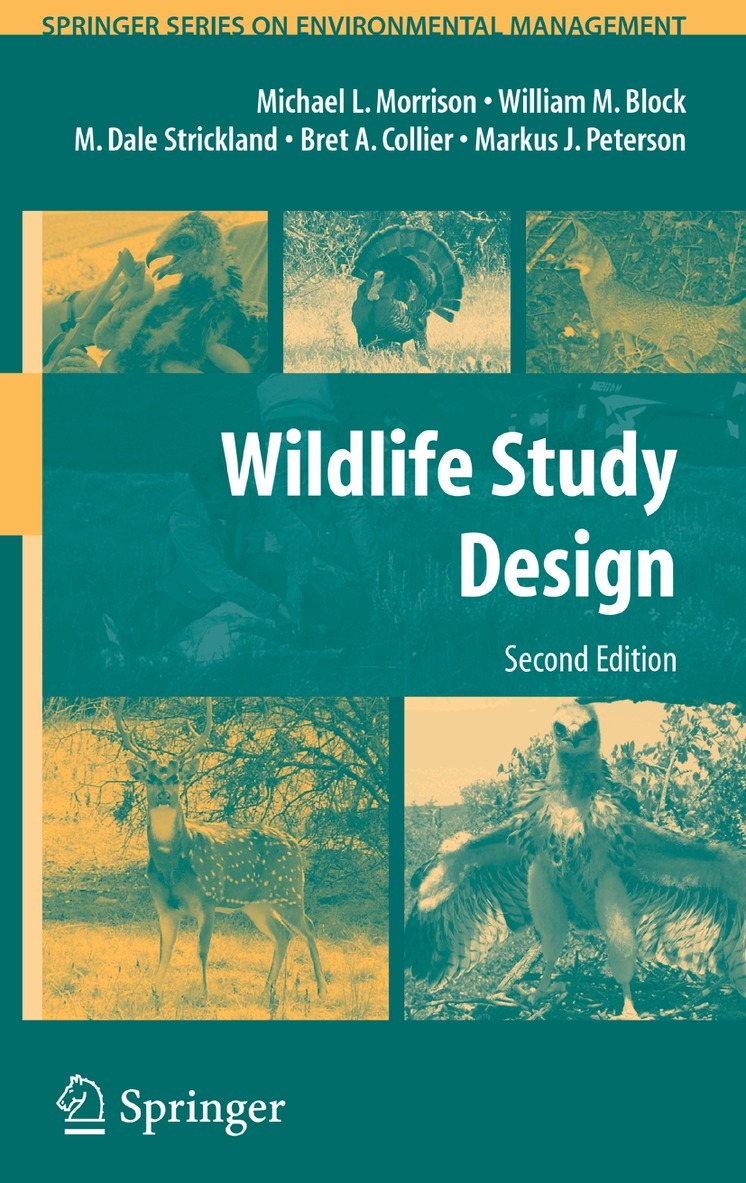
We developed the first edition of this book because we perceived a need for a compilation on study design with application to studies of the ecology, conser- tion, and management of wildlife. We felt that the need for coverage of study design in one source was strong, and although a few books and monographs existed on some of the topics that we covered, no single work attempted to synthesize the many facets of wildlife study design. We decided to develop this second edition because our original goal – synthesis of study design – remains strong, and because we each gathered a substantial body of new material with which we could update and expand each chapter. Several of us also used the first edition as the basis for workshops and graduate teaching, which provided us with many valuable suggestions from readers on how to improve the text. In particular, Morrison received a detailed review from the graduate s- dents in his “Wildlife Study Design” course at Texas A&M University. We also paid heed to the reviews of the first edition that appeared in the literature.
825 kr
Skickas inom 7-10 vardagar
"Habitat" is probably the most common term in ecological research. Elementary school students are introduced to the term, college students study the concept in depth, hunters make their plans based on it, nature explorers chat about the different types, and land managers spend enormous time and money modifying and restoring habitats. Although a broad swath of people now have some notion of what habitat is-opening up ample opportunity for further education and conservation-the scientific community has by and large failed to define it concretely, despite repeated attempts in the literature to come to meaningful conclusions regarding what habitat is and how we should study, manipulate, and ultimately conserve it. Wildlife Habitat Conservation presents an up-to-date review of the habitat concept, provides a scientifically rigorous definition, and emphasizes how we must focus on those critical factors contained within what we call habitat. The result is a habitat concept that promises long-term persistence of animal populations.Key concepts and items in the book include: the necessity of moving away from vague and inconsistent perspectives to more rigorous and standard conceptual definitions of wildlife and their habitat; a discussion of the essential integration of population demographics and population persistence with the concept of habitat; the importance of carry over and lag effects, behavioral processes, genetics, and species interactions to our understanding of habitat; an examination of spatiotemporal heterogeneity, realized through fragmentation, disruption to eco-evolutionary processes, and alterations to plant and animal assemblages; and, an explanation of how anthropogenic effects alter population size and distribution (isolation), genetic processes, and species diversity (including exotic plants and animals). It includes advocacy of proactive conservation and management through predictive modeling, restoration, and monitoring. Each chapter is accessibly written in a style that will be welcomed by private land owners and public resource managers at local, state, and federal levels.Also ideal for undergraduate and graduate natural resource and conservation courses, the book is organized perfectly for a one semester class. Contributors:William M. Block, Kathi L. Borgmann, J. Curtis Burkhalter, Bret A. Collier, Courtney J. Conway, Clinton W. Epps, Clinton D. Francis, Fred S. Guthery, Douglas H. Johnson, Julie L. Lockwood, Heather A. Mathewson, Kevin S. McKelvey, Michael L. Morrison, Amanda D. Rodewald, Jamie S. Sanderlin, Michael K. Schwartz, K. Shawn Smallwood, Bronson K. Strickland, Beatrice Van Horne, Lisette P. Waits, and, John A. Wiens.
772 kr
Skickas inom 7-10 vardagar
A look at how wildlife professionals can modernize their approaches to habitat and population management with a fresh take on animal ecology.How can we maximize the probability that a species of wild animal will persist into the future? This audacious book proposes that advancing animal ecology—and conservation itself—demands that we reenvision our basic understanding of how animals interact with their environments and with each other. Synthesizing where we are and where we need to go with our studies of animals and their environs, Foundations for Advancing Animal Ecology asserts that studies of animal ecology should begin with a focus on the behaviors and characteristics of individual organisms. The book examines• the limitations of classic approaches to the study of animal ecology• how organisms organize into collections, such as breeding pairs, flocks, and herds• how the broader biotic and abiotic environment shapes animal populations, communities, and ecosystems• factors underlying the distribution and abundance of species through space and time• the links between habitat and population• why communication between researchers and managers is key• specific strategies for managing wild animal populations and habitats in an evolutionary and ecosystem contextThroughout, the authors stress the importance of speaking a common and well-defined language. Avoiding vague and misleading terminology, they argue, will help ecologists translate science into meaningful and lasting actions in the environment. Taking the perspective of the organism of interest in developing concepts and applications, the authors always keep the potentially biased human perspective in focus. A major advancement in understanding the factors underlying wildlife-habitat relationships, Foundations for Advancing Animal Ecology will be an invaluable resource to professionals and practitioners in natural resource management in public and private sectors, including state and federal agencies, non-governmental organizations, and environmental consultants.
628 kr
Skickas inom 5-8 vardagar
A book that emphasized the concept of wildlife habitat for a generation of students and professionals is now available to even more readers."Habitat" is probably the most common term in ecological research. Elementary school students are introduced to the term, college students study the concept in depth, hunters make their plans based on it, nature explorers chat about the different types, and land managers spend enormous time and money modifying and restoring habitats. Although a broad swath of people now have some notion of what habitat is, the scientific community has by and large failed to define it concretely, despite repeated attempts in the literature to come to meaningful conclusions regarding what habitat is and how we should study, manipulate, and ultimately conserve it.Wildlife Habitat Conservation presents an authoritative review of the habitat concept, provides a scientifically rigorous definition, and emphasizes how we must focus on those critical factors contained within what we call habitat. The result is a habitat concept that promises long-term persistence of animal populations. Key concepts and items in the book include:• Rigorous and standard conceptual definitions of wildlife and their habitat.• A discussion of the essential integration of population demographics and population persistence with the concept of habitat.• The importance of carryover and lag effects, behavioral processes, genetics, and species interactions to our understanding of habitat. • An examination of spatiotemporal heterogeneity, realized through fragmentation, disruption to eco-evolutionary processes, and alterations to plant and animal assemblages.• An explanation of how anthropogenic effects alter population size and distribution (isolation), genetic processes, and species diversity (including exotic plants and animals).• Advocacy of proactive management and conservation through predictive modeling, restoration, and monitoring.Each chapter is accessibly written in a style that will be welcomed by private landowners and public resource managers at local, state, and federal levels. Also ideal for undergraduate and graduate natural resource and conservation courses, the book is organized perfectly for a one-semester class.Published in association with The Wildlife Society.
772 kr
Skickas inom 7-10 vardagar
Practical guidance for wildlife professionals working to improve study design, data analysis, and the application of results to habitat and population management.Winner of the Wildlife Society Publications Book Award by The Wildlife SocietyDespite major advances in sampling techniques and analytical methods, many animal ecologists conduct research that is primarily relevant to a specific time and place. They also tend to focus more on the statistical analyses and nuances of modeling than actual study design. Arguing that studies of animal ecology should always begin with a focus on the behaviors and characteristics of individual organisms, including how they form into distinct biological populations, Applications for Advancing Animal Ecology takes a fresh and critical look at the field. Building from its companion volume, Foundations for Advancing Animal Ecology, this practical book presents readers with the principal methods used to observe animal behavior. Teaching them to assess resource abundance categories of species-environmental relationships models, it also explores• major aspects of measuring animal habitat: what to measure and how to measure it;• common sampling and estimation methods to assess population parameters;• when to measure and how to analyze data;• problems that will confront ecologists in the coming years—and how to gather information to adequately address them; and• how the experimental approach can be used to advance the science of animal ecology.Throughout the book, the authors stress the importance of speaking a common and well-defined language. Avoiding vague and misleading terminology, they assert, will help ecologists translate science into meaningful and lasting actions in the environment. Taking the perspective of the organism of interest in developing concepts and applications, the authors always keep the potentially biased human perspective in focus. They also provide a selection of suggested research projects, cautions, and caveats. A major advancement in understanding the factors underlying wildlife–habitat relationships, Applications for Advancing Animal Ecology will be an invaluable resource to natural resource management professionals and practitioners, including state and federal agencies, non-governmental organizations, and environmental consultants.
800 kr
Skickas inom 10-15 vardagar
Wildlife Study Design provides researchers and resource managers with a comprehensive guide to planning new studies by covering all aspects of study design, including surveys of major types of studies and variables, impact assessment, statistics, sampling techniques, inventorying and monitoring, and analysis of data. The book includes a practical, step-by-step guide to setting up a new study, minimal mathematical notation, and examples drawn from field research in order to make applied animal ecology both accessible and relevant. This new edition includes substantial new and updated content, including an increase in the number of non-terrestrial vertebrate examples, a glossary of terms, expanded chapter summaries and additional examples in text boxes for easy reference. Resource managers, researchers, and students of wildlife and conservation biology will find this book a fundamental resource for implementing and evaluating appropriate studies.
615 kr
Skickas inom 3-6 vardagar
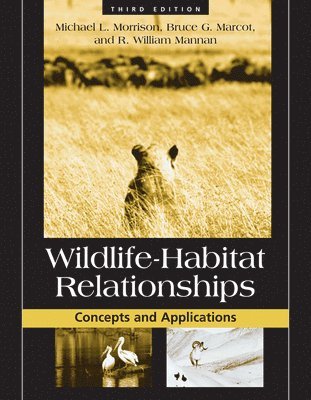
"Wildlife-Habitat Relationships" goes beyond introductory wildlife biology texts to provide wildlife professionals and students with an understanding of the importance of habitat relationships in studying and managing wildlife. The book offers a unique synthesis and critical evaluation of data, methods, and studies, along with specific guidance on how to conduct rigorous studies. Now in its third edition, "Wildlife-Habitat Relationships" combines basic field zoology and natural history, evolutionary biology, ecological theory, and quantitative tools in explaining ecological processes and their influence on wildlife and habitats. Also included is a glossary of terms that every wildlife professional should know.
586 kr
Skickas inom 7-10 vardagar
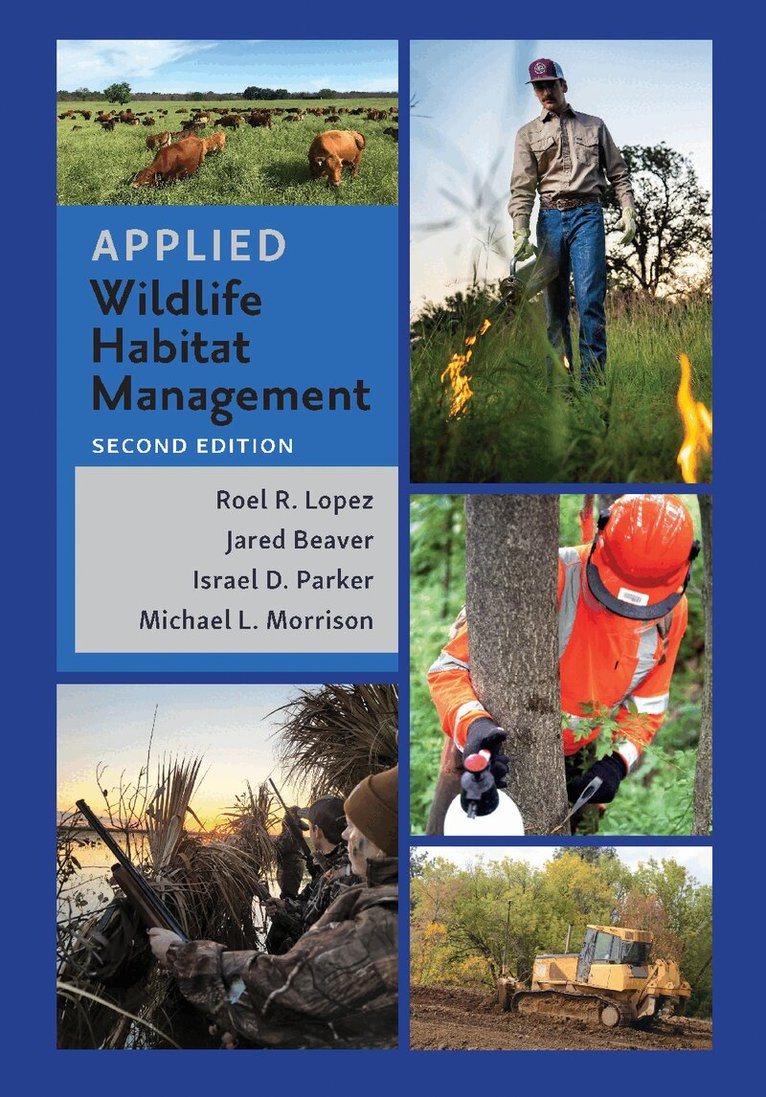
Applied Wildlife Habitat Management, Second Edition, provides a practical guide for users with many levels of expertise in wildlife habitat management and an interest in land conservation planning. Topics are presented so the reader can develop a component of a wildlife management plan through the completion of each chapter—wildlife habitat planning, wildlife habitat relationships, environmental measurements, wildlife habitat analyses, habitat management techniques, common planning approaches, and emerging issues. The work introduces the basic tools to understand, plan, implement, measure, analyze, and document efforts to improve habitat for wildlife using science-based decision-making approaches.Providing a step-by-step guide that is adaptable to a range of environmental settings, the authors first lay out the ecological principles applicable to any project. They take the reader through various sampling designs, measurement techniques, and analytical methods required to develop and complete a habitat project, including the creation of a report or management plan. End-of-chapter summaries emphasize key management concepts with exercises putting ecological principles into practice.This guide is an invaluable reference for students, land managers, and landowners who are developing and implementing management plans for habitat modification and improvement on both private and public lands.