Leonard A. Brennan - Böcker
Visar alla böcker från författaren Leonard A. Brennan. Handla med fri frakt och snabb leverans.
6 produkter
6 produkter
928 kr
Skickas inom 10-15 vardagar
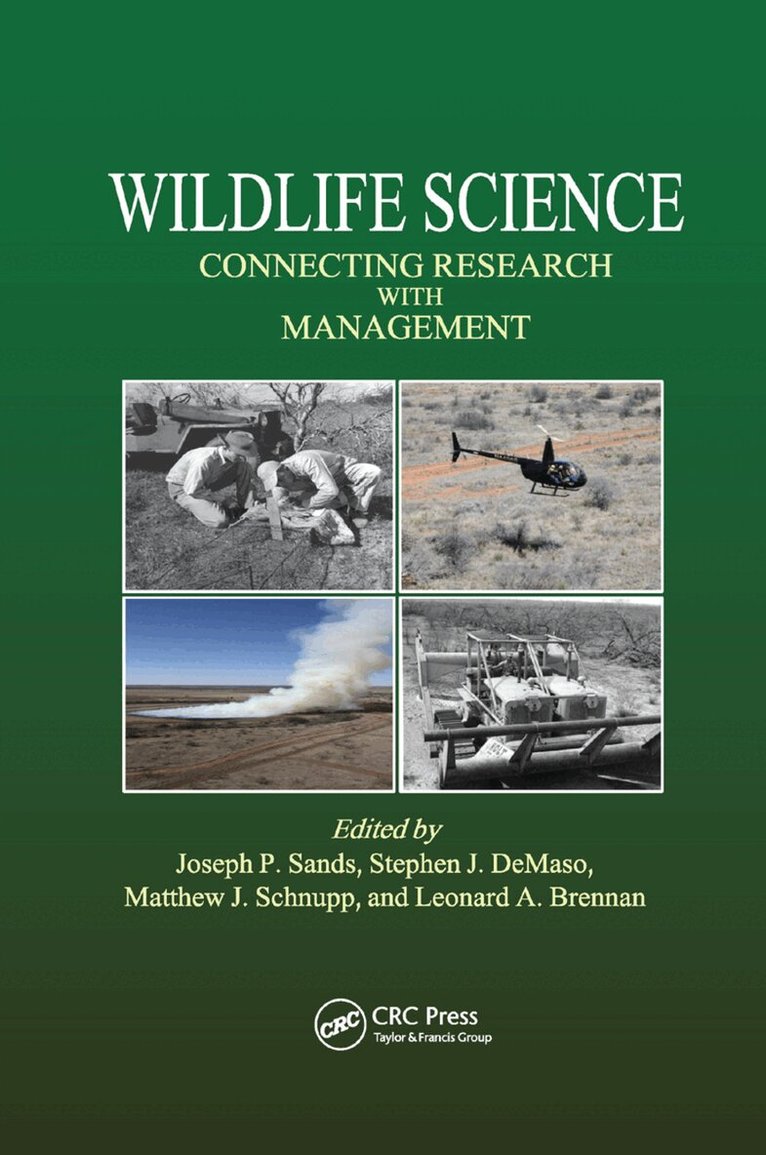
Despite the potential synergy that can result from basing management applications on results from research, there is a polarization of cultures between wildlife managers and wildlife researchers. Wildlife Science: Connecting Research with Management provides strategies for bridging cultural and communication gaps between these groups. The text covers the history of the longstanding disconnect, research and management entities, species case studies, management and policy case studies, and conclusions and future directions. The authors present case studies of both successful and failed interactions, providing a platform for discussion of the underlying issues. They examine current issues in wildlife science and management to explore real-world implications resulting from the research and management disconnect.
825 kr
Skickas inom 7-10 vardagar
An authoritative guide to quantitative methods that will help wildlife scientists improve analysis and decision-making.Over the past fifty years, wildlife science has become increasingly quantitative. But to wildlife scientists, many of whom have not been formally trained as biometricians, computer modelers, or mathematicians, the wide array of available techniques for analyzing wildlife populations and habitats can be overwhelming. This practical book aims to help students and professionals alike understand how to use quantitative methods to inform their work in the field. Covering the most widely used contemporary approaches to the analysis of wildlife populations and habitats, Quantitative Analyses in Wildlife Science is divided into five broad areas:• general statistical methods• demographic estimation• dynamic process modeling• analysis of spatially based data on animals and resources• numerical methodsAddressing a variety of topics, from population estimation and growth trend predictions to the study of migration patterns, this book presents fresh data on such pressing issues as sustainable take, control of invasives, and species reintroduction. Authored by leading researchers in wildlife science, each chapter considers the structure of data in relation to a particular analytical technique, as well as the structure of variation in those data. Providing conceptual and quantitative overviews of modern analytical methods, the techniques covered in this book also apply to conservation research and wildlife policy. Whether a quick refresher or a comprehensive introduction is called for, Quantitative Analyses in Wildlife Science is an indispensable addition to every wildlife professional's bookshelf. Contributors: William M. Block, Leonard A. Brennan, Stephen T. Buckland, Christopher C. Chizinski, Evan C. Cooch, Raymond J. Davis, Stephen J. DeMaso, Randy W. DeYoung, Jane Elith, Joseph J. Fontane, Julie A. Heinrichs, Mevin B. Hooten, Julianna M. A. Jenkins, Zachary S. Laden, Damon B. Lesmeister, Daniel Linden, Jeffrey J. Lusk, Bruce G. Marcot, David L. Miller, Michael L. Morrison, Eric Rexstad, Jamie S. Sanderlin, Joseph P. Sands, Erica F. Stuber, Chris Sutherland, Andrew N. Tri, David B. Wester, Gary C. White, Christopher K. Williams, Damon L. Williford
772 kr
Skickas inom 7-10 vardagar
A look at how wildlife professionals can modernize their approaches to habitat and population management with a fresh take on animal ecology.How can we maximize the probability that a species of wild animal will persist into the future? This audacious book proposes that advancing animal ecology—and conservation itself—demands that we reenvision our basic understanding of how animals interact with their environments and with each other. Synthesizing where we are and where we need to go with our studies of animals and their environs, Foundations for Advancing Animal Ecology asserts that studies of animal ecology should begin with a focus on the behaviors and characteristics of individual organisms. The book examines• the limitations of classic approaches to the study of animal ecology• how organisms organize into collections, such as breeding pairs, flocks, and herds• how the broader biotic and abiotic environment shapes animal populations, communities, and ecosystems• factors underlying the distribution and abundance of species through space and time• the links between habitat and population• why communication between researchers and managers is key• specific strategies for managing wild animal populations and habitats in an evolutionary and ecosystem contextThroughout, the authors stress the importance of speaking a common and well-defined language. Avoiding vague and misleading terminology, they argue, will help ecologists translate science into meaningful and lasting actions in the environment. Taking the perspective of the organism of interest in developing concepts and applications, the authors always keep the potentially biased human perspective in focus. A major advancement in understanding the factors underlying wildlife-habitat relationships, Foundations for Advancing Animal Ecology will be an invaluable resource to professionals and practitioners in natural resource management in public and private sectors, including state and federal agencies, non-governmental organizations, and environmental consultants.
772 kr
Skickas inom 7-10 vardagar
Practical guidance for wildlife professionals working to improve study design, data analysis, and the application of results to habitat and population management.Winner of the Wildlife Society Publications Book Award by The Wildlife SocietyDespite major advances in sampling techniques and analytical methods, many animal ecologists conduct research that is primarily relevant to a specific time and place. They also tend to focus more on the statistical analyses and nuances of modeling than actual study design. Arguing that studies of animal ecology should always begin with a focus on the behaviors and characteristics of individual organisms, including how they form into distinct biological populations, Applications for Advancing Animal Ecology takes a fresh and critical look at the field. Building from its companion volume, Foundations for Advancing Animal Ecology, this practical book presents readers with the principal methods used to observe animal behavior. Teaching them to assess resource abundance categories of species-environmental relationships models, it also explores• major aspects of measuring animal habitat: what to measure and how to measure it;• common sampling and estimation methods to assess population parameters;• when to measure and how to analyze data;• problems that will confront ecologists in the coming years—and how to gather information to adequately address them; and• how the experimental approach can be used to advance the science of animal ecology.Throughout the book, the authors stress the importance of speaking a common and well-defined language. Avoiding vague and misleading terminology, they assert, will help ecologists translate science into meaningful and lasting actions in the environment. Taking the perspective of the organism of interest in developing concepts and applications, the authors always keep the potentially biased human perspective in focus. They also provide a selection of suggested research projects, cautions, and caveats. A major advancement in understanding the factors underlying wildlife–habitat relationships, Applications for Advancing Animal Ecology will be an invaluable resource to natural resource management professionals and practitioners, including state and federal agencies, non-governmental organizations, and environmental consultants.
2 557 kr
Skickas inom 10-15 vardagar
Despite the potential synergy that can result from basing management applications on results from research, there is a polarization of cultures between wildlife managers and wildlife researchers. Wildlife Science: Connecting Research with Management provides strategies for bridging cultural and communication gaps between these groups. The text covers the history of the longstanding disconnect, research and management entities, species case studies, management and policy case studies, and conclusions and future directions. The authors present case studies of both successful and failed interactions, providing a platform for discussion of the underlying issues. They examine current issues in wildlife science and management to explore real-world implications resulting from the research and management disconnect.
796 kr
Skickas inom 7-10 vardagar
Building on the successful first edition, published in 2007, this comprehensive update to Texas Quails: Ecology and Management provides an encyclopedic overview of the research and best practices that support quail management and conservation, an accessible as well as useful guide for wildlife and natural resource professionals.Four species of quails are native to Texas—the Northern Bobwhite, Scaled Quail, Montezuma Quail, and Gambel's Quail—and hold the fascination of naturalists, hunters, and the general public. The Northern Bobwhite and Scaled Quail are of major economic significance to the state: hunters pay millions of dollars annually to lease land and construct hunting camps to support their pursuit of these birds. Gambel's Quail and Montezuma Quail are found in limited areas of southwestern Texas and represent an important barometer of rangelands and habitat conditions. In some regions, such as the brush country of South Texas or the grasslands of the Rolling Plains, quail are now an economic commodity on par with livestock and agricultural crops.Written collaboratively by leading experts, this updated edition brings the results of cutting-edge research to those who manage, enhance, and restore quail populations. This new edition will inform and serve quail management, conservation, and research priorities in Texas for decades.