• Fri frakt över 249 kr
  • •
  • Snabba leveranser
  • •
  • Billiga böcker
Kundservice

Du är på sajten för privatpersoner.

Företag, bibliotek eller offentlig verksamhet?

Du handlar på classic.bokus.com, där alla dina funktioner finns intakta.
Till classic.bokus.com
Bokus logotyp. Gå till startsidan.
  • Erbjudanden
  • Nyheter
  • Student
  • Topplistor
  • Barn & ungdom
  • Bokus Play
  • E-böcker
  • Pocketböcker
  • Spel & pussel

10% rabatt på allt med kod NYSTART10 →

Sidfot

Mina sidor

    Hjälp

    • Kundservice
    • Vanliga frågor och svar
    • Frakt och leverans
    • Retur vid ångerrätt
    • Reklamera vara
    • Betalning
    • Köpvillkor
    • Allmänna villkor
    • Information om webbplatsens tillgänglighet

    Om Bokus

    • Om oss
    • Pressrum
    • För studenter
    • För företag
    • För bibliotek och offentlig verksamhet
    • För leverantörer
    • Hållbarhet

    Populärt

    • Aktuella erbjudanden
    • Presentkort
    • Studentlitteratur
    • Nya böcker
    • Topplistor
    • Signerade böcker
    • Engelska böcker

    Inspiration

    • Boktips
    • BookTok
    • Populära bokserier
    • Barnbokskaraktärer
    • Populära författare
    Logotyp för Bokus
    Följ oss på Facebook (extern länk)Följ oss på Instagram (extern länk)Följ oss på YouTube (extern länk)Följ oss på TikTok (extern länk)
    bokus @ CookiesAnpassa cookiesIntegritetspolicyKöpvillkor
    Till Citymail hemsida (extern länk)Till Budbee hemsida (extern länk)Till Postnord hemsida (extern länk)Till Schenker hemsida (extern länk)Till Early Bird hemsida (extern länk)Till Walleys hemsida (extern länk)
    1. Naturvetenskap och teknik
    2. Geovetenskap
    3. Miljövetenskap och miljöpolitik

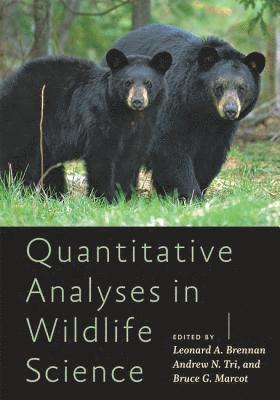
    Quantitative Analyses in Wildlife Science

    AvLeonard A. Brennan,Andrew N. Tri

    Inbunden, Engelska, 2019

    Del i serien Wildlife Management and Conservation

    853 kr

    Beställningsvara. Skickas inom 5-8 vardagar. Fri frakt över 249 kr.

    Beskrivning

    An authoritative guide to quantitative methods that will help wildlife scientists improve analysis and decision-making.Over the past fifty years, wildlife science has become increasingly quantitative. But to wildlife scientists, many of whom have not been formally trained as biometricians, computer modelers, or mathematicians, the wide array of available techniques for analyzing wildlife populations and habitats can be overwhelming. This practical book aims to help students and professionals alike understand how to use quantitative methods to inform their work in the field. Covering the most widely used contemporary approaches to the analysis of wildlife populations and habitats, Quantitative Analyses in Wildlife Science is divided into five broad areas:• general statistical methods• demographic estimation• dynamic process modeling• analysis of spatially based data on animals and resources• numerical methodsAddressing a variety of topics, from population estimation and growth trend predictions to the study of migration patterns, this book presents fresh data on such pressing issues as sustainable take, control of invasives, and species reintroduction. Authored by leading researchers in wildlife science, each chapter considers the structure of data in relation to a particular analytical technique, as well as the structure of variation in those data. Providing conceptual and quantitative overviews of modern analytical methods, the techniques covered in this book also apply to conservation research and wildlife policy. Whether a quick refresher or a comprehensive introduction is called for, Quantitative Analyses in Wildlife Science is an indispensable addition to every wildlife professional's bookshelf. Contributors: William M. Block, Leonard A. Brennan, Stephen T. Buckland, Christopher C. Chizinski, Evan C. Cooch, Raymond J. Davis, Stephen J. DeMaso, Randy W. DeYoung, Jane Elith, Joseph J. Fontane, Julie A. Heinrichs, Mevin B. Hooten, Julianna M. A. Jenkins, Zachary S. Laden, Damon B. Lesmeister, Daniel Linden, Jeffrey J. Lusk, Bruce G. Marcot, David L. Miller, Michael L. Morrison, Eric Rexstad, Jamie S. Sanderlin, Joseph P. Sands, Erica F. Stuber, Chris Sutherland, Andrew N. Tri, David B. Wester, Gary C. White, Christopher K. Williams, Damon L. Williford

    Produktinformation

    • Utgivningsdatum:2019-11-30
    • Mått:178 x 254 x 29 mm
    • Vikt:862 g
    • Format:Inbunden
    • Språk:Engelska
    • Serie:Wildlife Management and Conservation
    • Antal sidor:344
    • Förlag:Johns Hopkins University Press
    • ISBN:9781421431079
    • Utmärkelser:Short-listed for Wildlife Society Outstanding Edited Book 2020 (United States)

    Utforska kategorier

    • Miljövetenskap och miljöpolitik inom Naturvetenskap och teknik
    • Naturhistoriska böcker inom Djur och Natur
    • Biologi inom Naturvetenskap och teknik

    Mer om författaren

    Leonard A. Brennan, a Wildlife Society Fellow, is the C. C. "Charlie" Winn Endowed Chair for Quail Research Professor at the Caesar Kleberg Wildlife Research Institute, Texas A&M University–Kingsville. Andrew N. Tri is a research wildlife biologist with the Forest Wildlife and Populations Research Group at the Minnesota Department of Natural Resources and an adjunct faculty member at the Caesar Kleberg Wildlife Research Institute, Texas A&M University–Kingsville. Bruce G. Marcot is a research wildlife biologist with the Pacific Northwest Research Station and the coauthor of Wildlife Habitat Relationships: Concepts and Applications.

    Recensioner i media

    This is primarily a book for students and working wildlife management professionals; however that is not to say that it is, or should be, outside the realm of consideration by those with a sincere interest in how wildlife researchers collect and interpret data. As so many aspects of contemporary wildlife conservation revolve around what the number are, how they were collected, and how they are interpreted, most anyone with a serious interest in wildlife conservation would do well to at least understand how the metaphorical sausage is made – even if they're not making it themselves. To that end, this is most certainly the book from which to best acquire such an understanding.—Johannes E. Riutta, The Well-Read Naturalist

    Innehållsförteckning

    • List of ContributorsForeword, by R. J. GutiérrezPrefaceAcknowledgments1 IntroductionLeonard A. Brennan, Andrew N. Tri, and Bruce G. MarcotPART I GENERAL STATISTICAL METHODS2 Regression: Linear and Nonlinear, Parametricband NonparametricDavid B. Wester3 Multivariate Models and AnalysesErica F. Stuber, Christopher C. Chizinski, Jeffrey J. Lusk, and Joseph J. Fontaine4 Comparing Ecological ModelsMevin B. Hooten and Evan G. CoochPART II ESTIMATION OF ABUNDANCE AND DEMOGRAPHIC PARAMETERS5 Estimation of Population Parameters Using Marked AnimalsGary C. White6 Distance SamplingStephen T. Buckland, David L. Miller, and Eric Rexstad7 Occupancy Modeling ApplicationsChris Sutherland and Daniel W. LindenPART III DYNAMIC MODELING OF PROCESSES8 Analysis of Population Monitoring DataJamie S. Sanderlin, Michael L. Morrison, and William M. Block9 Systems Analysis and SimulationStephen J. Demaso and Joseph P. Sands10 Applications of Individual-Based ModelsJulie A. Heinrichs and Bruce G. Marcot11 Detecting and Analyzing Density DependenceZachary S. Ladin and Christopher K. WilliamsPART IV ANALYSIS OF SPATIALLY BASED DATA ON ANIMALS AND RESOURCES12 Resource Selection AnalysisJulianna M. A. Jenkins, Damon B. Lesmeister, and Raymond J. Davis13 Spatial Statistics in Wildlife ResearchAndrew N. TriPART V NUMERICAL METHODS14 Bayesian Analysis of Molecular Genetics DataDamon L. Williford and Randy W. Deyoung15 Machine Learning, Random Forests, and Boosted Regression TreesJane Elith16 Causal Modeling and the Role of Expert KnowledgeBruce G. Marcot17 Summary and Synthesis: Looking to the FutureAndrew N. Tri, Bruce G. Marcot, and Leonard A. BrennanIndex