Michele Gillespie - Böcker
Visar alla böcker från författaren Michele Gillespie. Handla med fri frakt och snabb leverans.
8 produkter
8 produkter
1 128 kr
Skickas inom 5-8 vardagar
When Europeans settled in the early South, they quarrelled over many things --- but few imbroglios were so fierce as battles over land. Landowners wrangled bitterly over boundaries with neighbours and contested areas became known as "the devil's lane". Violence and bloodshed were but some of the consequences to befall those who ventured into these disputed territories.The Devil's Lane highlights important new work on sexuality, race, and gender in the South from the seventeeth to the nineteenth centuries. Contributors explore legal history by examining race, crime and punishment, sex across the colour line, and slander. Emerging stars and established scholars such as Peter Wood and Carol Berkin weave together the fascinating story of competing agendas and clashing cultures on the southern frontier. One chapter focuses on a community's resistance to a hermaphrodite, where the town court conducted a series of "examinations" to determine the individual's gender. Other pieces address topics ranging from resistance to sexual exploitation on the part of slave women to spousal murders, from interpreting women's expressions of religious ecstasy to a pastor's sermons about depraved sinners and graphic depictions of carnage, all in the name of "exposing" evil, and from a case of infanticide to the practice of state-mandated castration.Several of the authors pay close attention to the social and personal dynamics of interracial women's networks and relationships across place and time. The Devil's Lane illuminates early forms of sexual oppression, inviting comparative questions about authority and violence, social attitudes and sexual tensions, the impact of slavery as well as the twisted course of race relations among blacks, whites, and Indians. Several scholars look particularly at the Gulf South, myopically neglected in traditional literature, and an outstanding feature of this collection.These eighteen original essays reveal why the intersection of sex and race marks an essential point of departure for understanding Southern social relations, and a turning point for the field of colonial history. The rich, varied, and distinctive experiences showcased in The Devil's Lane provide an extraordinary opportunity for readers interested in women's history, African-American history, southern history, and especially colonial history to explore a wide range of exciting issues.
320 kr
Skickas inom 5-8 vardagar
When Europeans settled in the early South, they quarreled over many things--but few imbroglios were so fierce as battles over land. Landowners wrangled bitterly over boundaries with neighbors and contested areas became known as "the devil's lane." Violence and bloodshed were but some of the consequences to befall those who ventured into these disputed territories.The Devil's Lane highlights important new work on sexuality, race, and gender in the South from the seventeenth- to the nineteenth-centuries. Contributors explore legal history by examining race, crime and punishment, sex across the color line, and slander. Emerging stars and established scholars such as Peter Wood and Carol Berkin weave together the fascinating story of competing agendas and clashing cultures on the southern frontier. One chapter focuses on a community's resistance to a hermaphrodite, where the town court conducted a series of "examinations" to determine the individual's gender. Other pieces address topics ranging from resistance to sexual exploitation on the part of slave women to spousal murders, from interpreting women's expressions of religious ecstasy to a pastor's sermons about depraved sinners and graphic depictions of carnage, all in the name of "exposing" evil, and from a case of infanticide to the practice of state-mandated castration.Several of the authors pay close attention to the social and personal dynamics of interracial women's networks and relationships across place and time. The Devil's Lane illuminates early forms of sexual oppression, inviting comparative questions about authority and violence, social attitudes and sexual tensions, the impact of slavery as well as the twisted course of race relations among blacks, whites, and Indians. Several scholars look particularly at the Gulf South, myopically neglected in traditional literature, and an outstanding feature of this collection.These eighteen original essays reveal why the intersection of sex and race marks an essential point of departure for understanding southern social relations, and a turning point for the field of colonial history. The rich, varied and distinctive experiences showcased in The Devil's Lane provides an extraordinary opportunity for readers interested in women's history, African American history, southern history, and especially colonial history to explore a wide range of exciting issues.
463 kr
Skickas inom 10-15 vardagar
The world of the working woman in the old South of the USA has been largely neglected by historians. This text pushes southern history beyond the plantation to examine the lives and labours of ordinary southern women - white, free black and Indian. Contributors to this volume illuminate women's involvement in the southern market economy in all its diversity. Thirteen essays explore the working lives of a wide range of women - nuns and prostitutes, iron workers and basket weavers, teachers and domestic servants - in urban and rural settings across the antebellum South. By highlighting contrasts between paid and unpaid, officially acknowledged and ""invisible"" work within the context of cultural attitudes regarding women's proper place in society, the book sheds light on the ambiguities that marked relations between race, class and gender in the modernising South.
Free Labor in an Unfree World
White Artisans in Slaveholding Georgia, 1789-1860
Häftad, Engelska, 2004
502 kr
Skickas inom 5-8 vardagar
White male artisans in the antebellum South occupied a marginal and ambiguous social and professional position very unlike that of their northern counterparts. As skilled, free laborers in a slaveholding society, they did not fit into a defined social class. In the first book-length study of white tradespeople in the pre-Civil War South, Michele Gillespie highlights the complex world and lives of a nearly hidden population marginalized by a growing slave system. Gillespie demonstrates that the appearance of solidarity in the white antebellum South was false, that, in fact, strong class conflicts threatened to divide white southern society.Beginning with a discussion of the roles and interests of white artisans in the commercial and industrial revolutions and political world of the late eighteenth and early nineteenth centuries, the book explores the migration of craft and trade workers to the South, the evolution of a rudimentary class identity, and the development of political culture and structure among artisan groups during the post-Revolutionary period. Describing the declining social and economic opportunities afforded southern white artisans during an era increasingly dominated by slaves, Gillespie compares their situation with that of their counterparts in the northern states. The book documents the ways in which the hegemony of slavery thwarted efforts to organize a white working class in the South prior to the Civil War. Individual case studies explore the artisans' worlds on a more personal level, introducing us to the lives and work of such individuals as William Price Talmage, a journeyman, Reuben King, an artisan who became a planter, and Jett Thomas, one of the first master builders to leave his mark on Georgia's architecture. Gillespie's illuminating study of artisans who survived—and even succeeded—at their work despite the hardships they faced advances our knowledge of the antebellum South far beyond the plantation and the farm.
1 475 kr
Skickas inom 5-8 vardagar
By the twentieth century, North Carolina’s progressive streak had strengthened, thanks in large part to a growing number of women who engaged in and influenced state and national policies and politics. These women included Gertrude Weil who fought tirelessly for the Nineteenth Amendment, which extended suffrage to women, and founded the state chapter of the League of Women Voters once the amendment was ratified in 1920. Gladys Avery Tillett, an ardent Democrat and supporter of Roosevelt's New Deal, became a major presence in her party at both the state and national levels. Guion Griffis Johnson turned to volunteer work in the postwar years, becoming one of the state's most prominent female civic leaders. Through her excellent education, keen legal mind, and family prominence, Susie Sharp in 1949 became the first woman judge in North Carolina and in 1974 the first woman in the nation to be elected and serve as chief justice of a state supreme court. Throughout her life, the Reverend Dr. Anna Pauline "Pauli" Murray charted a religious, literary, and political path to racial reconciliation on both a national stage and in North Carolina.This is the second of two volumes that together explore the diverse and changing patterns of North Carolina women's lives. The essays in this volume cover the period beginning with women born in the late nineteenth and early twentieth centuries but who made their greatest contributions to the social, political, cultural, legal, and economic life of the state during the late progressive era through the late twentieth century.
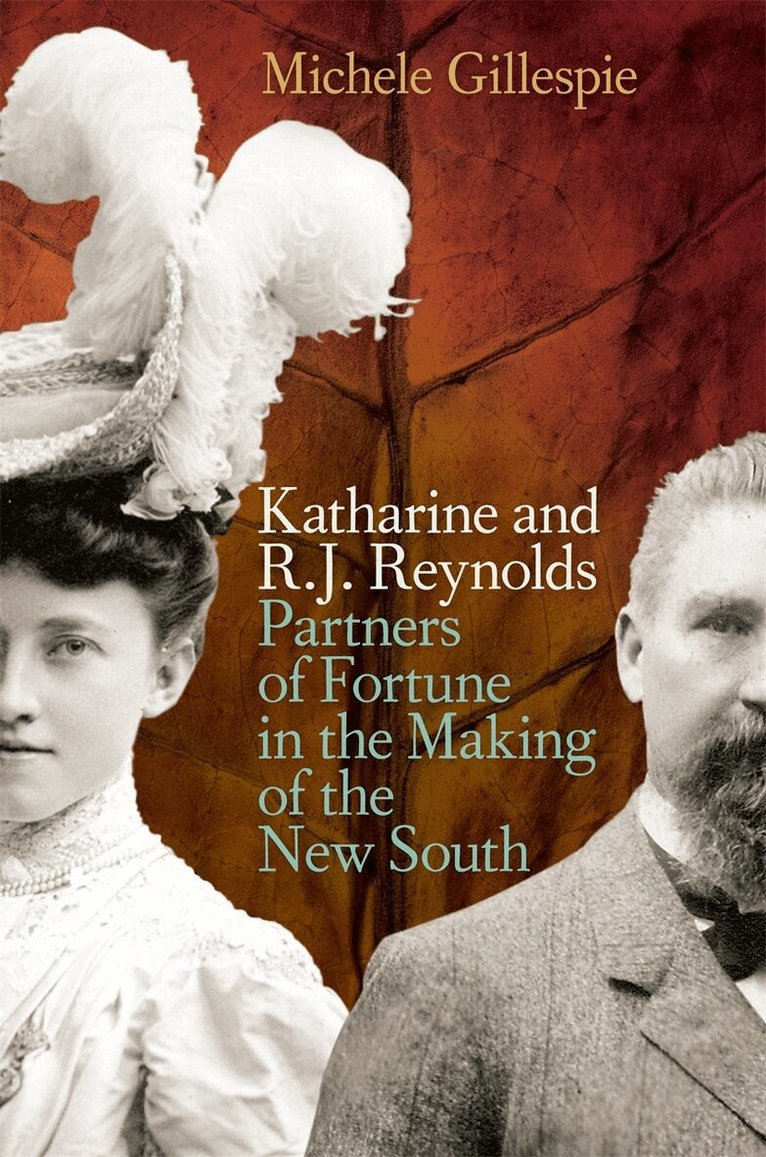
Katharine and R. J. Reynolds
Partners of Fortune in the Making of the New South
Häftad, Engelska, 2016
336 kr
Skickas inom 3-6 vardagar
Separately they were formidable—together they were unstoppable. Despite their intriguing lives and the deep impact they had on their community and region, the story of Richard Joshua Reynolds (1850–1918) and Katharine Smith Reynolds (1880–1924) has never been fully told. Now Michele Gillespie provides a sweeping account of how R. J. and Katharine succeeded in realizing their American dreams.From relatively modest beginnings, R. J. launched the R. J. Reynolds Tobacco Company, which would eventually develop two hugely profitable products, Prince Albert pipe tobacco and Camel cigarettes. His marriage in 1905 to Katharine Smith, a dynamic woman thirty years his junior, marked the beginning of a unique partnership that went well beyond the family. As a couple, the Reynoldses conducted a far-ranging social life and, under Katharine's direction, built Reynolda House, a breathtaking estate and model farm. Providing leadership to a series of progressive reform movements and business innovations, they helped drive one of the South's best examples of rapid urbanization and changing race relations in the city of Winston-Salem, North Carolina. Together they became one of the New South's most influential elite couples. Upon R. J.'s death, Katharine reinvented herself, marrying a World War I veteran many years her junior and engaging in a significant new set of philanthropic pursuits.Katharine and R. J. Reynolds reveals the broad economic, social, cultural, and political changes that were the backdrop to the Reynoldses' lives. Portraying a New South shaped by tensions between rural poverty and industrial transformation, white working-class inferiority and deeply entrenched racism, and the solidification of a one-party political system, Gillespie offers a masterful life-and-times biography of these important North Carolinians.
Technology, Innovation, and Southern Industrialization
From the Antebellum Era to the Computer Age
Häftad, Engelska, 2008
317 kr
Skickas inom 7-10 vardagar
Because of its strong agrarian roots, the South has typically been viewed as a region not favorably disposed to innovation and technology. Yet innovation was never absent from industrialization in this part of the United States. From the early nineteenth century onward, southerners were as eager as other Americans to embrace technology as a path to modernity.This second volume in the series ""New Currents in the History of Southern Economy and Society"" features seven essays that range widely across the region and its history, from the antebellum era to the present, to assess the role of innovations presumed lacking by most historians. Offering a challenging interpretation of industrialization in the South, these writings show that the benefits of innovations had to be carefully weighed against the costs to both industry and society.The essays consider a wide range of innovative technologies. Some examine specific industries in subregions: steamboats in the lower Mississippi valley, textile manufacturing in Georgia and Arkansas, coal mining in Virginia, and sugar planting and processing in Louisiana. Others consider the role of technology in South Carolina textile mills around the turn of the twentieth century, the electrification of the Tennessee valley, and telemedicine in contemporary Arizona - marking the expansion of the region into the southwestern Sunbelt.Together, these articles show that southerners set significant limitations on what technological innovations they were willing to adopt, particularly in a milieu where slaveholding agriculture had shaped the allocation of resources. They also reveal how scarcity of capital and continued reliance on agriculture influenced that allocation into the twentieth century, relieved eventually by federal spending during the Depression and its aftermath that sparked the Sunbelt South's economic boom.""Technology, Innovation, and Southern Industrialization"" clearly demonstrates that the South's embrace of technological innovation in the modern era doesn't mark a radical change from the past but rather signals that such pursuits wer always part of the region's economy. It deflates the myth of southern agrarianism while expanding the scope of antebellum American industrialization beyond the Northeast and offers new insights into the relationship of southern economic history to the region's society and politics.
2 014 kr
Skickas inom 3-6 vardagar
Recent work on the history of migration and the Atlantic World has underscored the importance of the political economies of Europe, Africa, and the Americas in the eighteenth century, emphasizing the impact of these exchanges on political relations and state-building, and on economic structures, commerce, and wealth. Too little of this work explores culture and identity outside the Anglo-American context, especially as reflected through religious developments of radical Pietists and other Germans, the second largest group of migrants to the American colonies in the eighteenth century.This volume offers a fresh vantage point from which to examine the Atlantic World. Quick to traverse the conventional political boundaries that divided European states and American colonies, Moravians departed their homeland to form new congregations in the most cosmopolitan European cities as well as on the North American frontier. Pious Pursuits explores the lives and beliefs of Atlantic World Moravians, as well as their communities and culture, and it provides a new framework for analysis of the Atlantic World that is comparative and transnational.