Mike Barley – författare
Visar alla böcker från författaren Mike Barley. Handla med fri frakt och snabb leverans.
4 produkter
4 produkter
Häftad, Engelska, 2003
561 kr
Skickas inom 10-15 vardagar
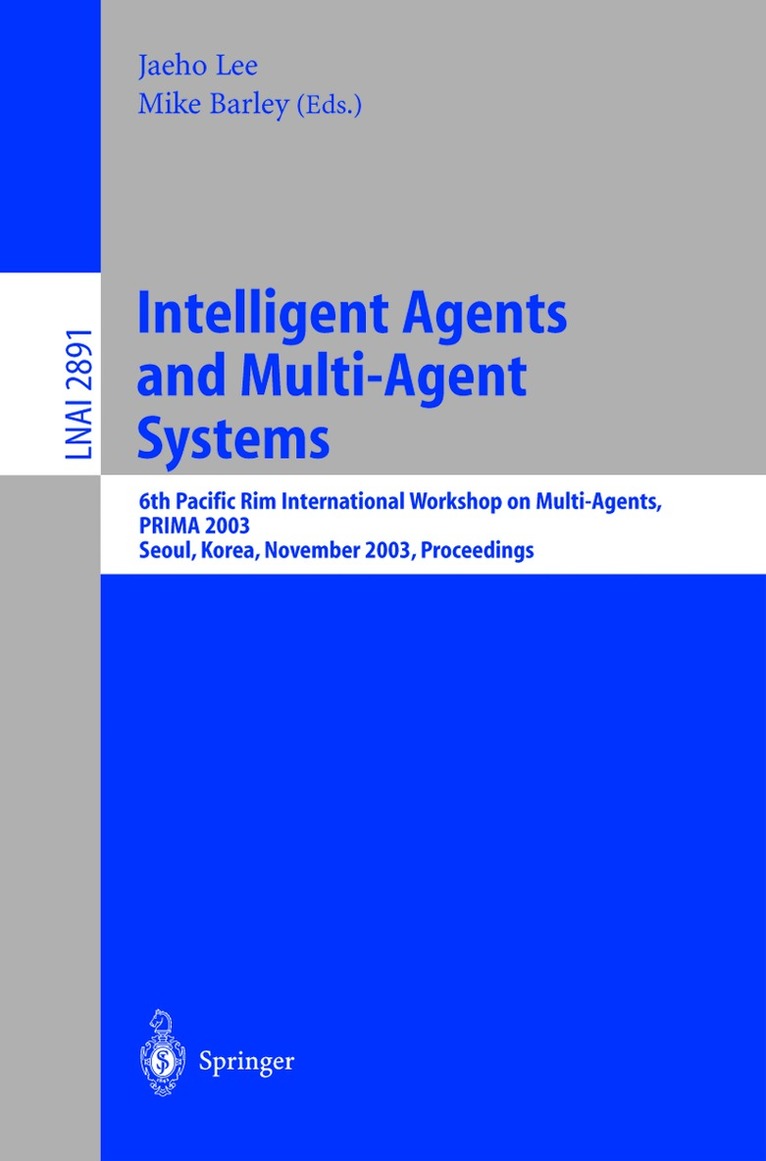
This book constitutes the refereed proceedings of the 6th Pacific Rim International Conference on Multi-Agents, PRIMA 2003, held in Seoul, Korea, in November 2003.The 18 revised full papers presented were carefully reviewed and selected from 44 submissions. The papers are devoted to current issues in multi-agent systems and applications in various fields.
E-bok
PDF, Engelska, 2003708 kr
Läs direkt efter köp
Five years ago, with excitement and uncertainty, we witnessed the birth of PRIMA (Paci?c Rim International Workshop on Multi-Agents). The ?rst PRIMA in 1998 has now grown into PRIMA 2003, the 6th Paci?c Rim Inter- tional Workshop on Multi-Agents in Seoul, Korea. During a period of ?ve years, the notion of agent research has grown so much that we hear the term agent on a daily basis. Various ?elds such as business, the Web, software engineering, on-line games and such are now using the term agent as a placeholder, just like the term object is used in the object-oriented paradigm. On the other hand, the research area has extended toward real applications, such as the Semantic Web and ubiquitous computing. The themes of PRIMA 2003 re?ected the following trends: – agent-based electronic commerce, auctions and markets – agent architectures and their applications – agent communication languages, dialog and interaction protocols – agent ontologies – agent programming languages, frameworks and toolkits – agentcities – agents and grid computing – agents and peer computing –agentsandtheSemanticWeb – agents and Web services – arti?cial social systems – con?ict resolution and negotiation – evaluation of multi-agent systems – languages and techniques for describing (multi-)agent systems – meta modeling and meta reasoning – multi-agent planning and learning – multi-agent systems and their applications – social reasoning, agent modeling, and organization – standards for agents and multi-agent systems – teams and coalitions – ubiquitous agents
Häftad, Engelska, 2009
561 kr
Skickas inom 10-15 vardagar
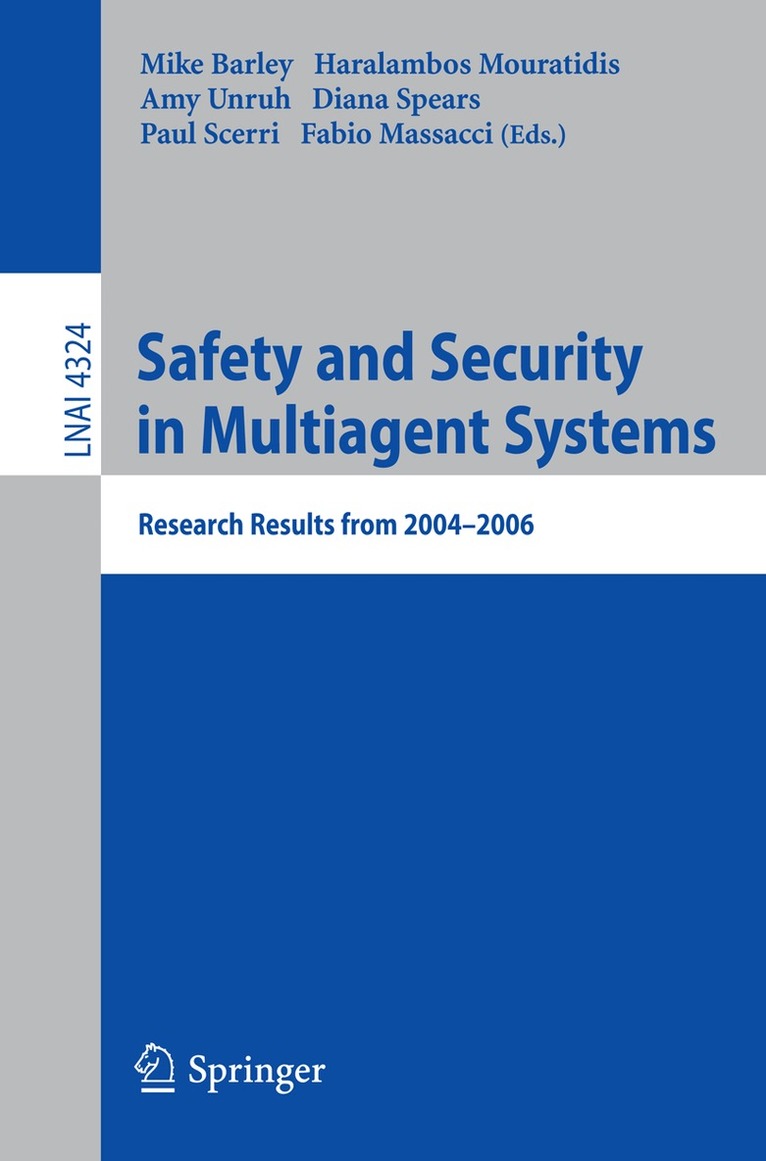
As intelligent autonomous agents and multiagent system applications become more pervasive, it becomes increasingly important to understand the risks associated with using these systems. Incorrect or inappropriate agent behavior can have harmful - fects, including financial cost, loss of data, and injury to humans or systems. For - ample, NASA has proposed missions where multiagent systems, working in space or on other planets, will need to do their own reasoning about safety issues that concern not only themselves but also that of their mission. Likewise, industry is interested in agent systems that can search for new supply opportunities and engage in (semi-) automated negotiations over new supply contracts. These systems should be able to securely negotiate such arrangements and decide which credentials can be requested and which credentials may be disclosed. Such systems may encounter environments that are only partially understood and where they must learn for themselves which aspects of their environment are safe and which are dangerous. Thus, security and safety are two central issues when developing and deploying such systems. We refer to a multiagent system’s security as the ability of the system to deal with threats that are intentionally caused by other intelligent agents and/or s- tems, and the system’s safety as its ability to deal with any other threats to its goals.
E-bok
PDF, Engelska, 2009708 kr
Läs direkt efter köp
As intelligent autonomous agents and multiagent system applications become more pervasive, it becomes increasingly important to understand the risks associated with using these systems. Incorrect or inappropriate agent behavior can have harmful - fects, including financial cost, loss of data, and injury to humans or systems. For - ample, NASA has proposed missions where multiagent systems, working in space or on other planets, will need to do their own reasoning about safety issues that concern not only themselves but also that of their mission. Likewise, industry is interested in agent systems that can search for new supply opportunities and engage in (semi-) automated negotiations over new supply contracts. These systems should be able to securely negotiate such arrangements and decide which credentials can be requested and which credentials may be disclosed. Such systems may encounter environments that are only partially understood and where they must learn for themselves which aspects of their environment are safe and which are dangerous. Thus, security and safety are two central issues when developing and deploying such systems. We refer to a multiagent system’s security as the ability of the system to deal with threats that are intentionally caused by other intelligent agents and/or s- tems, and the system’s safety as its ability to deal with any other threats to its goals.