Haris Mouratidis - Böcker
Visar alla böcker från författaren Haris Mouratidis. Handla med fri frakt och snabb leverans.
3 produkter
3 produkter
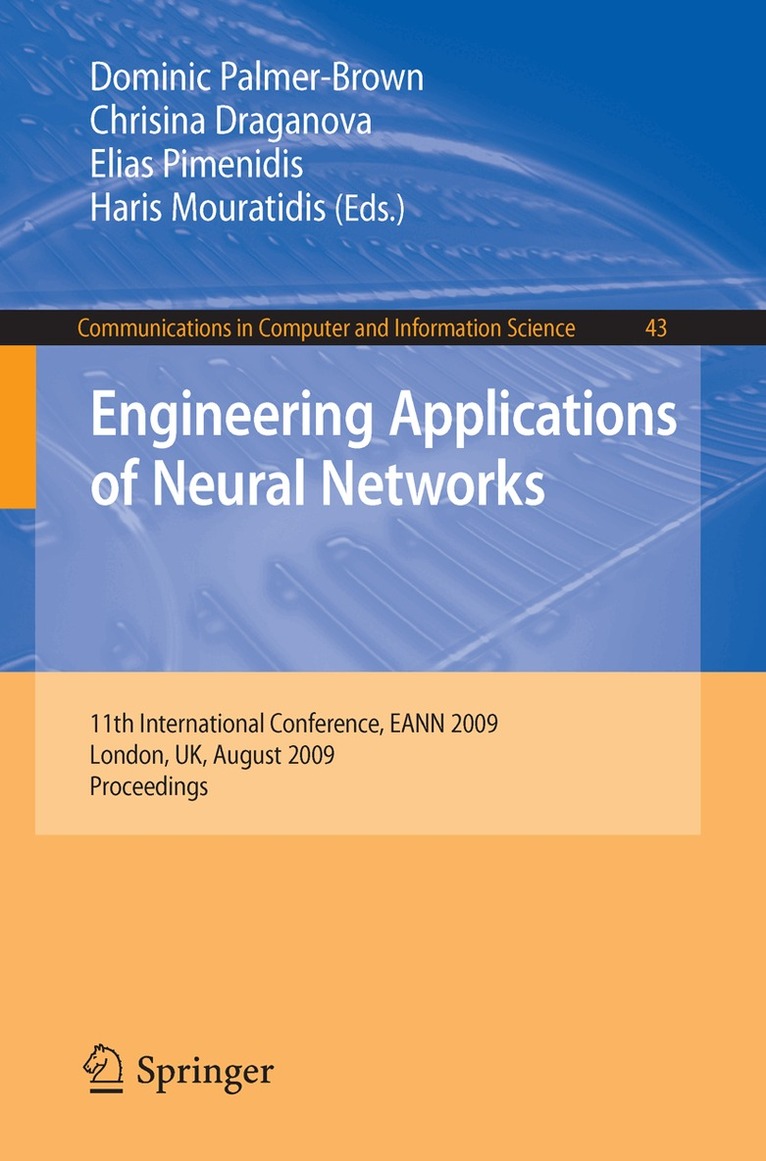
Engineering Applications of Neural Networks
11th International Conference, EANN 2009, London, UK, August 27-29, 2009, Proceedings
Häftad, Engelska, 2009
1 064 kr
Skickas inom 10-15 vardagar
A cursory glance at the table of contents of EANN 2009 reveals the am- ing range of neural network and related applications. A random but revealing sample includes: reducing urban concentration, entropy topography in epil- tic electroencephalography, phytoplanktonic species recognition, revealing the structure of childhood abdominal pain data, robot control, discriminating angry and happy facial expressions, ?ood forecasting, and assessing credit worthiness. The diverse nature of applications demonstrates the vitality of neural comp- ing and related soft computing approaches, and their relevance to many key contemporary technological challenges. It also illustrates the value of EANN in bringing together a broad spectrum of delegates from across the world to learn from each other’s related methods. Variations and extensions of many methods are well represented in the proceedings, ranging from support vector machines, fuzzy reasoning, and Bayesian methods to snap-drift and spiking neurons. This year EANN accepted approximately 40% of submitted papers for fu- length presentation at the conference. All members of the Program Committee were asked to participate in the reviewing process. The standard of submissions was high, according to the reviewers, who did an excellent job. The Program and Organizing Committees thank them. Approximately 20% of submitted - pers will be chosen, the best according to the reviews, to be extended and - viewedagainfor inclusionin a specialissueofthe journalNeural Computing and Applications. We hope that these proceedings will help to stimulate further research and development of new applications and modes of neural computing.
552 kr
Skickas inom 10-15 vardagar
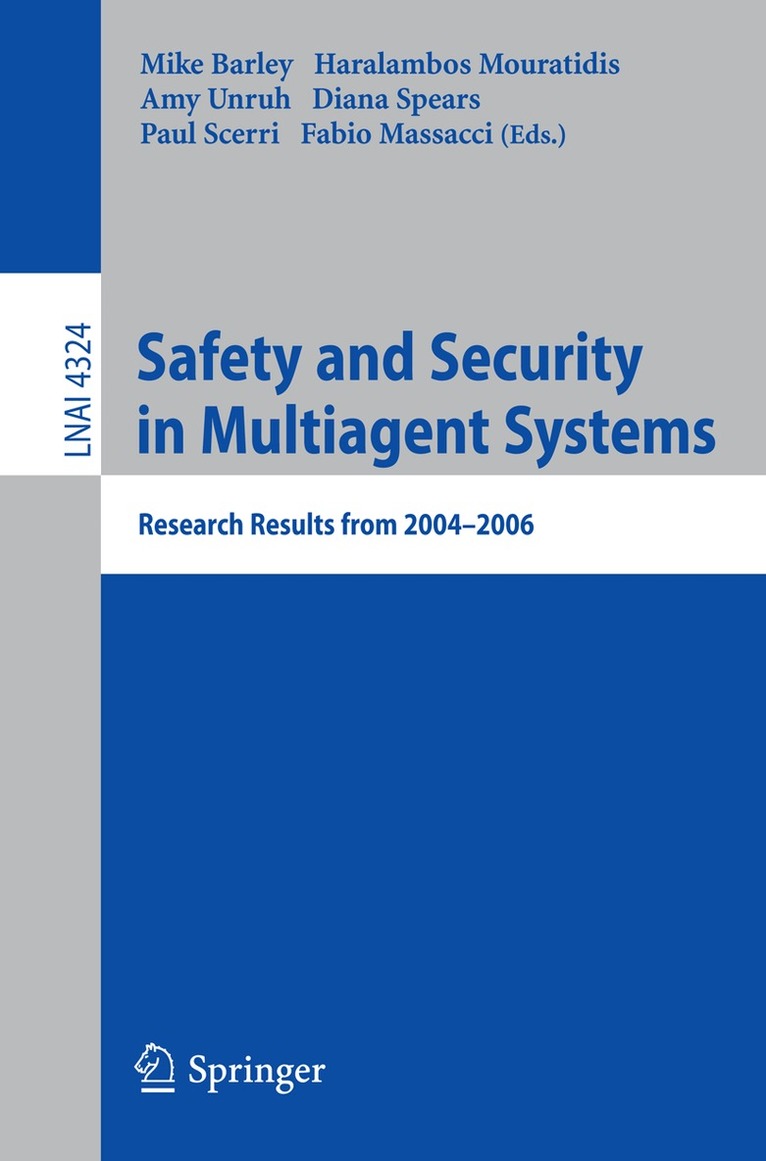
As intelligent autonomous agents and multiagent system applications become more pervasive, it becomes increasingly important to understand the risks associated with using these systems. Incorrect or inappropriate agent behavior can have harmful - fects, including financial cost, loss of data, and injury to humans or systems. For - ample, NASA has proposed missions where multiagent systems, working in space or on other planets, will need to do their own reasoning about safety issues that concern not only themselves but also that of their mission. Likewise, industry is interested in agent systems that can search for new supply opportunities and engage in (semi-) automated negotiations over new supply contracts. These systems should be able to securely negotiate such arrangements and decide which credentials can be requested and which credentials may be disclosed. Such systems may encounter environments that are only partially understood and where they must learn for themselves which aspects of their environment are safe and which are dangerous. Thus, security and safety are two central issues when developing and deploying such systems. We refer to a multiagent system’s security as the ability of the system to deal with threats that are intentionally caused by other intelligent agents and/or s- tems, and the system’s safety as its ability to deal with any other threats to its goals.
Advanced Information Systems Engineering
23rd International Conference, CAiSE 2011, London, UK, June 20-24, 2011, Proceedings
Häftad, Engelska, 2011
1 096 kr
Skickas inom 10-15 vardagar
This book constitutes the refereed proceedings of the 23rd International Conference on Advanced Information Systems Engineering, CAiSE 2011, held in London, UK, in June 2011. The 42 revised full papers and 5 revised short papers presented were carefully reviewed and selected from 320 submissions. In addition the book contains the abstracts of 2 keynote speeches. The contributions are organized in topical sections on requirements; adaptation and evolution; model transformation; conceptual design; domain specific languages; case studies and experiences; mining and matching; business process modelling; validation and quality; and service and management.