Mirjam Rajner - Böcker
Visar alla böcker från författaren Mirjam Rajner. Handla med fri frakt och snabb leverans.
14 produkter
14 produkter
Del 14 - Ars Judaica: The Bar-Ilan Journal of Jewish Art
Ars Judaica: The Bar-Ilan Journal of Jewish Art, Volume 14
Häftad, Engelska, 2018
882 kr
Skickas inom 7-10 vardagar
This volume focuses on the migration and acculturation of images in Jewish culture and how that reflects intercultural exchange. Gender aspects of Jewish art are also highlighted, as is the role of images in interreligious encounters. Other topics covered include the history, codicology, and iconography of a Haggadah produced in the late fifteenth century.
1 283 kr
Skickas inom 7-10 vardagar
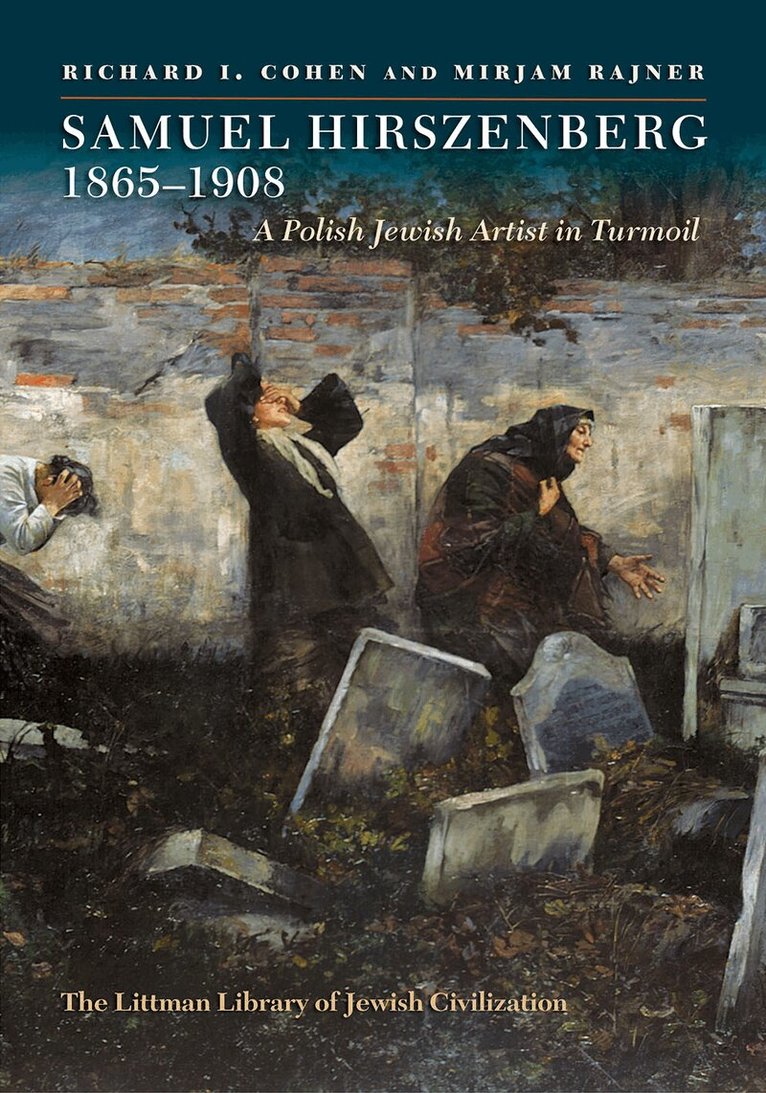
Samuel Hirszenberg is an artist who deserves to be more widely known: his work intertwined modernism and Jewish themes, and he influenced later artists of Jewish origin.Born into a traditional Jewish family in Łódź in 1865, Hirszenberg gradually became attached to Polish culture and language as he pursued his artistic calling. Like Maurycy Gottlieb before him, he studied at the School of Art in Kraków, which was then headed by the master of Polish painting, Jan Matejko. His early interests were to persist with varying degrees of intensity throughout his life: his Polish surroundings, traditional east European Jews, historical themes, the Orient, and the nature of relationships between men and women. He also had a lifelong commitment to landscape painting and portraiture.Hirszenberg’s personal circumstances, economic considerations, and historical upheavals took him to different countries, strongly influencing his artistic output. He moved to Jerusalem in 1907 and there, as a secular and acculturated Jew who had adopted the world of humanism and universalism, he strove also to express more personal aspirations and concerns. This fully illustrated study presents an intimate and detailed picture of the artist’s development.
857 kr
Skickas inom 7-10 vardagar
This volume focuses on the migration and acculturation of images in Jewish culture and how that reflects intercultural exchange. Gender aspects of Jewish art are also highlighted, as is the role of images in interreligious encounters. Other topics covered include the history, codicology, and iconography of a Haggadah produced in the late fifteenth century.
Del 22 - Ars Judaica: The Bar-Ilan Journal of Jewish Art
Ars Judaica: The Bar-Ilan Journal of Jewish Art, Volume 22
Häftad, Engelska, 2026
1 031 kr
Kommande
Ars Judaica is an annual publication of the Department of Jewish Art at Bar-Ilan University. It showcases the Jewish contribution to the visual arts and architecture from antiquity to the present from a variety of perspectives, including history, iconography, semiotics, psychology, sociology, and folklore. As such it is a valuable resource for art historians, collectors, curators, and all those interested in the visual arts.
Del 19 - Ars Judaica: The Bar-Ilan Journal of Jewish Art
Ars Judaica: The Bar-Ilan Journal of Jewish Art, Volume 19
Häftad, Engelska, 2024
786 kr
Skickas inom 7-10 vardagar
Ars Judaica is an annual publication of the Department of Jewish Art at Bar-Ilan University. It showcases the Jewish contribution to the visual arts and architecture from antiquity to the present from a variety of perspectives, including history, iconography, semiotics, psychology, sociology, and folklore. As such it is a valuable resource for art historians, collectors, curators, and all those interested in the visual arts.
Del 21 - Ars Judaica: The Bar-Ilan Journal of Jewish Art
Ars Judaica: The Bar-Ilan Journal of Jewish Art, Volume 21
Häftad, Engelska, 2026
782 kr
Kommande
Ars Judaica is an annual publication of the Department of Jewish Art at Bar-Ilan University. It showcases the Jewish contribution to the visual arts and architecture from antiquity to the present from a variety of perspectives, including history, iconography, semiotics, psychology, sociology, and folklore. As such it is a valuable resource for art historians, collectors, curators, and all those interested in the visual arts.
Del 7 - Ars Judaica: The Bar-Ilan Journal of Jewish Art
Ars Judaica: The Bar-Ilan Journal of Jewish Art, Volume 7
Häftad, Engelska, 2011
857 kr
Skickas inom 7-10 vardagar
Ars Judaica is an annual publication of the Department of Jewish Art at Bar-Ilan University. It showcases the Jewish contribution to the visual arts and architecture from antiquity to the present from a variety of perspectives, including history, iconography, semiotics, psychology, sociology, and folklore. As such it is a valuable resource for art historians, collectors, curators, and all those interested in the visual arts. The study of Jewish art frequently raises questions relating to Jewish survival and Jewish identity. These issues have always been of relevance throughout the Jewish diaspora, and as is evident from the articles in this volume they continue to concern Jewish artists to this day. The opening article, 'Illuminations of Kol Nidrei in Two Ashkenazi Mahzorim' by Sara Offenberg, deals with the hidden meanings expressed by groups of animals depicted in two medieval Ashkenazi prayer books for the Day of Atonement. By using allegorical animals in this way the Jews of the thirteenth and fourteenth centuries could safely express their fear of the hostile Christian society in which they lived, as well as their trust in God and belief in redemption.A surprising link between the Middle Ages and modern times is made by Rachel Singer’s article, 'Maurice Sendak’s Where the Wild Things Are: An Exploration of the Personal and the Collective'. Published in 1963, this classic children’s book, written and illustrated by the son of a Jewish immigrant family in Brooklyn, is far removed, both chronologically and geographically, from the Ashkenazi Middle Ages. In her study, however, Singer prises out hidden sources of antisemitic perceptions rooted in medieval Christian Europe. This leads us to the volume’s third article, 'The Return of the Wandering Jew(s) in Samuel Hirszenberg’s Art' by Richard I. Cohen and Mirjam Rajner. The motif of the wandering Jew, a negative and frightening figure, is rooted in the late Middle Ages: it made its first appearance in Christian art, in printed books which disseminated the Christian legend all over Europe. In the nineteenth century, Jewish artists engaging with the image of the wandering Jew endowed it with new interpretations and presentations. One of these is revealed by the authors as they focus on the painting The Wandering Jew, created in 1899 by the Polish Jewish artist Samuel Hirszenberg.As is well known, emancipation and the Jewish national awakening in late nineteenth-century Europe were accompanied by diverse artistic activities. These included the establishment of Jewish societies promoting Jewish art and artists, exhibitions, documentation, and research. Among the most impressive efforts were the activities of Jewish artists in interwar Poland, recorded in contemporary local newspapers and periodicals. As these were published in Polish and Yiddish they weren’t accessible to the English-speaking reader, something that is now rectified by Renata Piątkowska in ‘A Sense of Togetherness: The Jewish Society for the Encouragement of the Fine Arts in Warsaw (1923–1939)'. Based on primary sources, the article introduces us to the flourishing artistic life which was cruelly destroyed in the Holocaust.Another result of Jewish national awakening, in this case in the medium of photography, is presented in 'Modernity as Anti-Nostalgia: The Photographic Books of Tim Gidal and Moshe Vorobeichic and the Eastern European Shtetl', by Rose-Carol Washton Long. This article examines how Zionist ideas led two assimilated German-trained photographers to develop variant thematic and stylistic portrayals of eastern European shtetls in their photobooks, published in 1931 and 1932. Their volumes are neither romantic nor nostalgic, but instead convey a vibrant vision of modernity.While the first five articles discuss issues of identity encountered by Jewish individuals or groups, the next contribution focuses on a 'Jewish identity' that was imposed by a colonial administration. Dominique Jarrassé's 'Orientalism, Colonialism, and Jewish Identity in the Synagogues of North Africa under French Domination' fills the gaps in our knowledge of synagogue architecture in Tunisia and Algiers in the modern era in general, and about colonial Orientalism in particular.Covert Jewish identity is revealed by Milly Heyd in 'Hans Richter: Universalism vis-à-vis Particularism'. This is the third part of her study of the place of the hidden Jew in the Dada avant-garde, one part of which is published in volume 1 of Ars Judaica. The focus in the present piece is on Hans Richter’s art in the context of Man Ray, Tristan Tzara, and others who were born to Jewish families but opted for universalism rather than particularism in their art.The Special Item in this year’s volume is devoted to a painting by Moritz Oppenheim that was long thought to be lost. 'Of Provenance and Providence: On the Reappearance of David Playing the Harp for Saul by Moritz Oppenheim', by Susan Nashman Fraiman, raises some new and interesting questions about Oppenheim’s early work and patrons. The study of this painting reveals a conscious effort to incorporate Jewish source material into his work, an important aspect of his corpus which has previously been neglected.Volumes of Ars Judaica are distributed by the Littman Library of Jewish Civilization throughout the world, except Israel. Orders and enquiries from Israeli customers should be directed to: Ars Judaica, Department of Jewish Art, Bar-Ilan University, Ramat-Gan 52900, Telephone 03 5318413; Fax 03 6359241; Email [ajudaica@mail.biu.ac.il]
Del 8 - Ars Judaica: The Bar-Ilan Journal of Jewish Art
Ars Judaica: The Bar-Ilan Journal of Jewish Art, Volume 8
Häftad, Engelska, 2012
857 kr
Skickas inom 7-10 vardagar
Bringing to light little-known artistic traditions, the latest volume of Ars Judaica focuses on the local and temporal contexts of objects and their images and explores collective and personal memories and identities in art.Rivka Ben-Sasson examines modes of symbolic perception of nature prevalent in religious thought and art by analysing images of the lulav and etrog. Iwona Brzewska and Waldemar Deluga discuss the significance of Hebrew script in paintings and prints of the fifteenth to seventeenth centuries originating from the borderland between the Catholic and Christian Orthodox domains of eastern Europe. Michelle Klein studies the typological development of the havdalah candle-holder, based on an analysis of 170 examples. Matthew Baigell suggests that American Jewish artists are characterized by concern for the betterment of humankind; his sources include Jewish postcards, photographs, and caricatures as well as the work of contemporary American Jewish artists. Astrid Schmetterling discusses how Else Lasker-Schüler’s Orientalism offered a serious aesthetic-political challenge to both German and Jewish society. Mor Presiado argues that the contemporary use of sewing and embroidery by contemporary Jewish women artists to depict women’s experience of the Holocaust initiates a new, feminist response to the Holocaust.The Special Item in this volume, an article by Shalom Sabar on the earliest illustrated Esther Scroll by Shalom Italia, is an illuminating insight into early modern Jewish art in the making. Also included are exhibition and book reviews.Ars Judaica is an annual publication of the Department of Jewish Art at Bar-Ilan University. It showcases the Jewish contribution to the visual arts and architecture from antiquity to the present from a variety of perspectives, including history, iconography, semiotics, psychology, sociology, and folklore. As such it is a valuable resource for art historians, collectors, curators, and all those interested in the visual arts.Volumes of Ars Judaica are distributed by the Littman Library of Jewish Civilization throughout the world, except Israel. Orders and enquiries from Israeli customers should be directed to: Ars Judaica, Department of Jewish Art, Bar-Ilan University, Ramat-Gan 52900, Telephone 03 5318413; Fax 036359241; Email ajudaica@mail.biu.ac.il
Del 9 - Ars Judaica: The Bar-Ilan Journal of Jewish Art
Ars Judaica: The Bar-Ilan Journal of Jewish Art, Volume 9
Häftad, Engelska, 2013
857 kr
Skickas inom 7-10 vardagar
Ars Judaica is an annual publication of the Department of JewishArt at Bar-Ilan University. It showcases theJewish contribution to the visual arts and architecture from antiquity to thepresent from a variety of perspectives, including history, iconography,semiotics, psychology, sociology, and folklore. As such it is a valuableresource for art historians, collectors, curators, and all those interested inthe visual arts.In this volume, Avraham Faust considers a unique phenomenon in thematerial culture of ancient Israel during the biblical period: pottery withoutpainted decoration. Moshe Idel, an expert on Jewish mysticism, sheds new lighton the figure of Helios in the Hammath Tiberias synagogue mosaic, comparing itto descriptions of angel ‘Anafi’el in the Heikhalot literature and medievalKabbalistic texts. Rahel Fronda attributes a group of medieval Ashkenazi Biblemanuscripts containing similar micrographic ornaments to the same scribal workshop,possibly near Würzburg. Alexander Mishory reveals a Scroll of Estherilluminated by one of the first Bezalel artists, Shmuel Ben-David, and focuseson his use of fowl and fox imagery deriving from an Arab fable. ArturTanikowski discusses social awareness and humanist values in the work of Polishmodernists of Jewish origin. The Special Itemby Nurit Sirkis Bank is dedicated to hasidic wedding rings. A silver ring,square on the outside, round within, and engraved with the Hebrew letter he is understood as a symbol of unityand harmony between man and woman, the human and the Divine, nature andculture, and even good and evil.Contributor Information:Walter Cahn, Professor, History of Art Department, Yale University, Avraham Faust, Director, Tel 'Eton Excavations, Institute of Archaeology, Martin (Szusz) Department of Land of Israel Studies and Archaeology, Bar-Ilan University, Rahel Fronda, Hebraica and Judaica Subject Librarian, Bodleian Library, University of Oxford, Carole Herselle Krinsky, Professor, Art History Department, New York University, Moshe Idel, Professor, Department of Jewish Thought, Hebrew University of Jerusalem; Senior Researcher, Shalom Hartman Institute, David Malkiel, Professor, Department of Jewish History, Bar-Ilan University, Alec Mishory, independent scholar, Israel, Ilia Rodov, Lecturer, Department of Jewish Art, Bar-Ilan University, Nurit Sirkis Bank, Curator, Wolfson Museum of Jewish Art, Hechal Shlomo; doctoral candidate, Bar-Ilan University, David Stern, Professor, Jewish Studies Faculty, University of Pennsylvania, Artur Tanikowski, Graphic Department, Academy of Fine Arts, Warsaw; Faculty of Humanities, Fryderyk Chopin Uiversity of Music, Warsaw; Curator, Museum of the History of Polish Jews, WarsawVolumes of ArsJudaica are distributed by the Littman Library of Jewish Civilizationthroughout the world, except Israel. Orders and enquiries from Israelicustomers should be directed to:Ars JudaicaDepartment of Jewish ArtBar-Ilan UniversityRamat-Gan 52900Telephone: 03 5318413Email: ajudaica@mail.biu.ac.il
Del 10 - Ars Judaica: The Bar-Ilan Journal of Jewish Art
Ars Judaica: The Bar-Ilan Journal of Jewish Art, Volume 10
Häftad, Engelska, 2014
857 kr
Skickas inom 7-10 vardagar
ArsJudaica is an annual publication of the Department ofJewish Art at Bar-Ilan University. It showcases the Jewish contribution to thevisual arts and architecture from antiquity to the present from a variety ofperspectives, including history, iconography, semiotics, psychology, sociology,and folklore. As such it is a valuable resource for art historians, collectors,curators, and all those interested in the visual arts.In this volume, Sarit Shalev-Eyni considers the Mahzor as a cosmologicalcalendar, while Katrin Kogman-Appel looks at the work of Elisha ben Abraham,known as Cresques, in fourtheenth-century Mallorca. Evelyn M. Cohen discusses a surprising modelfor Charlotte Rothschild's Haggadah of 1842 and Ronit Sternberg examinessampler embroidery past and present as an expression of merging Jewishidentity. Jechezkiel David Kirszenbaum’s exploration of personal displacementisthe subject of an article by Caroline Goldberg Igra, and the Great Synagogue onTłomackie Street in Warsaw one by Eleanora Bergman. The Special Item by Sergey R. Kravtsov and VladimirLevin is devoted to Perek Shirah on a wall of the Great Synagoguein Radyvyliv. The volume alsoincludes book reviews and an appreciation of the life of Alfred Moldovan byWilliam L. Gross. Contributors: Ziva Amishai-Maisels, Professor, History of Art Department, Hebrew University of Jerusalem, Eleonora Bergman, Emanuel Ringelbaum Jewish Historical Institute, Warsaw, Evelyn M. Cohen, Professor, Jewish Theological Seminary (JTS), New York, Caroline Goldberg Igra, Guest Curator, Beit Hatfusot, Tel Aviv, William L. Gross, Collector, Tel Aviv, Katrin Kogman-Appel, Professor, Ben-Gurion University of the Negev, Beersheva, Sergey R. Kravtsov, Center for Jewish Art, Hebrew University of Jerusalem, Vladimir Levin, Center for Jewish Art, Hebrew University of Jerusalem, Sarit Shalev-Eyni, History of Art Department, Hebrew University of Jerusalem, Larry Silver, History of Art Department, University of Pennsylvania, Ronit Steinberg, History and Theory Department, Bezalel Academy of Arts and design, JerusalemVolumes of ArsJudaica are distributed by the Littman Library of Jewish Civilizationthroughout the world, except Israel. Orders and enquiries from Israelicustomers should be directed to:Ars JudaicaDepartment of Jewish ArtBar-Ilan UniversityRamat-Gan 52900telephone 03 5318413fax 03 6359241email ajudaica@mail.biu.ac.il
Del 11 - Ars Judaica: The Bar-Ilan Journal of Jewish Art
Ars Judaica: The Bar-Ilan Journal of Jewish Art, Volume 11
Häftad, Engelska, 2015
857 kr
Skickas inom 7-10 vardagar
ArsJudaica is an annual publication of the Department ofJewish Art at Bar-Ilan University. It showcases the Jewish contribution to thevisual arts and architecture from antiquity to the present from a variety ofperspectives, including history, iconography, semiotics, psychology, sociology,and folklore. As such it is a valuable resource for art historians, collectors,curators, and all those interested in the visual arts.Contributors: Matthew Baigell, Rutgers University of New Jersey, Batya Brutin, Beit Berl Academic College, Zofit, Warren Zev Harvey, Department of Jewish Thought, Hebrew University of Jerusalem, Moshe Idel, Shalom Hartman Institute, Jerusalem; Department of Jewish Thought, Hebrew University of Jerusalem, Sara Offenberg, Department of Jewish Art, Bar-Ilan University, Nils Roemer, University of Texas at Dallas, Debra Higgs Strickland, School of Culture and Creative Arts, University of Glasgow, Annette Weber, Hochschule für Jüdische Studien, HeidelbergVolumesof Ars Judaica are distributed by the Littman Library of JewishCivilization throughout the world, except Israel. Orders and enquiries fromIsraeli customers should be directed to:Ars JudaicaDepartment of Jewish ArtBar-Ilan UniversityRamat-Gan 52900telephone 03 5318413fax 03 6359241email ajudaica@mail.biu.ac.il
Del 12 - Ars Judaica: The Bar-Ilan Journal of Jewish Art
Ars Judaica: The Bar-Ilan Journal of Jewish Art, Volume 12
Häftad, Engelska, 2016
857 kr
Skickas inom 7-10 vardagar
Ars Judaica is an annual publication of the Department of Jewish Art at Bar-Ilan University. It showcases the Jewish contribution to the visual arts and architecture from antiquity to the present from a variety of perspectives, including history, iconography, semiotics, psychology, sociology, and folklore. As such it is a valuable resource for art historians, collectors, curators, and all those interested in the visual arts.Contributors: Zsofia Buda, Andreina Contessa, Monika Czekanowska-Gutman, Basema Hamarneh, Moshe Idel, Sharman Kadish, Reuven Kiperwasser, Rudolf Klein, Susan Nashman Fraiman, Ido Noy, Larry Silver, Ronit Sorek, Sharon Weiser-FergusonVolumes of Ars Judaica are distributed by the Littman Library of Jewish Civilization throughout the world, except Israel. Orders and enquiries from Israeli customers should be directed to:Ars JudaicaDepartment of Jewish ArtBar-Ilan UniversityRamat-Gan 52900telephone 03 5318413fax 03 6359241email ajudaica@mail.biu.ac.il
Del 13 - Ars Judaica: The Bar-Ilan Journal of Jewish Art
Ars Judaica: The Bar-Ilan Journal of Jewish Art, Volume 13
The Michael J. Floersheim Memorial for Jewish Art
Häftad, Engelska, 2017
857 kr
Skickas inom 7-10 vardagar
Following current developments in contemporary art history, historiansof Jewish art increasingly redefine themselves as studying Jewish visualculture and also distance themselves from any single definition of ‘Jewish’.Focusing instead on the range and flexibility of both individual and collectiveJewish self-identification, the trend today is to consider artistic creativity,messages, and reception in multiple intracultural settings.Reflecting this trend, the volumepresents a round-table discussion and selected papers from Constructing andDeconstructing Jewish Art, an international symposium held at Bar-IlanUniversity in 2015. Accordingly, Steven Fine questions the role of ideologiesand the limits of semantic analysis in contemporary readings of ancient Jewishart. Sergey Kravtsov traces the transmission of legends about the Jewish pastthrough cultures and artistic practices. Larry Silver proposes that in modernsocieties, all artists of Jewish origin are marked by their Jewishness anddevelop a minority self-consciousness. Ben Schachter notes how criticism of religiousart has neglected the material and artistic process and focused only onspirituality and theology. Kathrin Pieren discusses the role of public displaysin negotiating the relationship between art and identities. The volume alsoincludes two articles on the effects of displacement on the art oftwentieth-century Jewish artists of Russian origin; description of a forgottenmasterpiece by Hermann Struck; and book reviews.ArsJudaica is an annual publication of the Department ofJewish Art at Bar-Ilan University. It showcases the Jewish contribution to thevisual arts and architecture from antiquity to the present from a variety ofperspectives, including history, iconography, semiotics, psychology, sociology,and folklore. As such it is a valuable resource for art historians, collectors,curators, and all those interested in the visual arts.Contributors: Ziva Amishai-Maisels, Hebrew University of Jerusalem, Maya Balakirsky Katz, Touro College, New York, Samantha Baskind, Cleveland State University, Asher Biemann, University of Virginia, Monika Czekanowska-Gutman, University of Warsaw, Marina Dmitrieva, Leibniz-Institut für Geschichte und Kultur des Östlichen Europa, Leipzig, Steven Fine, Yeshiva University, New York, Eva Frojmovich, University of Leeds, Batsheva Goldman-Ida, Tel Aviv Museum of Art, William L. Gross, collector, Tel Aviv, Felicitas Heiman-Jelinek, independent scholar and curator, Vienna, Ahuva Klein, independent researcher, Tel Aviv, Rudolf Klein, Szent István University, Budapest, Lola Kantor Kazovsky, Hebrew University of Jerusalem, Katrin Kogman-Appel, Westfälische Wilhelms-Universität, Münster, Sergey R. Kravtsov, Hebrew University of Jerusalem, Shulamit Laderman, Schechter Institute for Jewish Studies, Jerusalem, Irit Miller, University of Haifa, Kathrin Pieren, University of Southampton, Mirjam Rajner, Bar-Ilan University, Ramat-Gan, Ilia Rodov, Bar-Ilan University, Ramat-Gan, Ben Schachter, Saint Vincent College, Pennsylvania, Larry Silver, University of Pennsylvania, Daniel Sperber, Bar-Ilan University, Ramat-Gan, Annette Weber, Hochschule für Jüdische Studien, Heidelberg, Gil Weissblei, National Library of Israel, Jerusalem, Bracha Yaniv, Bar-Ilan University, Ramat-GanVolumes of Ars Judaica are distributed bythe Littman Library of Jewish Civilization throughout the world, except Israel.Orders and enquiries from Israeli customers should be directed to:Ars JudaicaDepartment of Jewish ArtBar-Ilan UniversityRamat-Gan 52900telephone 03 5318413fax 03 6359241email ajudaica@mail.biu.ac.il
Del 26 - Balkan Studies Library
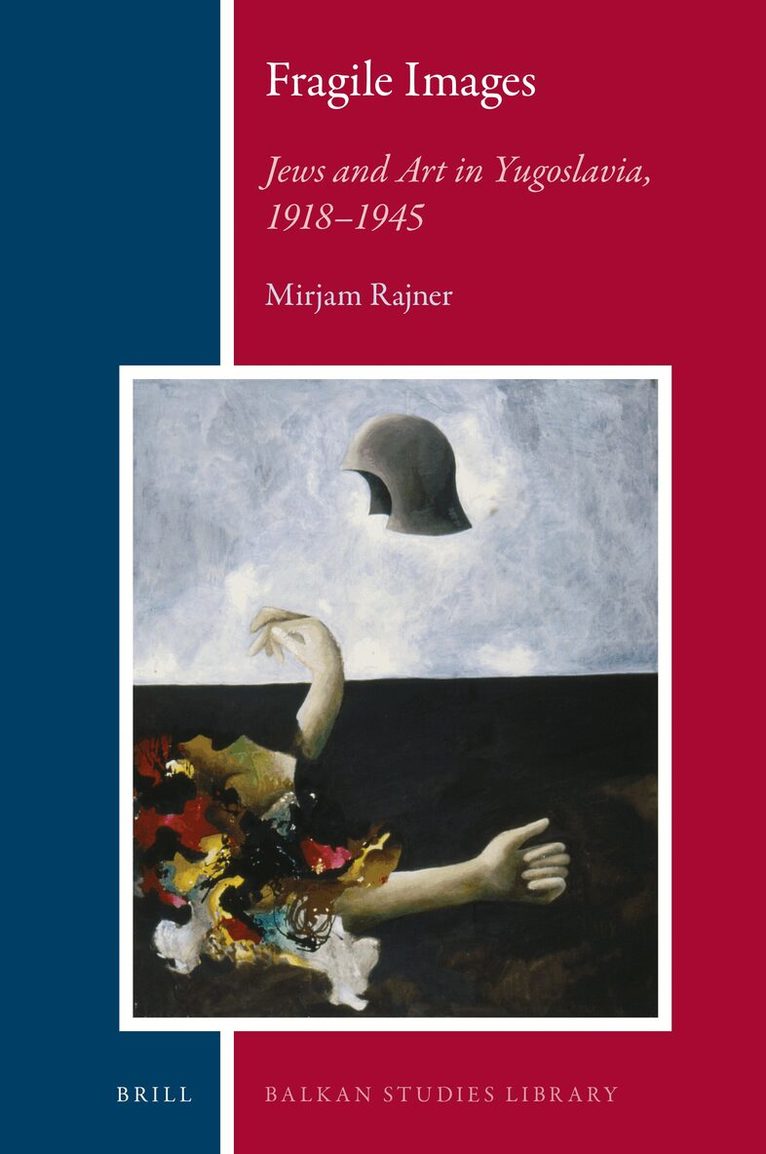
Fragile Images
Jews and Art in Yugoslavia, 1918-1945
Inbunden, Engelska, 2019
3 159 kr
Skickas inom 5-8 vardagar
In Fragile Images: Jews and Art in Yugoslavia, 1918-1945, Mirjam Rajner traces the lives and creativity of seven artists of Jewish origin. The artists - Moša Pijade, Daniel Kabiljo, Adolf Weiller, Bora Baruh, Daniel Ozmo, Ivan Rein and Johanna Lutzer - were characterized by multiple and changeable identities: nationalist and universalist, Zionist and Sephardic, communist and cosmopolitan.These fluctuating identities found expression in their art, as did their wartime fate as refugees, camp inmates, partisans and survivors. A wealth of newly-discovered images, diaries and letters highlight this little-known aspect of Jewish life and art in Yugoslavia, illuminating a turbulent era that included integration into a newly-founded country, the catastrophe of the Holocaust, and renewal in its aftermath.interview with the author