Mitchell H. Gail - Böcker
Visar alla böcker från författaren Mitchell H. Gail. Handla med fri frakt och snabb leverans.
6 produkter
6 produkter
Del 23 - Monographs in Epidemiology and Biostatistics
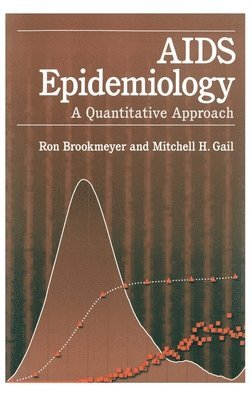
AIDS Epidemiology
A Quantitative Approach
Inbunden, Engelska, 1994
1 146 kr
Skickas inom 5-8 vardagar
AIDS has appeared in more than 130 countries, and over 100,000 cases of AIDS have been reported in the U.S. alone. More and more, the public will be depending on statisticians to provide answers about the future course of this epidemic. This comprehensive work confronts the problems that are unique to AIDS research and unites them under a single conceptual framework. It focuses on methods for the design and analysis of epidemiologic studies, the natural history of AIDS and the transmission of HIV, methods for tracking and projecting the course of the epidemic, and statistical issues in therapeutic trials. The various methods of monitoring and forecasting this disease receive comprehensive treatment. These methods include back-calculation, which the authors developed; interpretation of survey data on HIV prevalence; mathematical models for HIV transmission; and approaches that combine different types of epidemiological data. Much of this material -- such as a discussion of methods for assessing safety of the blood supply, an evaluation of survey approaches, and methods to project paediatric AIDS incidence -- is not available in any other work.This is an essential purchase for all AIDS investigators and epidemiologists.
704 kr
Skickas inom 10-15 vardagar
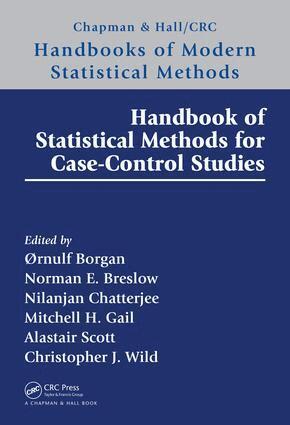
Handbook of Statistical Methods for Case-Control Studies is written by leading researchers in the field. It provides an in-depth treatment of up-to-date and currently developing statistical methods for the design and analysis of case-control studies, as well as a review of classical principles and methods. The handbook is designed to serve as a reference text for biostatisticians and quantitatively-oriented epidemiologists who are working on the design and analysis of case-control studies or on related statistical methods research. Though not specifically intended as a textbook, it may also be used as a backup reference text for graduate level courses.Book Sections:Classical designs and causal inference, measurement error, power, and small-sample inference Designs that use full-cohort informationTime-to-event dataGenetic epidemiology
Absolute Risk
Methods and Applications in Clinical Management and Public Health
Häftad, Engelska, 2020
745 kr
Skickas inom 10-15 vardagar
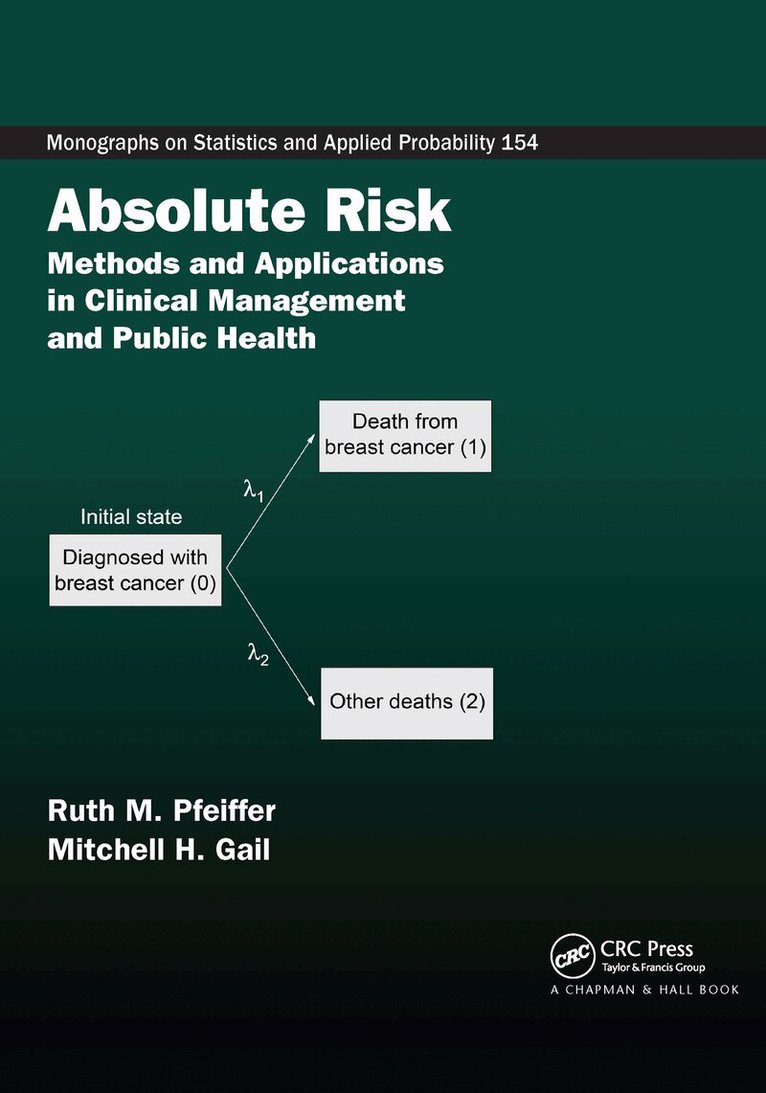
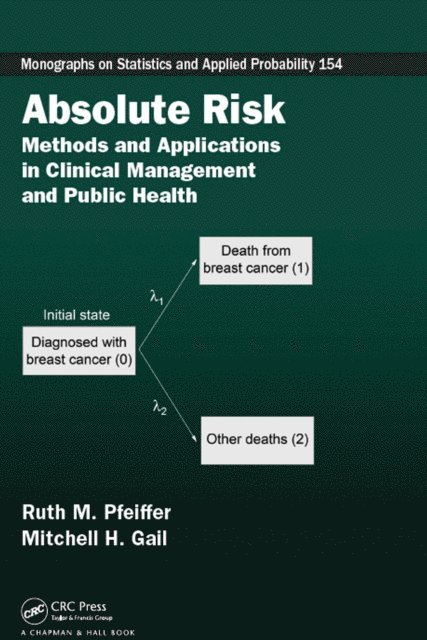
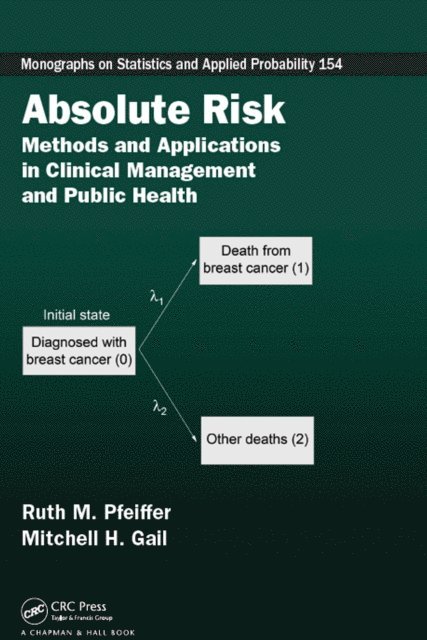
Absolute Risk: Methods and Applications in Clinical Management and Public Health provides theory and examples to demonstrate the importance of absolute risk in counseling patients, devising public health strategies, and clinical management. The book provides sufficient technical detail to allow statisticians, epidemiologists, and clinicians to build, test, and apply models of absolute risk. Features: Provides theoretical basis for modeling absolute risk, including competing risks and cause-specific and cumulative incidence regression Discusses various sampling designs for estimating absolute risk and criteria to evaluate models Provides details on statistical inference for the various sampling designs Discusses criteria for evaluating risk models and comparing risk models, including both general criteria and problem-specific expected losses in well-defined clinical and public health applications Describes many applications encompassing both disease prevention and prognosis, and ranging from counseling individual patients, to clinical decision making, to assessing the impact of risk-based public health strategies Discusses model updating, family-based designs, dynamic projections, and other topics Ruth M. Pfeiffer is a mathematical statistician and Fellow of the American Statistical Association, with interests in risk modeling, dimension reduction, and applications in epidemiology. She developed absolute risk models for breast cancer, colon cancer, melanoma, and second primary thyroid cancer following a childhood cancer diagnosis. Mitchell H. Gail developed the widely used "Gail model" for projecting the absolute risk of invasive breast cancer. He is a medical statistician with interests in statistical methods and applications in epidemiology and molecular medicine. He is a member of the National Academy of Medicine and former President of the American Statistical Association. Both are Senior Investigators in the Division of Cancer Epidemiology and Genetics, National Cancer Institute, National Institutes of Health.
9 904 kr
Skickas inom 7-10 vardagar
Featuring articles from the prestigious Encyclopedia of Biostatistics, many of which have been revised and updated to include recent developments, the Encyclopedia of Epidemiologic Methods also includes newly commissioned articles reflecting the latest thinking in Cancer RegistriesBirth Defect RegistriesMeta Analysis of Epidemiologic StudiesEpidemiology OverviewSample SizeSex Ratio at BirthSoftware Design and AnalysisFeaturing contributions from leading experts in academia, government and industry, the Encyclopedia of Epidemiologic Methods has been designed to complement existing texts on the subject by providing further extensive, up-to-date coverage of specialised topics and by introducing the reader to the research literature.Offering a wealth of information in a single resource, the Encyclopedia of Epidemiologic Methods Offers an excellent introduction to a vast array of specialised topicsIncludes in-depth coverage of the statistical underpinnings of contemporary epidemiologic methodsProvides concise definitions and introductions to numerous concepts found in the current literatureUses extensive cross-references, helping to facilitate further research, and enabling the reader to locate definitions and related conceptsIn addition to featuring extensive articles in the areas of descriptive and analytic epidemiology, the Encyclopedia also provides the reader with articles on case-control design and offers substantial coverage of allied statistical methods.
Absolute Risk
Methods and Applications in Clinical Management and Public Health
Inbunden, Engelska, 2017
1 080 kr
Skickas inom 10-15 vardagar
Absolute Risk: Methods and Applications in Clinical Management and Public Health provides theory and examples to demonstrate the importance of absolute risk in counseling patients, devising public health strategies, and clinical management. The book provides sufficient technical detail to allow statisticians, epidemiologists, and clinicians to build, test, and apply models of absolute risk. Features: Provides theoretical basis for modeling absolute risk, including competing risks and cause-specific and cumulative incidence regression Discusses various sampling designs for estimating absolute risk and criteria to evaluate models Provides details on statistical inference for the various sampling designs Discusses criteria for evaluating risk models and comparing risk models, including both general criteria and problem-specific expected losses in well-defined clinical and public health applications Describes many applications encompassing both disease prevention and prognosis, and ranging from counseling individual patients, to clinical decision making, to assessing the impact of risk-based public health strategies Discusses model updating, family-based designs, dynamic projections, and other topicsRuth M. Pfeiffer is a mathematical statistician and Fellow of the American Statistical Association, with interests in risk modeling, dimension reduction, and applications in epidemiology. She developed absolute risk models for breast cancer, colon cancer, melanoma, and second primary thyroid cancer following a childhood cancer diagnosis. Mitchell H. Gail developed the widely used "Gail model" for projecting the absolute risk of invasive breast cancer. He is a medical statistician with interests in statistical methods and applications in epidemiology and molecular medicine. He is a member of the National Academy of Medicine and former President of the American Statistical Association. Both are Senior Investigators in the Division of Cancer Epidemiology and Genetics, National Cancer Institute, National Institutes of Health.
1 679 kr
Skickas inom 10-15 vardagar
Handbook of Statistical Methods for Case-Control Studies is written by leading researchers in the field. It provides an in-depth treatment of up-to-date and currently developing statistical methods for the design and analysis of case-control studies, as well as a review of classical principles and methods. The handbook is designed to serve as a reference text for biostatisticians and quantitatively-oriented epidemiologists who are working on the design and analysis of case-control studies or on related statistical methods research. Though not specifically intended as a textbook, it may also be used as a backup reference text for graduate level courses. Book Sections Classical designs and causal inference, measurement error, power, and small-sample inference Designs that use full-cohort information Time-to-event data Genetic epidemiology About the EditorsØrnulf Borgan is Professor of Statistics, University of Oslo. His book with Andersen, Gill and Keiding on counting processes in survival analysis is a world classic.Norman E. Breslow was, at the time of his death, Professor Emeritus in Biostatistics, University of Washington. For decades, his book with Nick Day has been the authoritative text on case-control methodology.Nilanjan Chatterjee is Bloomberg Distinguished Professor, Johns Hopkins University. He leads a broad research program in statistical methods for modern large scale biomedical studies. Mitchell H. Gail is a Senior Investigator at the National Cancer Institute. His research includes modeling absolute risk of disease, intervention trials, and statistical methods for epidemiology.Alastair Scott was, at the time of his death, Professor Emeritus of Statistics, University of Auckland. He was a major contributor to using survey sampling methods for analyzing case-control data.Chris J. Wild is Professor of Statistics, University of Auckland. His research includes nonlinear regression and methods for fitting models to response-selective data.