Mona Simion - Böcker
Visar alla böcker från författaren Mona Simion. Handla med fri frakt och snabb leverans.
9 produkter
9 produkter
1 091 kr
Skickas inom 5-8 vardagar
Shifty Speech and Independent Thought is a manifesto for epistemic independence: the independence of good thinking from practical considerations. Mona Simion defends the independence of thought from the most prominent threat that has surfaced in the last twenty years of epistemological theorizing: the phenomenon of shiftiness of proper assertoric speech with practical context.This study does four things: firstly, it shows that, against orthodoxy, the argument from practical shiftiness of proper assertoric speech against the independence of proper thought from the practical does not go through, for it rests on normative ambiguation. Secondly, it defends a proper functionalist knowledge account of the epistemic normativity of assertion, in conjunction with classical invariantism about knowledge attributions. Thirdly, it develops the first integrated account of the normativity of constative speech. Lastly, it defends detailed normative accounts for conjecturing, telling, and moral assertion.
1 240 kr
Skickas inom 5-8 vardagar
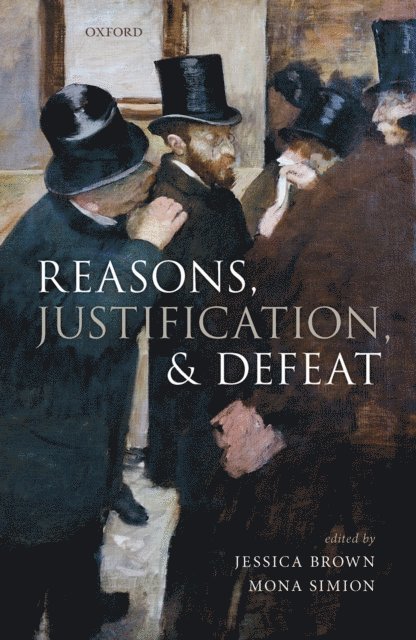
Traditionally, the notion of defeat has been central to epistemology, practical reasoning, and ethics. Within epistemology, it is standardly assumed that a subject who knows that p, or justifiably believes that p, can lose this knowledge or justified belief by acquiring a so-called 'defeater', whether that is evidence that not-p, evidence that the process that produced her belief is unreliable, or evidence that she has likely misevaluated her own evidence. Within ethics and practical reasoning, it is widely accepted that a subject may initially have a reason to do something although this reason is later defeated by her acquisition of further information. However, the traditional conception of defeat has recently come under attack. Some have argued that the notion of defeat is problematically motivated; others that defeat is hard to accommodate within externalist or naturalistic accounts of knowledge or justification; and still others that the intuitions that support defeat can be explained in other ways. This volume presents new work re-examining the very notion of defeat, and its place in epistemology and in normativity theory at large.
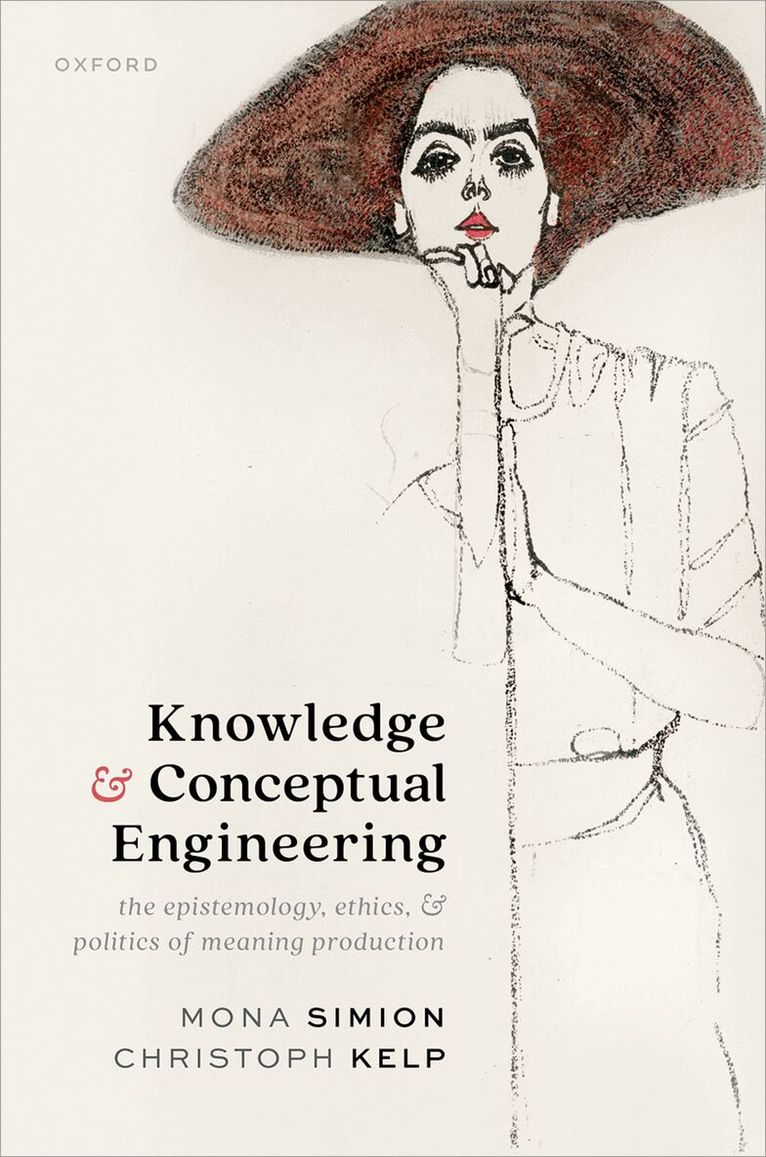
Knowledge and Conceptual Engineering
The Epistemology, Ethics, and Politics of Meaning Production
Inbunden, Engelska, 2026
1 051 kr
Skickas inom 5-8 vardagar
Suppose you could change people's way of thinking about the world at its very roots, by changing the very concepts by means of which they think. Suppose, further, that this would make the world a better place; that would be quite something. Knowledge and Conceptual Engineering is a comprehensive and systematic study of the nature and normativity of conceptual engineering. This book comprehensively deals with all the central questions in the field: the very possibility of conceptual engineering, its success conditions, the epistemic and moral permissibility of conceptual engineering, the nature of conceptual ignorance and conceptual understanding, and duties to engage in conceptual engineering. It also considers the political aspects, such as engineering social kind concepts, the nature of hermeneutical injustice, and conceptual disinformation. Mona Simion and Christoph Kelp develop a systemic and unified framework centred on conceptual functions, and espouse a functionalist approach that is wholeheartedly optimistic, in that it takes conceptual engineering to be something that we can and should do.
310 kr
Skickas inom 7-10 vardagar
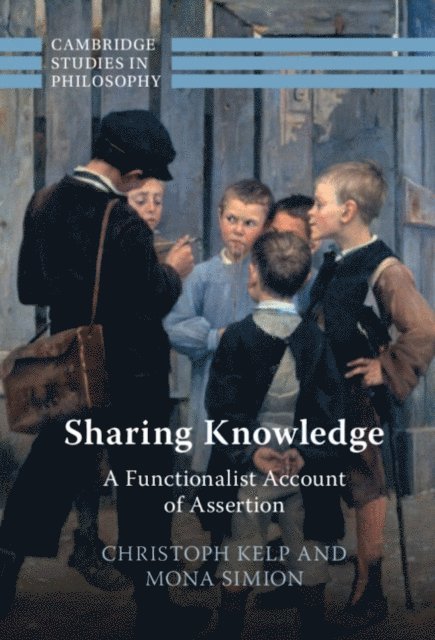
Assertion is the central vehicle for the sharing of knowledge. Whether knowledge is shared successfully often depends on the quality of assertions: good assertions lead to successful knowledge sharing, while bad ones don't. In Sharing Knowledge, Christoph Kelp and Mona Simion investigate the relation between knowledge sharing and assertion, and develop an account of what it is to assert well. More specifically, they argue that the function of assertion is to share knowledge with others. It is this function that supports a central norm of assertion according to which a good assertion is one that has the disposition to generate knowledge in others. The book uses this functionalist approach to motivate further norms of assertion on both the speaker and the hearer side and investigates ramifications of this view for other questions about assertion.
310 kr
Skickas inom 7-10 vardagar
We have increasingly sophisticated ways of acquiring and communicating knowledge, but efforts to spread this knowledge often encounter resistance to evidence. The phenomenon of resistance to evidence, while subject to thorough investigation in social psychology, is acutely under-theorised in the philosophical literature. Mona Simion's book is concerned with positive epistemology: it argues that we have epistemic obligations to update and form beliefs on available and undefeated evidence. In turn, our resistance to easily available evidence is unpacked as an instance of epistemic malfunctioning. Simion develops a full positive, integrated epistemological picture in conjunction with novel accounts of evidence, defeat, norms of inquiry, permissible suspension, and disinformation. Her book is relevant for anyone with an interest in the nature of evidence and justified belief and in the best ways to avoid the high-stakes practical consequences of evidence resistance in policy and practice. This title is also available as Open Access on Cambridge Core.
1 126 kr
Skickas inom 7-10 vardagar
We have increasingly sophisticated ways of acquiring and communicating knowledge, but efforts to spread this knowledge often encounter resistance to evidence. The phenomenon of resistance to evidence, while subject to thorough investigation in social psychology, is acutely under-theorised in the philosophical literature. Mona Simion's book is concerned with positive epistemology: it argues that we have epistemic obligations to update and form beliefs on available and undefeated evidence. In turn, our resistance to easily available evidence is unpacked as an instance of epistemic malfunctioning. Simion develops a full positive, integrated epistemological picture in conjunction with novel accounts of evidence, defeat, norms of inquiry, permissible suspension, and disinformation. Her book is relevant for anyone with an interest in the nature of evidence and justified belief and in the best ways to avoid the high-stakes practical consequences of evidence resistance in policy and practice. This title is also available as Open Access on Cambridge Core.
753 kr
Skickas inom 7-10 vardagar
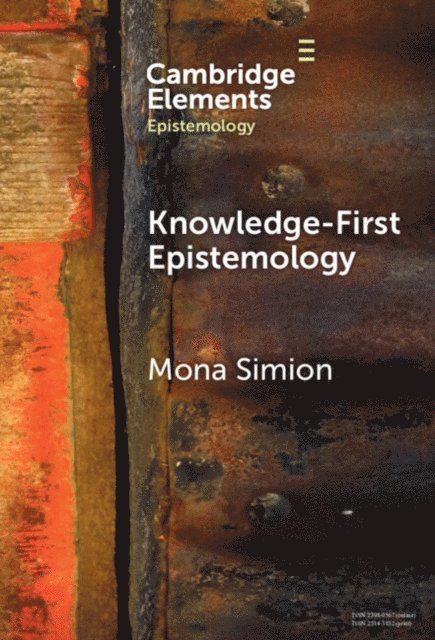
Knowledge-first epistemology places knowledge at the normative core of epistemological affairs: on this approach, central epistemic phenomena are to be analyzed in terms of knowledge. This Element offers a defence of an integrated, naturalistic knowledge-first account of justified belief, reasons, evidence and defeat, permissible assertion and action, and the epistemic normativity of practical and theoretical reasoning. On this account, the epistemic is an independent normative domain organized around one central etiological epistemic function: generating knowledge. In turn, this epistemic function generates epistemic norms of proper functioning that constitute the epistemic domain, and govern moves in our epistemic practice, such as forming beliefs, asserting, and reasoning. This title is also available as Open Access on Cambridge Core.
234 kr
Skickas inom 7-10 vardagar
Knowledge-first epistemology places knowledge at the normative core of epistemological affairs: on this approach, central epistemic phenomena are to be analyzed in terms of knowledge. This Element offers a defence of an integrated, naturalistic knowledge-first account of justified belief, reasons, evidence and defeat, permissible assertion and action, and the epistemic normativity of practical and theoretical reasoning. On this account, the epistemic is an independent normative domain organized around one central etiological epistemic function: generating knowledge. In turn, this epistemic function generates epistemic norms of proper functioning that constitute the epistemic domain, and govern moves in our epistemic practice, such as forming beliefs, asserting, and reasoning. This title is also available as Open Access on Cambridge Core.
1 034 kr
Skickas inom 7-10 vardagar
Assertion is the central vehicle for the sharing of knowledge. Whether knowledge is shared successfully often depends on the quality of assertions: good assertions lead to successful knowledge sharing, while bad ones don't. In Sharing Knowledge, Christoph Kelp and Mona Simion investigate the relation between knowledge sharing and assertion, and develop an account of what it is to assert well. More specifically, they argue that the function of assertion is to share knowledge with others. It is this function that supports a central norm of assertion according to which a good assertion is one that has the disposition to generate knowledge in others. The book uses this functionalist approach to motivate further norms of assertion on both the speaker and the hearer side and investigates ramifications of this view for other questions about assertion.