Monique Teillaud - Böcker
Visar alla böcker från författaren Monique Teillaud. Handla med fri frakt och snabb leverans.
3 produkter
3 produkter
1 064 kr
Skickas inom 10-15 vardagar
Computational geometry emerged as a discipline in the seventies and has had considerable success in improving the asymptotic complexity of the solutions tobasicgeometricproblemsincludingconstructionsofdatastructures,convex hulls, triangulations, Voronoi diagrams and geometric arrangements as well as geometric optimisation. However, in the mid-nineties, it was recognized that the computational geometry techniques were far from satisfactory in practice and a vigorous e?ort has been undertaken to make computational geometry more practical. This e?ort led to major advances in robustness, geometric software engineering and experimental studies, and to the development of a large library of computational geometry algorithms, Cgal. The goal of this book is to take into consideration the multidisciplinary nature of the problem and to provide solid mathematical and algorithmic foundationsfore?ectivecomputationalgeometryforcurvesandsurfaces. This book covers two main approaches. In a ?rst part, we discuss exact geometric algorithms for curves and s- faces. We revisit two prominent data structures of computational geometry, namely arrangements (Chap. 1) and Voronoi diagrams (Chap. 2) in order to understand how these structures, which are well-known for linear objects, behave when de?ned on curved objects. The mathematical properties of these structures are presented together with algorithms for their construction. To ensure the e?ectiveness of our algorithms, the basic numerical computations that need to be performed are precisely speci?ed, and tradeo?s are considered between the complexity of the algorithms (i. e. the number of primitive calls), and the complexity of the primitives and their numerical stability. Chap.
551 kr
Skickas inom 10-15 vardagar
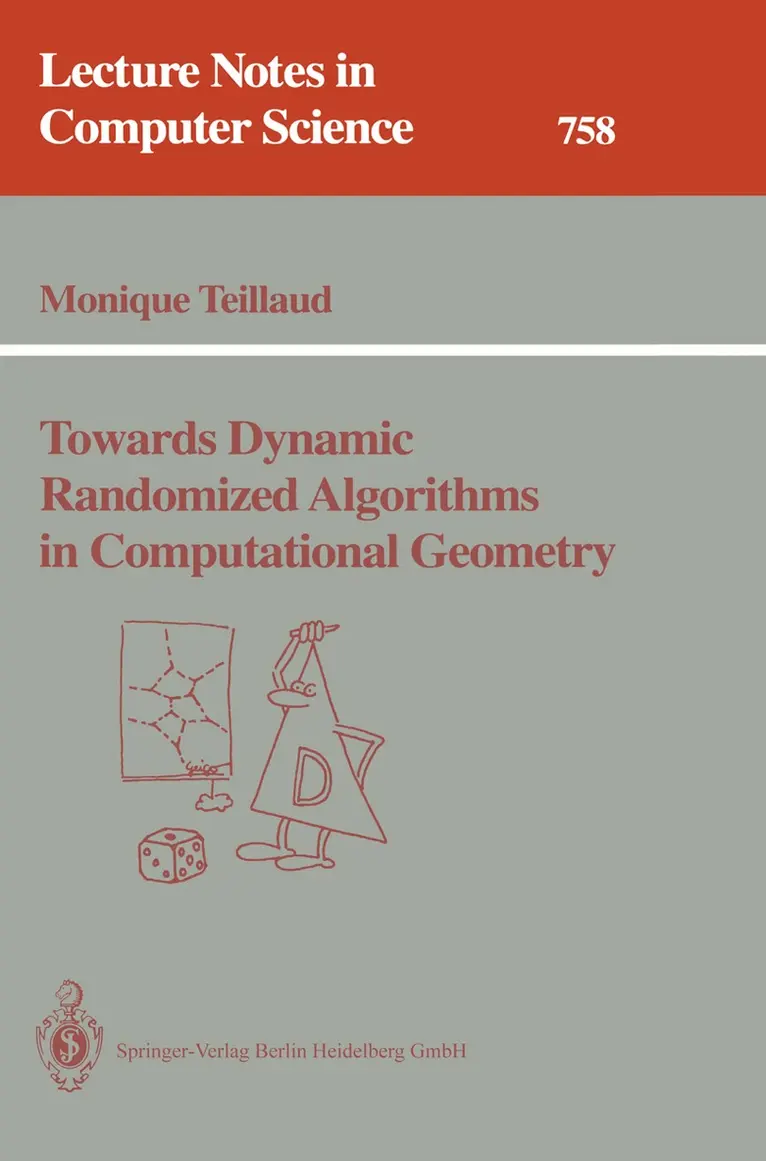
Computational geometry concerns itself with designing andanalyzing algorithms for solving geometric problems. Thefield has reached a high level of sophistication, and verycomplicated algorithms have been designed. However, it isalso useful to develop more practical algorithms, so long asthey are based on rigorous methods. One such method is theuse of randomized algorithms. These algorithms have becomemore and more popular, turning into one of the hottest areasof recent years. Dynamic algorithms are particularlyinteresting because in practice the data of a problem areoften acquired progressively. In this monograph the authorstudies the theoretical complexity and practical efficiencyof randomized dynamic algorithms.
1 064 kr
Skickas inom 10-15 vardagar
Computational geometry emerged as a discipline in the seventies and has had considerable success in improving the asymptotic complexity of the solutions tobasicgeometricproblemsincludingconstructionsofdatastructures,convex hulls, triangulations, Voronoi diagrams and geometric arrangements as well as geometric optimisation. However, in the mid-nineties, it was recognized that the computational geometry techniques were far from satisfactory in practice and a vigorous e?ort has been undertaken to make computational geometry more practical. This e?ort led to major advances in robustness, geometric software engineering and experimental studies, and to the development of a large library of computational geometry algorithms, Cgal. The goal of this book is to take into consideration the multidisciplinary nature of the problem and to provide solid mathematical and algorithmic foundationsfore?ectivecomputationalgeometryforcurvesandsurfaces. This book covers two main approaches. In a ?rst part, we discuss exact geometric algorithms for curves and s- faces. We revisit two prominent data structures of computational geometry, namely arrangements (Chap. 1) and Voronoi diagrams (Chap. 2) in order to understand how these structures, which are well-known for linear objects, behave when de?ned on curved objects. The mathematical properties of these structures are presented together with algorithms for their construction. To ensure the e?ectiveness of our algorithms, the basic numerical computations that need to be performed are precisely speci?ed, and tradeo?s are considered between the complexity of the algorithms (i. e. the number of primitive calls), and the complexity of the primitives and their numerical stability. Chap.