Morton D. Paley - Böcker
Visar alla böcker från författaren Morton D. Paley. Handla med fri frakt och snabb leverans.
8 produkter
8 produkter
152 kr
Skickas
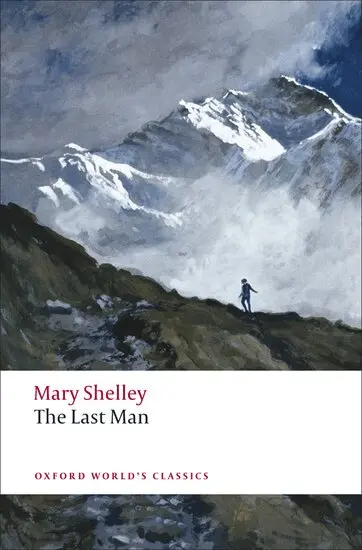
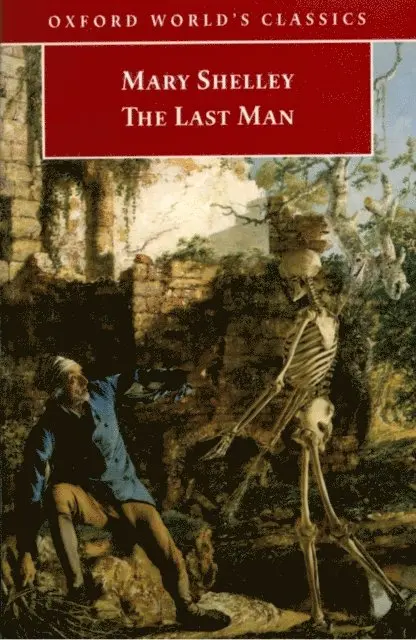
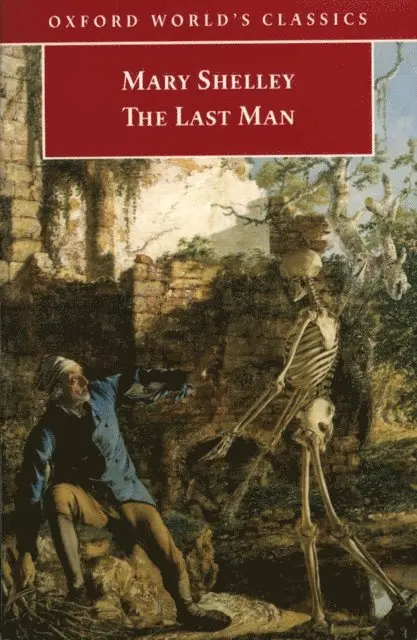
'The last man! I may well describe that solitary being's feelings, feeling myself as the last relic of a beloved race, my companions extinct before me.' Mary Shelley, Journal (May 1824). Best remembered as the author of Frankenstein, Mary Shelley wrote The Last Man eight years later, on returning to England from Italy after her husband's death. It is the twenty-first century, and England is a republic governed by a ruling elite, one of whom, Adrian, Earl of Windsor, has introduced a Cumbrian boy to the circle. This outsider, Lionel Verney, narrates the story, a tale of complicated, tragic love, and of the gradual extermination of the human race by plague. The Last Man also functions as an intriguing roman à clef, for the saintly Adrian is a monument to Percy Bysshe Shelley, and his friend Lord Raymond is a portrait of Byron. The novel offers a vision of the future that expresses a reaction against Romanticism, as Shelley demonstrates the failure of the imagination and of art to redeem her doomed characters. ABOUT THE SERIES: For over 100 years Oxford World's Classics has made available the widest range of literature from around the globe. Each affordable volume reflects Oxford's commitment to scholarship, providing the most accurate text plus a wealth of other valuable features, including expert introductions by leading authorities, helpful notes to clarify the text, up-to-date bibliographies for further study, and much more.
3 793 kr
Skickas inom 7-10 vardagar
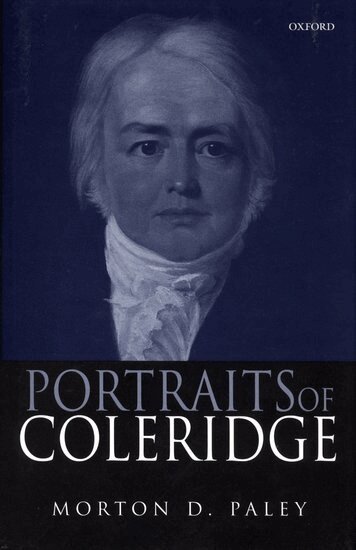
What do the portraits of a great poet tell us about his life, his image of himself, and the ideas of him held by his friends and his public? Portraits of Coleridge attempts to answer this question with respect to the author of `The Rime of the Ancient Mariner' and `Kubla Khan'. It also provides a critical and scholarly study of the portraits as works of art, considering the place of each in the career of the artist who produced it. All the life portraits are discussed in detail, catalogued, and (wherever there is an extant photograph) reproduced. As many verbal descriptions by contemporaries as possible are reprinted for the sake of comparison. A concluding essay on posthumous portraits of Coleridge considers how they reflect changes in the public's attitude toward their subject. Both a contribution to the biography of Coleridge and an essay in the history of literary and artistic taste, this book is for readers interested in English poetry, in Romantic portraiture, and in the relationship between literature and the visual arts.
1 929 kr
Skickas inom 3-6 vardagar
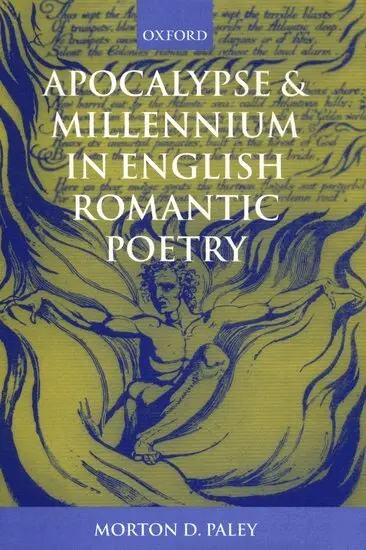
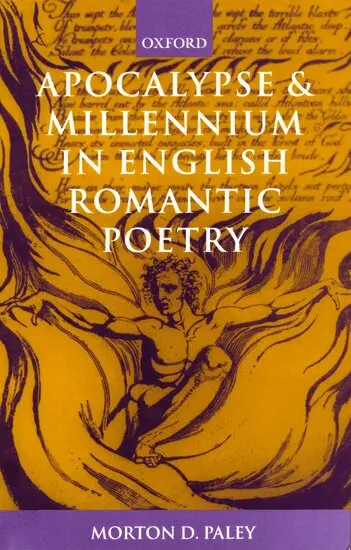
The interrelationship of the ideas of apocalypse and millennium is a dominant concern of British Romanticism. The Book of Revelation provides a model of history in which apocalypse is followed by millennium, but in their various ways the major Romantic poets - Blake, Wordsworth, Coleridge, Byron, Keats, and Shelley - question and even at times undermine the possibility of a successful secularization of this model. No matter how confidently the sequence of apocalypse and millennium seems to be affirmed in some of the major works of the period, the issue is always in doubt: the fear that millennium may not ensue emerges as a significant, if often repressed, theme in the great works of the period. Related to it is the tension in Romantic poetry between conflicting models of history itself: history as teleology, developing towards end time and millennium, and history as purposeless cycle. This subject-matter is traced through a selection of works by the major poets, partly through an exposition of their underlying intellectual traditions, and partly through a close examination of the poems themselves.
803 kr
Skickas inom 7-10 vardagar
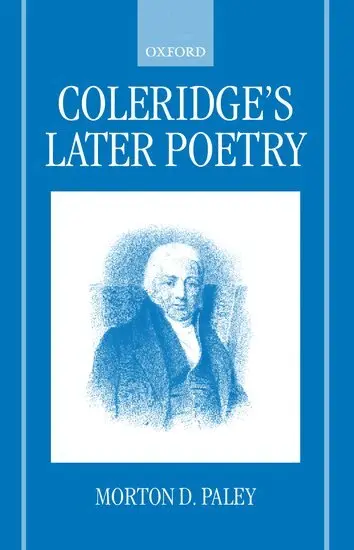
The poems that Coleridge wrote after his golden period are seldom studied or anthologized. Yet among the poems written after his most famous works are many of quality and interest, addressing such universal themes as the nature of the self and the experience of unfulfilled love. Paley examines the later verse in the context of Coleridge's oeuvre, discusses what characterizes it, and looks at why the poet felt he had to develop distinctively different modes of writing for these works. To William Wordsworth is presented as a transitional poem, exhibiting the vatic quality of earlier poems even while declaring that this quality must be abandoned. Morton D. Paley then explores the poetry of the abyss (which he terms The Limbo Constellation), and this is followed by poems on the theme of the self and of love. The last chapter examines the role of epitaphs in the later works, culminating in a study of the epitaph which Coleridge wrote for himself.
827 kr
Skickas inom 3-6 vardagar
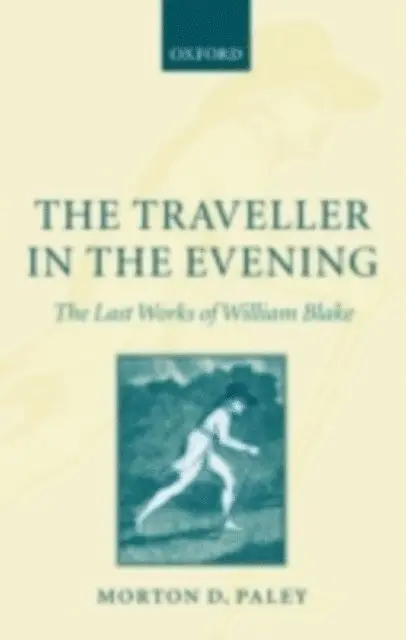
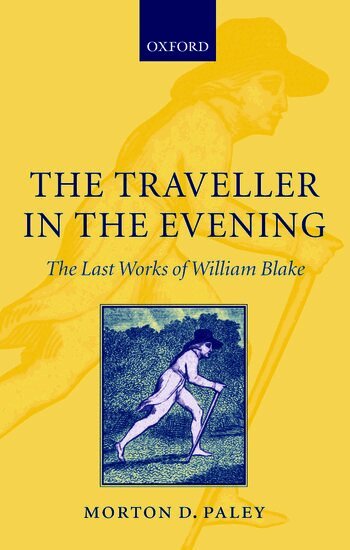
There has never been a book about Blake's last period, from his meeting with John Linnell in 1818 to his death in 1827, although it includes some of his greatest works. In The Traveller in the Evening, Morton Paley argues that this late phase involves attitudes, themes, and ideas that are either distinctively new or different in emphasis from what preceded them. After an introduction on Blake and his milieu during this period, Paley begins with a chapter on Blake's illustrations to Thornton's edition of Virgil. Paley relates these to Blake's complex view of pastoral, before proceeding to a history of the project, its near-abortion, and its fulfillment as Blake's one of greatest accomplishments as an illustrator. In Yah and His Two Sons the presentation of the divine, except where it is associated with art, is ambiguous where it is not negative. Paley takes up this separate plate in the context of artists's representations of the Laocoön that would have been known to Blake, and also of what Blake would have known of its history from classical antiquity to his own time. Blake's Dante water colours and engravings are the most ambitious accomplishment of the last years of his life, and Paley shows that the problematic nature of some of these pictures, with Beatrice Addressing Dante from the Car as a main example, arises from Blake's own divided and sharply polarized attitude toward Dante's Comedy. The closing chapter, called 'Blake's Bible', is on the Bible-related designs and writings of Blake's last years. Paley discusses The Death of Abel (addressed to Lord Byron 'in the Wilderness') as a response to its literary forerunners, especially Gessner's Death of Abel and Byron's Cain. For the Job engravings Paley shows how the border designs and the marginal texts set up a dialogue with the main illustrations unlike anything in Blake's Job water colours on the same subjects. Also included here are Blake's last pictorial work on a Biblical subject, The Genesis manuscript, and Blake's last writing on a Biblical text, his vitriolic comments on Thornton's translations of the Lord's Prayer.
1 861 kr
Skickas inom 5-8 vardagar
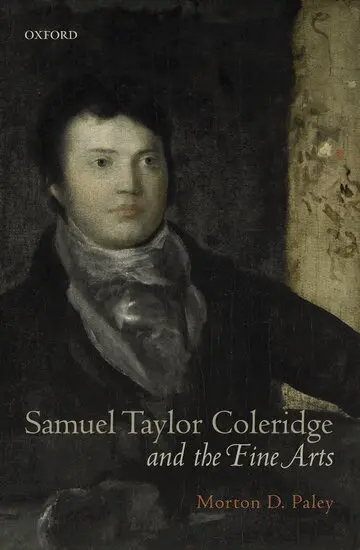
Although Coleridge's thinking and writing about the fine arts was both considerable and interesting, this has not been the subject of a book before.Coleridge owed his initiation into art to Sir George Beaumont. In 1803-4 he had frequent opportunities to learn from Beaumont, to study Beaumont's small but elegant collection and to visit private collections. Before leaving for Malta in April 1804, Coleridge wrote 'I have learnt as much fr[om] Sir George Beaumont respecting Pictures & Painting and Paint[ers as] I ever learnt on any subject from any man in the same Space of Time.'In Italy in 1806, Coleridge's experience of art deepened, thanks to the American artist Washington Allston, who taught him to see the artistic sights of Rome with a painter's eye. Coleridge also visited Florence and Pisa, and later said of the frescoes in Pisa's Camp Santo: 'The impression was greater, I may say, than that any poem ever made upon me.'Back in England, Coleridge visited London exhibitions, country house collections, and even artists' studios. In 1814, both Coleridge and Allston were in Bristol - Coleridge lecturing, Allston exhibiting. Coleridge's 'On the Principles of Genial Criticism' began as a defense of Allston's paintings but became a statement about all the arts. This book, an important contribution to Coleridge's intellectual biography, will make readers aware of a dimension of his thinking that has been largely ignored until now.
3 223 kr
Skickas inom 5-8 vardagar
There has never been a book about Blake's last period, from his meeting with John Linnell in 1818 to his death in 1827, although it includes some of his greatest works. In The Traveller in the Evening, Morton Paley argues that this late phase involves attitudes, themes, and ideas that are either distinctively new or different in emphasis from what preceded them.After an introduction on Blake and his milieu during this period, Paley begins with a chapter on Blake's illustrations to Thornton's edition of Virgil. Paley relates these to Blake's complex view of pastoral, before proceeding to a history of the project, its near-abortion, and its fulfillment as one of Blake's greatest accomplishments as an illustrator. In Yah and His Two Sons the presentation of the divine, except where it is associated with art, is ambiguous where it is not negative. Paley takes up this separate plate in the context of artists's representations of the Laocoon that would have been known to Blake, and also of what Blake would have known of its history from classical antiquity to his own time. Blake's Dante water colours and engravings are the most ambitious accomplishment of the last years of his life, and Paley shows that the problematic nature of some of these pictures, with Beatrice Addressing Dante from the Car as a main example, arises from Blake's own divided and sharply polarized attitude toward Dante's Comedy.The closing chapter, called 'Blake's Bible', is on the Bible-related designs and writings of Blake's last years. Paley discusses The Death of Abel (addressed to Lord Byron 'in the Wilderness') as a response to its literary forerunners, especially Gessner's Death of Abel and Byron's Cain. For the Job engravings Paley shows how the border designs and the marginal texts set up a dialogue with the main illustrations unlike anything in Blake's Job water colours on the same subjects. Also included here are Blake's last pictorial work on a Biblical subject, The Genesis manuscript, and Blake's last writing on a Biblical text, his vitriolic comments on Thornton's translations of the Lord's Prayer.
1 059 kr
Skickas inom 5-8 vardagar
The interrelationship of the ideas of apocalypse and millennium is a dominant concern of British Romanticism. The Book of Revelation provides a model of history in which apocalypse is followed by millennium, but in their various ways the major Romantic poets - Blake, Wordsworth, Coleridge, Byron, Keats, and Shelley - question and even at times undermine the possibility of a successful secularization of this model. No matter how confidently the sequence of apocalypse and millennium seems to be affirmed in some of the major works of the period, the issue is always in doubt: the fear that millennium may not ensue emerges as a significant, if often repressed, theme in the great works of the period. Related to it is the tension in Romantic poetry between conflicting models of history itself: history as teleology, developing towards end time and millennium, and history as purposeless cycle. This subject-matter is traced through a selection of works by the major poets, partly through an exposition of their underlying intellectual traditions, and partly through a close examination of the poems themselves.