Mustafa Mughazy – författare
Visar alla böcker från författaren Mustafa Mughazy. Handla med fri frakt och snabb leverans.
4 produkter
4 produkter
523 kr
Skickas inom 7-10 vardagar
"Translation is like a reverse-engineering process -- whereby, say, we might take apart a clock made of metal parts in order to build a functioning replica made entirely of plastic. Our final product will not look the same as the original clock, and it would be impossible to simply copy the designs of its inner workings, because plastic and metals have very different properties. For example, we cannot make small plastic springs or very thin gears of plastic. But these changes do not matter; the only thing that matters is that our replica will tell the time correctly." -- From the Introduction The Georgetown Guide to Arabic-English Translation is an essential step-by-step, practical manual for advanced learners of Arabic interested in how to analyze and accurately translate nonfiction Arabic texts ranging from business correspondence to textbooks. Mustafa Mughazy, a respected Arabic linguist, presents an innovative, functional approach that de-emphasizes word-for-word translation.Based on the Optimality Theory, it favors remaining faithful to the communicative function of the source material, even if this means adding explanatory text, reconfiguring sentences, paraphrasing expressions, or omitting words. From how to select a text for translation or maintain tense or idiom, to how to establish translation patterns, The Georgetown Guide to Arabic-English Translation is useful both as a textbook and a reference. An invaluable set of appendices offers shortcuts to translate particularly difficult language like abbreviations, collocations, and common expressions in business correspondence, while authentic annotated texts provide the reader opportunities to practice the strategies presented in the book. A must-read for advanced learners of Arabic, this is a book every scholar and graduate-level student will wish to own.
1 919 kr
Skickas inom 5-8 vardagar
"Translation is like a reverse-engineering process -- whereby, say, we might take apart a clock made of metal parts in order to build a functioning replica made entirely of plastic. Our final product will not look the same as the original clock, and it would be impossible to simply copy the designs of its inner workings, because plastic and metals have very different properties. For example, we cannot make small plastic springs or very thin gears of plastic. But these changes do not matter; the only thing that matters is that our replica will tell the time correctly." -- From the Introduction The Georgetown Guide to Arabic-English Translation is an essential step-by-step, practical manual for advanced learners of Arabic interested in how to analyze and accurately translate nonfiction Arabic texts ranging from business correspondence to textbooks. Mustafa Mughazy, a respected Arabic linguist, presents an innovative, functional approach that de-emphasizes word-for-word translation.Based on the Optimality Theory, it favors remaining faithful to the communicative function of the source material, even if this means adding explanatory text, reconfiguring sentences, paraphrasing expressions, or omitting words. From how to select a text for translation or maintain tense or idiom, to how to establish translation patterns, The Georgetown Guide to Arabic-English Translation is useful both as a textbook and a reference. An invaluable set of appendices offers shortcuts to translate particularly difficult language like abbreviations, collocations, and common expressions in business correspondence, while authentic annotated texts provide the reader opportunities to practice the strategies presented in the book. A must-read for advanced learners of Arabic, this is a book every scholar and graduate-level student will wish to own.
2 612 kr
Kommande
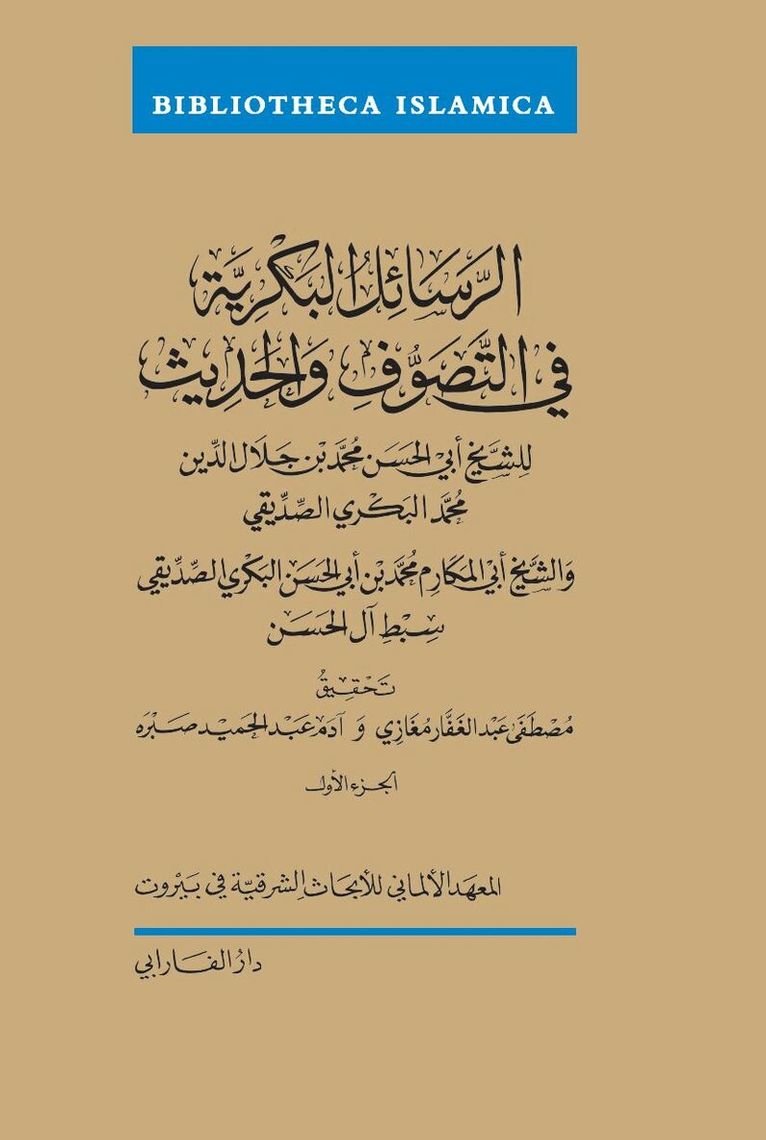
These two volumes offer a collection of the short treatises of two influential Egyptian religious scholars of the sixteenth century. Abū al-Ḥasan Muḥammad al-Bakrī (898-952/1492-1545) and his son Muḥammad ibn Abī al-Ḥasan al-Bakrī al-Ṣiddīqī Sibṭ Āl al-Ḥasan (930-94/1524-86), who lived between Cairo and Mecca, authored numerous texts on Sufism and Ḥadīth. Abū al-Ḥasan’s works include forty-eight collections of forty ḥadīths, a work on voluntary poverty, an early defense of the consumption of coffee in Sufi ritual, his Ḥizb and his Waṣīya. Muḥammad al-Bakrī’s treatises focus on spiritual instruction, the ritual of samāʿ, Sufi theology, including the author’s rejection of waḥdat al-wujūd, commentary on poems by Ibn al-Fāriḍ and ʿAlī Wafā, and a number of prayers, especially for the Prophet, among other topics. Together they provide insights into the religious trends current in the Arabophone provinces of the Ottoman Empire in the sixteenth century. Furthermore, since the Bakrīs were revered from West Africa to South Asia, these texts are important for the study of the early modern Islamic cosmopolis.
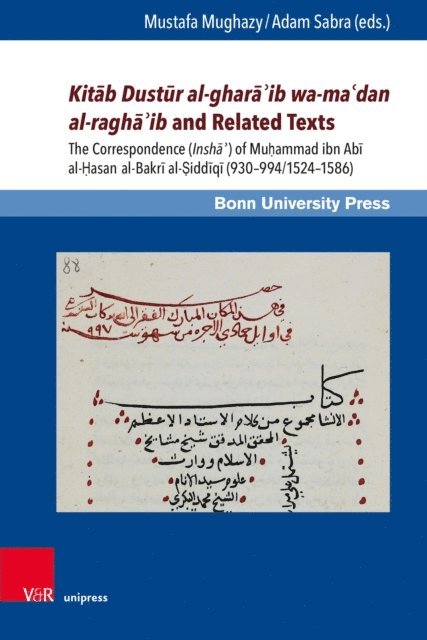
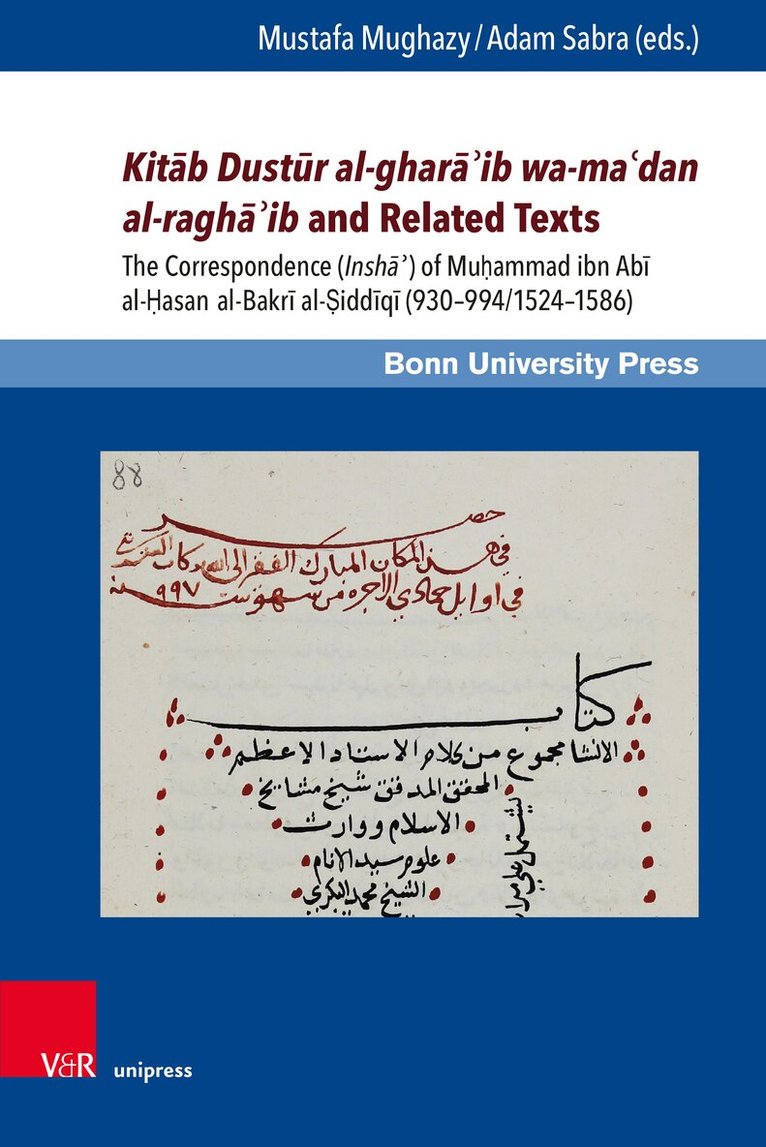
Kitāb Dustūr al-gharāʾib wa-maʿdan al-raghāʾib and Related Texts
The Correspondence (Inshāʾ) of Muḥammad ibn Abī al-Ḥasan al-Bakrī al-Ṣiddīqī (930–994/1524–1586)
Inbunden, Engelska, 2020
1 111 kr
Skickas inom 11-20 vardagar