Nagarajan Ranganathan - Böcker
Visar alla böcker från författaren Nagarajan Ranganathan. Handla med fri frakt och snabb leverans.
3 produkter
3 produkter
1 588 kr
Skickas inom 10-15 vardagar
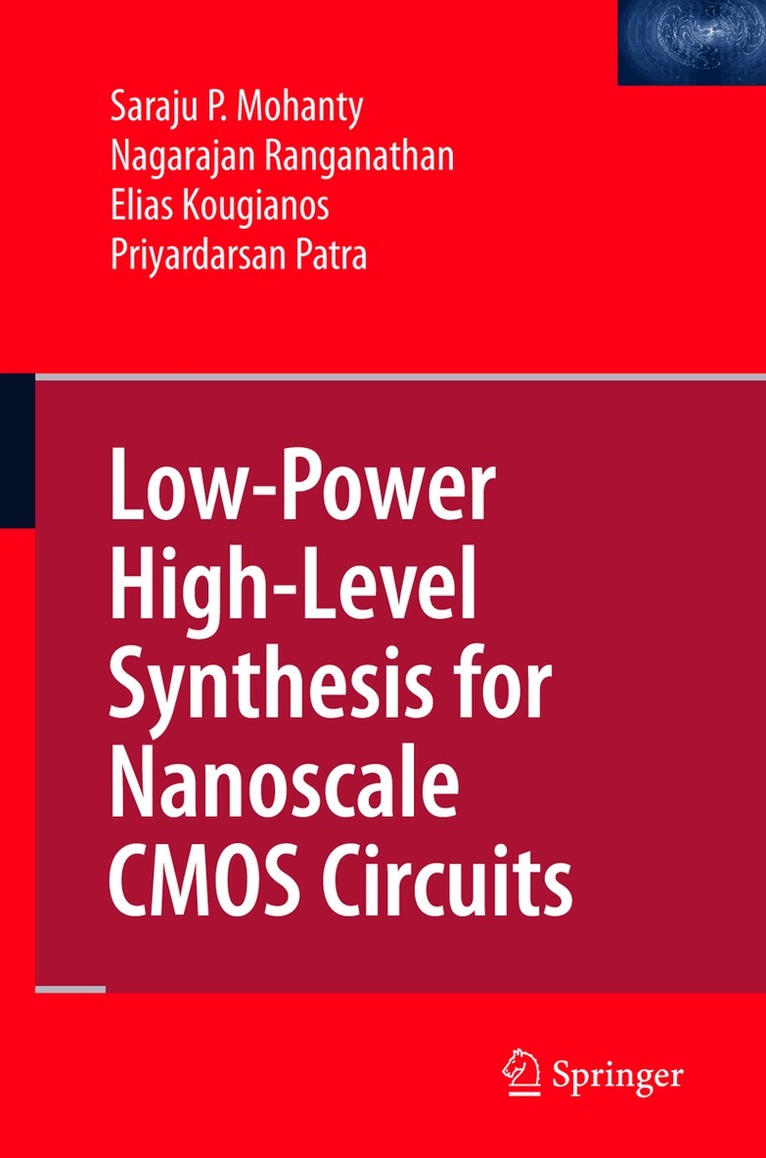
Low-Power High-Level Synthesis for Nanoscale CMOS Circuits addresses the need for analysis, characterization, estimation, and optimization of the various forms of power dissipation in the presence of process variations of nano-CMOS technologies. The authors show very large-scale integration (VLSI) researchers and engineers how to minimize the different types of power consumption of digital circuits. The material deals primarily with high-level (architectural or behavioral) energy dissipation because the behavioral level is not as highly abstracted as the system level nor is it as complex as the gate/transistor level. At the behavioral level there is a balanced degree of freedom to explore power reduction mechanisms, the power reduction opportunities are greater, and it can cost-effectively help in investigating lower power design alternatives prior to actual circuit layout or silicon implementation.The book is a self-contained low-power, high-level synthesis text for Nanoscale VLSI design engineers and researchers. Each chapter has simple relevant examples for a better grasp of the principles presented. Several algorithms are given to provide a better understanding of the underlying concepts. The initial chapters deal with the basics of high-level synthesis, power dissipation mechanisms, and power estimation. In subsequent parts of the text, a detailed discussion of methodologies for the reduction of different types of power is presented including: • Power Reduction Fundamentals• Energy or Average Power Reduction• Peak Power Reduction• Transient Power Reduction• Leakage Power ReductionLow-Power High-Level Synthesis for Nanoscale CMOS Circuits provides a valuable resource for the design of low-power CMOS circuits.
1 585 kr
Skickas inom 10-15 vardagar
Low-Power High-Level Synthesis for Nanoscale CMOS Circuits addresses the need for analysis, characterization, estimation, and optimization of the various forms of power dissipation in the presence of process variations of nano-CMOS technologies. The authors show very large-scale integration (VLSI) researchers and engineers how to minimize the different types of power consumption of digital circuits. The material deals primarily with high-level (architectural or behavioral) energy dissipation because the behavioral level is not as highly abstracted as the system level nor is it as complex as the gate/transistor level. At the behavioral level there is a balanced degree of freedom to explore power reduction mechanisms, the power reduction opportunities are greater, and it can cost-effectively help in investigating lower power design alternatives prior to actual circuit layout or silicon implementation.The book is a self-contained low-power, high-level synthesis text for Nanoscale VLSI design engineers and researchers. Each chapter has simple relevant examples for a better grasp of the principles presented. Several algorithms are given to provide a better understanding of the underlying concepts. The initial chapters deal with the basics of high-level synthesis, power dissipation mechanisms, and power estimation. In subsequent parts of the text, a detailed discussion of methodologies for the reduction of different types of power is presented including: • Power Reduction Fundamentals• Energy or Average Power Reduction• Peak Power Reduction• Transient Power Reduction• Leakage Power ReductionLow-Power High-Level Synthesis for Nanoscale CMOS Circuits provides a valuable resource for the design of low-power CMOS circuits.
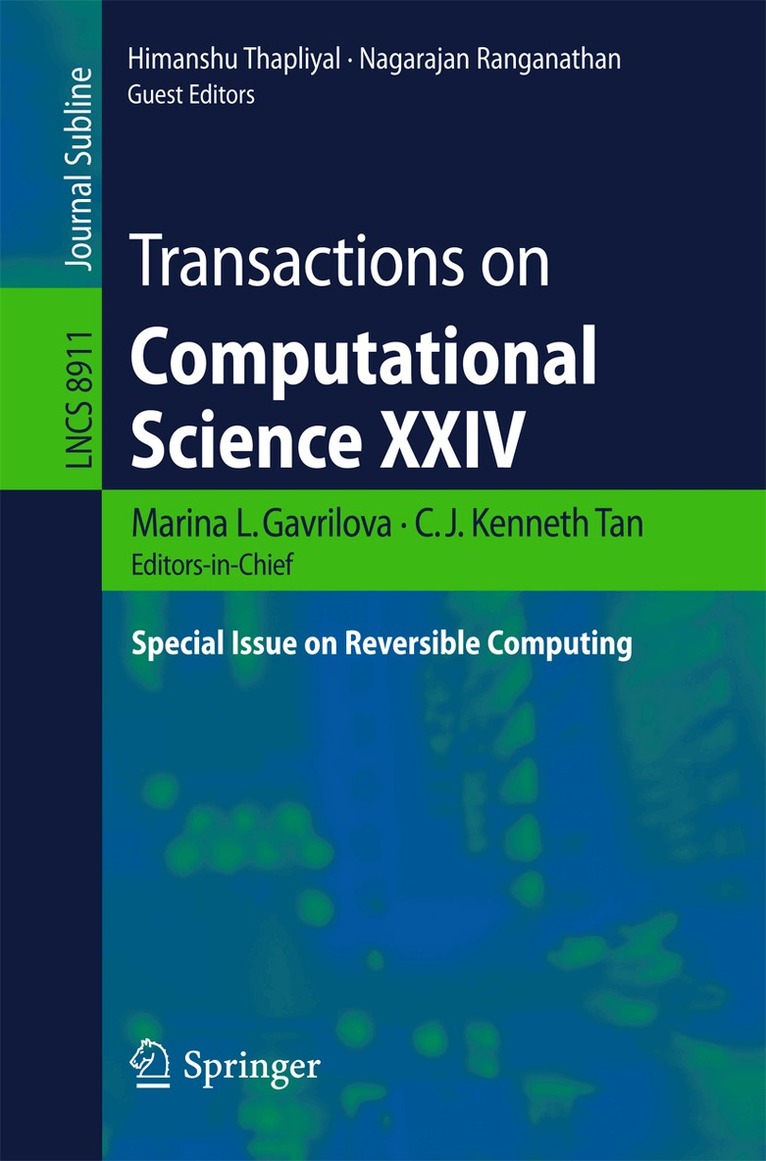
Transactions on Computational Science XXIV
Special Issue on Reversible Computing
Häftad, Engelska, 2014
550 kr
Skickas inom 10-15 vardagar
The LNCS journal Transactions on Computational Science reflects recent developments in the field of Computational Science, conceiving the field not as a mere ancillary science but rather as an innovative approach supporting many other scientific disciplines.