Nanda Dulal Jana - Böcker
Visar alla böcker från författaren Nanda Dulal Jana. Handla med fri frakt och snabb leverans.
3 produkter
3 produkter
2 021 kr
Skickas inom 10-15 vardagar
Biomedical engineering is a rapidly growing interdisciplinary area that is providing solutions to biological and medical problems and improving the healthcare system. It is connected to various applications like protein structure prediction, computer-aided drug design, and computerized medical diagnosis based on image and signal data, which accomplish low-cost, accurate, and reliable solutions for improving healthcare services. With the recent advancements, machine learning (ML) and deep learning (DL) techniques are widely used in biomedical engineering to develop intelligent decision-making healthcare systems in real-time. However, accuracy and reliability in model performance can be a concern in tackling data generated from medical images and signals, making it challenging for researchers and practitioners. Therefore, optimized models can produce quality healthcare services to handle the complexities involved in biomedical research.Various optimization techniques have been employed to optimize parameters, hyper-parameters, and architectural information of ML/DL models explicitly applied to biological, medical, and signal data. The swarm intelligence approach has the potential to solve complex non-linear optimization problems. It mimics the collective behavior of social swarms such as ant colonies, honey bees, and bird flocks. The cooperative nature of swarms can search global settings of ML/DL models, which efficiently provide the solution to biomedical engineering applications. Finally, the book aims to provide the utility of swarm optimization and similar optimization techniques to design ML/DL models to improve the solutions related to biomedical engineering.
Del 31 - Emergence, Complexity and Computation
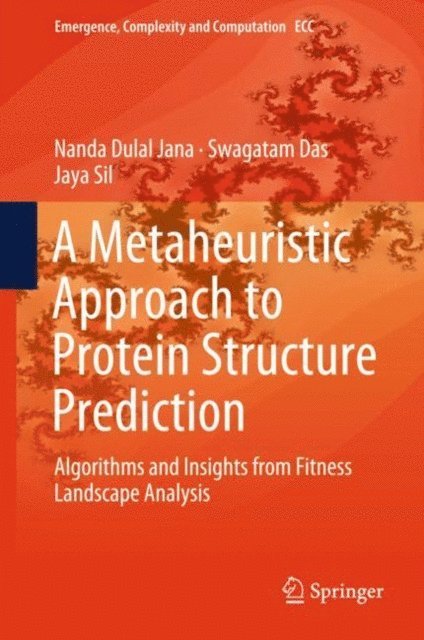
Metaheuristic Approach to Protein Structure Prediction
Algorithms and Insights from Fitness Landscape Analysis
Häftad, Engelska, 2018
1 064 kr
Skickas inom 10-15 vardagar
This book introduces characteristic features of the protein structure prediction (PSP) problem. It focuses on systematic selection and improvement of the most appropriate metaheuristic algorithm to solve the problem based on a fitness landscape analysis, rather than on the nature of the problem, which was the focus of methodologies in the past. Protein structure prediction is concerned with the question of how to determine the three-dimensional structure of a protein from its primary sequence. Recently a number of successful metaheuristic algorithms have been developed to determine the native structure, which plays an important role in medicine, drug design, and disease prediction.This interdisciplinary book consolidates the concepts most relevant to protein structure prediction (PSP) through global non-convex optimization. It is intended for graduate students from fields such as computer science, engineering, bioinformatics and as a reference for researchers and practitioners.
Del 31 - Emergence, Complexity and Computation
Metaheuristic Approach to Protein Structure Prediction
Algorithms and Insights from Fitness Landscape Analysis
Inbunden, Engelska, 2018
1 064 kr
Skickas inom 10-15 vardagar
This book introduces characteristic features of the protein structure prediction (PSP) problem. It focuses on systematic selection and improvement of the most appropriate metaheuristic algorithm to solve the problem based on a fitness landscape analysis, rather than on the nature of the problem, which was the focus of methodologies in the past. Protein structure prediction is concerned with the question of how to determine the three-dimensional structure of a protein from its primary sequence. Recently a number of successful metaheuristic algorithms have been developed to determine the native structure, which plays an important role in medicine, drug design, and disease prediction.This interdisciplinary book consolidates the concepts most relevant to protein structure prediction (PSP) through global non-convex optimization. It is intended for graduate students from fields such as computer science, engineering, bioinformatics and as a reference for researchers and practitioners.