Nathaniel Peters – författare
Visar alla böcker från författaren Nathaniel Peters. Handla med fri frakt och snabb leverans.
4 produkter
4 produkter
801 kr
Kommande
William of Saint-Thierry, Isaac of Stella, and Baldwin of Forde created a distinctly Cistercian body of Eucharistic theology in the twelfth century. In this book, Nathaniel Peters offers a scholarly account of that theology and examines the connection between medieval Trinitarian and Eucharistic theology.These Cistercian authors thought that the character of God as a Trinity of persons united in essence provides the structure of the economy of salvation—especially its turning point, the Eucharist. They saw the Eucharist as the place where the ontological union of the Incarnation becomes intimate, personal, and communal. In the Eucharist, God the Father draws those who receive to himself by uniting them to the body and blood of the Son. This unity brings an increase of unity with the Holy Spirit. Once united to the Son and Spirit, the faithful are united to the Father. The Eucharist also connects the meditation, sacrifices, and offering of their own lives to the life of Christ, with which they are offered to the Father.Chapter 1 examines the thought of William of Saint-Thierry, who has the most developed understanding of Eucharistic presence, conversion, and reception. It also treats the connections William draws between Eucharistic reception and meditation on scripture and the passion of Christ. Chapter 2 treats Isaac of Stella, who uses more intellectualist imagery and imagery of the mystical body of Christ. Chapter 3 studies Baldwin of Forde, who argues that the term transubstantiation best describes Eucharistic conversion and emphasizes reception by faith in the truth about Christ. Chapter 5 offers a brief conclusion, with reference to later thinkers who explore the Trinitarian shape of the Eucharist in similar ways.
99 kr
Tillfälligt slut
The gospel teaches that every human is sacred. Refugee children and Islamist terrorists. Police officers and young African Americans. Unborn babies, always, and also abortionists. Orange-haired casino owners, former First Ladies, progressive hipsters, prosperity-gospel televangelists, members of Congress, Confederate-flag-waving white nationalists? Sacred. This absurd claim is at the heart of the gospel. Each person is created in the image and likeness of God. Each is someone for whom Jesus died. And if this is true, we have much work to do. The writers in this issue may not agree on the best ways and means, but each challenges us to consider the implications of this gospel of life that makes no exceptions.Also in this issue:-- A former asylum seeker returns to Iraq to stand with Christians on the run from ISIS.-- Shane Claiborne tells us why abolishing the death penalty is the church’s business.-- Joel Salatin, America’s most famous farmer, reveals what pigs can teach us about the glory of God.-- John Dear reports on the Vatican’s historic turn toward nonviolence.-- Erna Albertz tells Richard Dawkins how her sister with Down syndrome can help him.-- Gun owners respond to gun violence with a fresh take on “swords into plowshares.”-- Ron Sider looks at the consistently pro-life witness of the early church.-- A hospice nurse reflects on euthanasia and the value of being a burden.-- Jason Landsel asks what made MohammadMuhammad Ali great.Then there’s new poetry, book reviews, a children’s story, insights from Pope Francis and George MacDonald, and art by Pawel Kuczynski, Xenia Hausner, William H. Johnson, Käthe Kollwitz, and Deidre Scherer.Plough Quarterly features stories, ideas, and culture for people eager to put their faith into action. Each issue brings you in-depth articles, interviews, poetry, book reviews, and art to help you put Jesus’ message into practice and find common cause with others.
99 kr
Tillfälligt slut
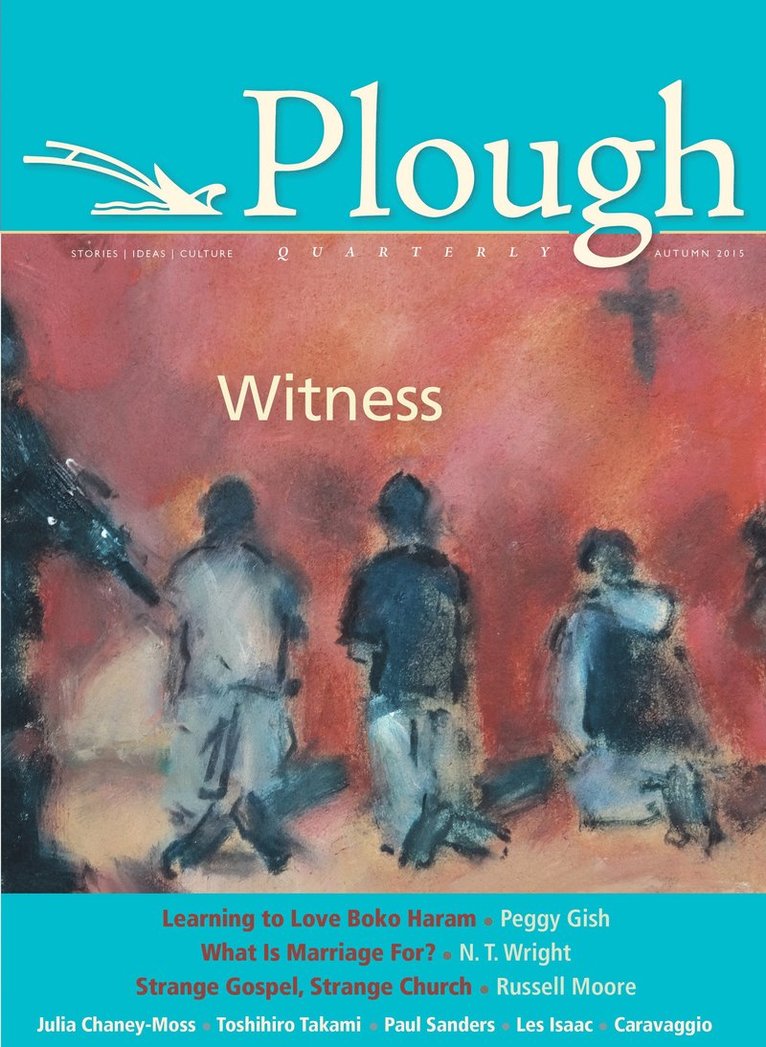
The contributors to this issue of Plough Quarterly focus on what it means to bear witness to the gospel. Peggy Gish reports on the church’s response to Boko Haram in Nigeria, where thousands of Christians have been killed. But in addition to witnesses who die for their faith, there are those who live for it, such as the families of those who died in Emanuel AME Church in Charleston, South Carolina. And in the wake of the US Supreme Court’s move to redefine marriage, we can’t talk about Christian witness without considering marriage and sexuality. With insights from Russell Moore, N. T. Wright, Amy Carmichael, Pope Francis, George Fox, Ivan Illich, Julia Chaney-Moss, Nathaniel Peters, Channah Ben-Eliezer, Chico Fajardo-Heflin, Les Isaac, Paul Sanders, and Robert Paeglow, this issue is sure to stimulate reflection and discussion. And as if that weren’t enough, you also get world-class art by Caravaggio, August Macke, Eric Drooker, Denis Barsukov, Pablo Picasso, George Tooker, Lucas Cranach the Elder, Janice Earley, John Singer Sargent, Paul Sanders, Paul Klee, Ghislaine Howard, and others.Plough Quarterly features stories, ideas, and culture for people eager to put their faith into action. Each issue brings you in-depth articles, interviews, poetry, book reviews, and art to help you put Jesus’ message into practice and find common cause with others.
100 kr
Tillfälligt slut
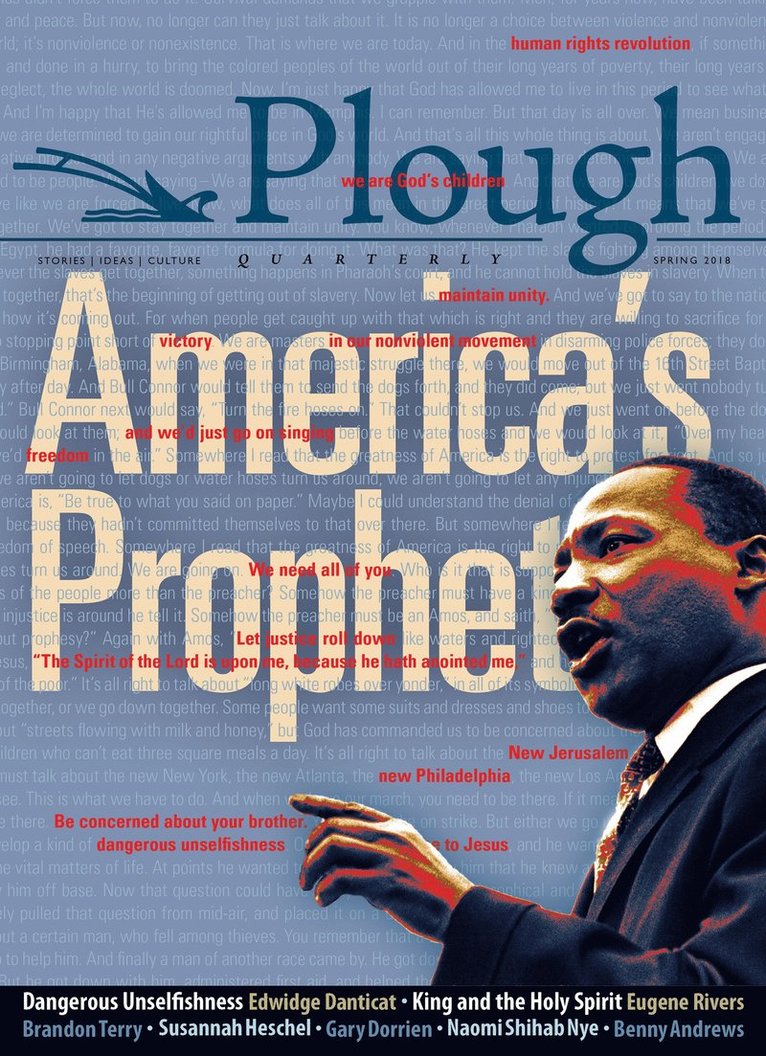
What if Martin Luther King Jr., this name-branded, oft-sanitized preacher from Atlanta, is a prophet whose message America has yet to fully reckon with?Ten days before Martin Luther King Jr.’s assassination, Rabbi Abraham Joshua Heschel said, “Where in America today do we hear a voice like the voice of the prophets of Israel? Martin Luther King is a sign that God has not forsaken the United States of America. God has sent him to us.” What if Heschel’s words about King are true? What if this name-branded, oft-sanitized, Super-Bowl-ad-commercialized, National-Mall-memorialized preacher from Atlanta . . . is a prophet whose message America has yet to fully reckon with? This issue of Plough Quarterly looks at King’s unfinished struggle against the three evils of racism, materialism, and militarism. Perspectives from Edwidge Danticat, Gary Dorrien, Brandon M. Terry, D. L. Mayfield, Eugene Rivers, and Susannah Heschel explore the ways King’s message of nonviolence, justice, and love of neighbor still matters today: to refugees and immigrants, soldiers and veterans, preachers and prisoners, black lives matter activists and the white working class.Also in this issue: original poetry by Naomi Shihab Nye; reviews of new books by James Forman Jr., Steve Krivák, Jim Forest, and Christopher de Hamel; and art by Yvan Lamothe, Roberson Joseph, Barry Moser, Benny Andrews, Zoe Cromwell, Julian Peters, Asuka Hishiki, Mark Smith, Mary Kang, Marc Chagall,John Partipilo, Yuri Kozyrev, Vinicius Barajas, Iain Stewart, Giovanni Bellini.Plough Quarterly features stories, ideas, and culture for people eager to put their faith into action. Each issue brings you in-depth articles, interviews, poetry, book reviews, and art to help you put Jesus’ message into practice and find common cause with others.