Nicholas Boyle - Böcker
Visar alla böcker från författaren Nicholas Boyle. Handla med fri frakt och snabb leverans.
12 produkter
12 produkter
Goethe: The Poet and the Age
Volume III: In the Shadow of Napoleon (1803–1809)
Inbunden, Engelska, 2026
424 kr
Kommande
The long-awaited third and fourth volumes of Nicholas Boyle's magisterial biography Goethe: The Poet and the Age cover the period of the Napoleonic Empire in Germany, relatively neglected by literary scholars as years national humiliation. Yet these years saw the publication by Goethe of the major works of his maturity by which his European reputation was established in the nineteenth century and beyond: Faust: Part One, the Theory of Colour, the mysterious novel Elective Affinities, and the three volumes of his autobiography, Poetry and Truth. Neglect of the political and personal context in which these works were written has led to serious misunderstandings which these volumes aim to remedy. Volume III brings to life the turbulent years from 1803 to 1809 which saw the extension of Napoleon's rule to Germany and his establishment of the 'continental system' to blockade British commerce. Vivid accounts are given of Prussia's disastrous defeat at Jena in 1806 and the traumatic occupation of Weimar; of Napoleon's Congress of Erfurt in 1808; and of Weimar's bloody participation in his campaigns in the Tirol and Austria. The direct consequences for Goethe include his sudden marriage to his long-term mistress, Christiana Vulpius, his nervous breakdown after the defeat at Jena (reflected in his drawings and the polemical sections of Theory of Colour), his gradual reconciliation with the Napoleonic settlement and Napoleon's courtship of him at Erfurt, his long working vacations amid the glittering society at the Bohemian spas, and the inspiration for Elective Affinities, of which a radically new interpretation is proposed. Among the many figures whose intellectual and personal relationship with Goethe is depicted are: Schiller, whose death haunted him throughout this period; Hegel, whose Phenomenology is shown to owe much to Goethe; the Romantic dramatist, Zacharias Werner; Silvie von Ziegesar and Bettina Brentano with whom he was linked in sentimental affairs; and his son, August, with whom his relationship gradually matured.
129 kr
Skickas inom 5-8 vardagar
German writers, from Luther and Goethe to Heine, Brecht, and Günter Grass, have had a profound influence on the modern world. This Very Short Introduction presents an engrossing tour of the course of German literature from the late Middle Ages to the present, focussing especially on the last 250 years. Emphasizing the economic and religious context of many masterpieces of German literature, it highlights how they can be interpreted as responses to social and political changes within an often violent and tragic history. The result is a new and clear perspective which illuminates the power of German literature and the German intellectual tradition, and its impact on the wider cultural world. ABOUT THE SERIES: The Very Short Introductions series from Oxford University Press contains hundreds of titles in almost every subject area. These pocket-sized books are the perfect way to get ahead in a new subject quickly. Our expert authors combine facts, analysis, perspective, new ideas, and enthusiasm to make interesting and challenging topics highly readable.
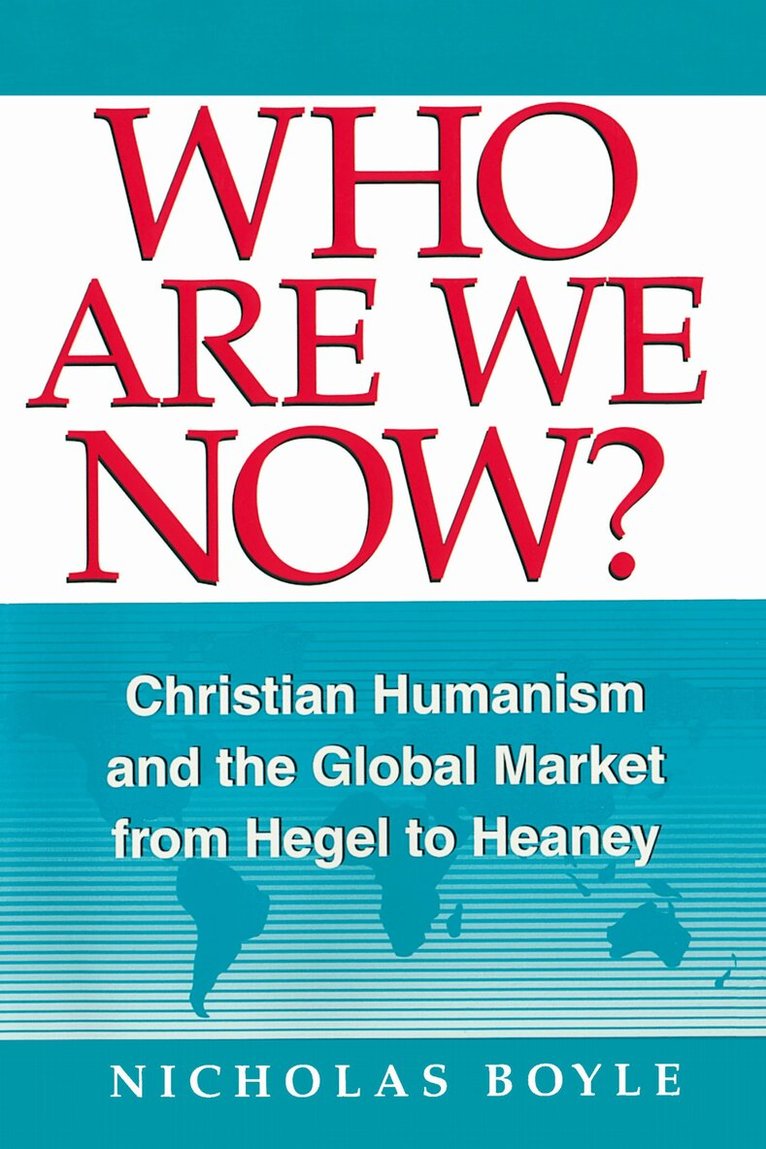
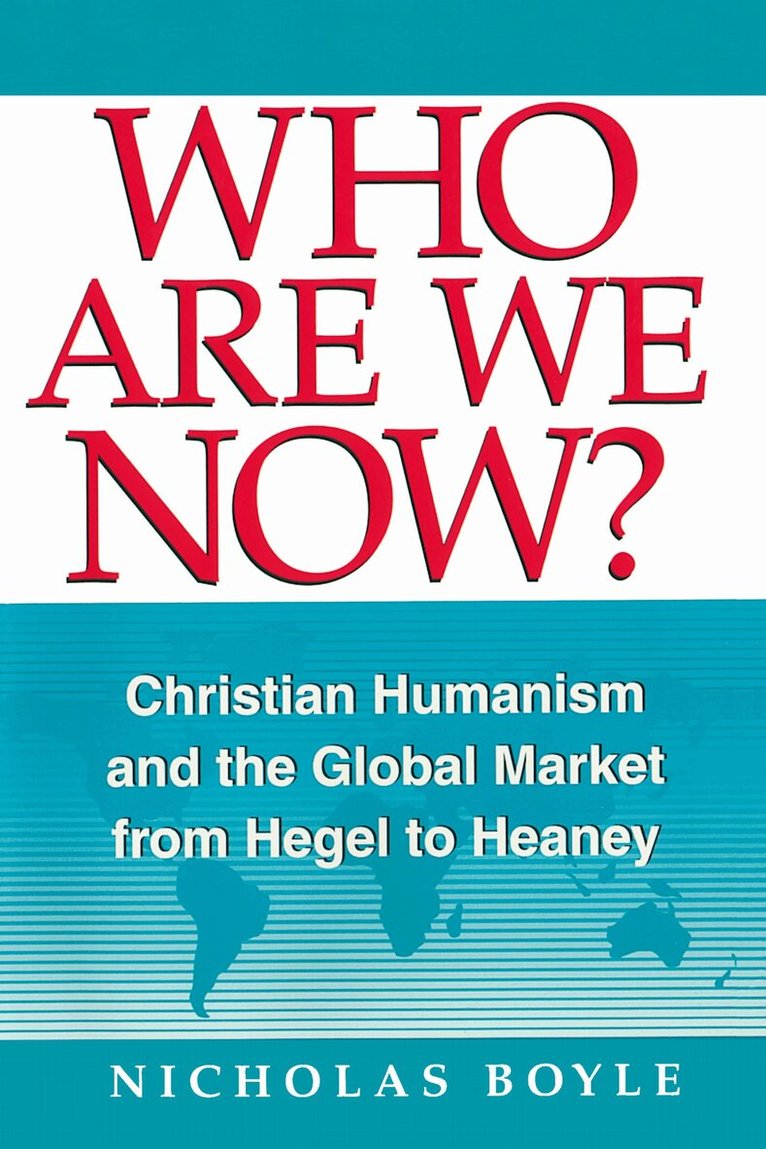
Who Are We Now?
Christian Humanism and the Global Market from Hegel to Heaney
Inbunden, Engelska, 2011
1 347 kr
Skickas inom 10-15 vardagar
Along with the spectacular collapse in 1989 of the perspectives imposed by the Cold War, the false certainties of the national and imperial age which shaped our collective and individual identity fell away as well. As we try to regroup and redefine ourselves and our social bonds, we must take into account two seemingly contradictory forces: the trend toward diversity and pluralism, on the one hand, and the pull toward ever greater unification, on the other.In this book, Nicholas Boyle offers ten studies of the implications of the increasingly integrated world economic structure for our sense of political, cultural, and personal identity. He argues for the deep interconnectedness of politics, religion, philosophy, and literature and their shared inseparability from the economic base. In the process, he uses philosophical and literary ideas to establish systematic grounds for optimism about an emerging supra-national order, aiming to restore the possibility of "grand narrative" to our collective past and future.However, his exploration of the global mind does not ignore the many haunting personal questions raised by the upheaval of the 90s: Are we more than consumers and producers? To what extent do our nationhood, our gender, our religious and cultural affiliations still define us? Is a Christian perspective viable in such a secular world? Can literature and philosophy make sense of individual lives? What role will the intellectual class play?Boyle takes a close look at Germany and Britain, their differences and growing similarity. He discusses, among others, Thatcher, Fukuyama, Hegel, Nietzsche, Heidegger, Derrida, and Seamus Heaney. Boyle asserts that as the world becomes less divided but more disparate, and its order less draconian but more precarious, choosing the paths most likely to lead to justice and peace will reform our shattered sense of identity.
369 kr
Skickas inom 10-15 vardagar
Along with the spectacular collapse in 1989 of the perspectives imposed by the Cold War, the false certainties of the national and imperial age which shaped our collective and individual identity fell away as well. As we try to regroup and redefine ourselves and our social bonds, we must take into account two seemingly contradictory forces: the trend toward diversity and pluralism, on the one hand, and the pull toward ever greater unification, on the other.In this book, Nicholas Boyle offers ten studies of the implications of the increasingly integrated world economic structure for our sense of political, cultural, and personal identity. He argues for the deep interconnectedness of politics, religion, philosophy, and literature and their shared inseparability from the economic base. In the process, he uses philosophical and literary ideas to establish systematic grounds for optimism about an emerging supra-national order, aiming to restore the possibility of "grand narrative" to our collective past and future.However, his exploration of the global mind does not ignore the many haunting personal questions raised by the upheaval of the 90s: Are we more than consumers and producers? To what extent do our nationhood, our gender, our religious and cultural affiliations still define us? Is a Christian perspective viable in such a secular world? Can literature and philosophy make sense of individual lives? What role will the intellectual class play?Boyle takes a close look at Germany and Britain, their differences and growing similarity. He discusses, among others, Thatcher, Fukuyama, Hegel, Nietzsche, Heidegger, Derrida, and Seamus Heaney. Boyle asserts that as the world becomes less divided but more disparate, and its order less draconian but more precarious, choosing the paths most likely to lead to justice and peace will reform our shattered sense of identity.
1 241 kr
Skickas inom 10-15 vardagar
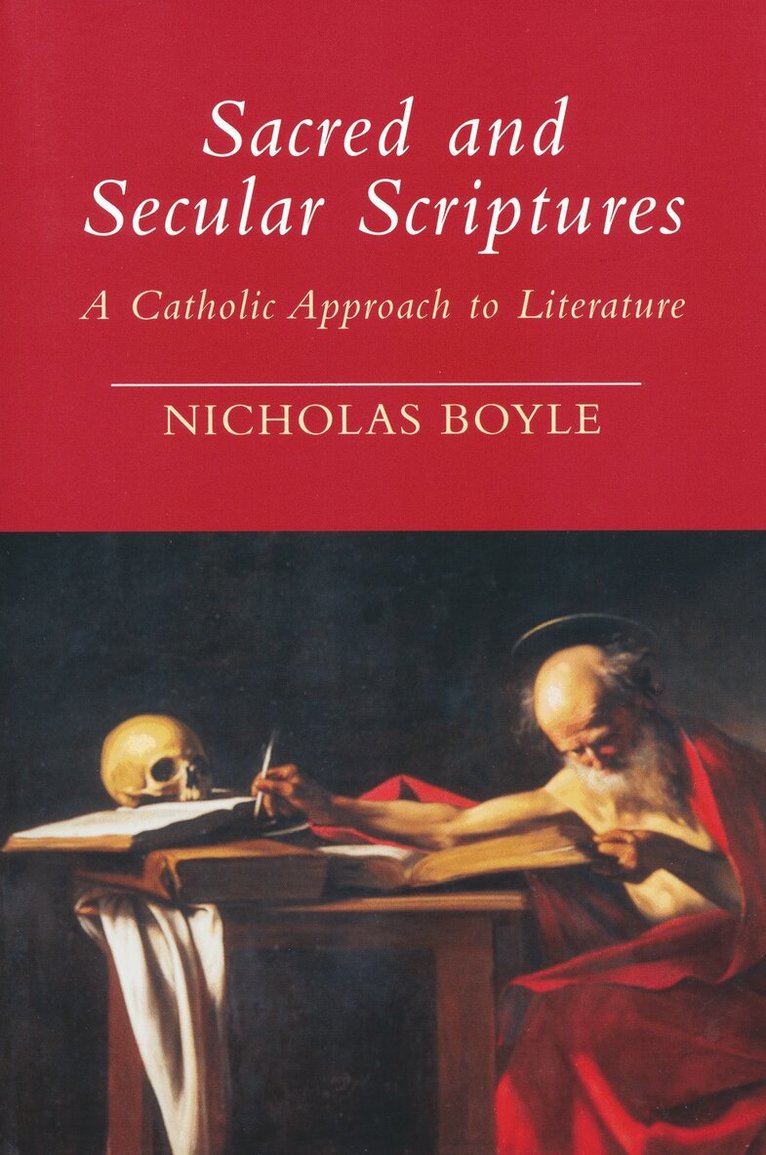
Nicholas Boyle's latest work begins with an observation—from theologian and medievalist Father Marie-Dominique Chenu, O.P.—that the Bible should be seen as a divinely ordained mediation between human culture and divine truth. But how far can we say that the Bible is 'literature'? Chenu is surely right that God is revealed in Scripture not through a system of ideas, but through a vivid historical narrative of people and places. But the Bible is also a sacred book. Expanding on this central dilemma, Boyle demonstrates that biblical scholarship and literary criticism must work together in the largely neglected task of integrating theology and modern secular culture.Boyle explores two lines of thought. In the first series of essays, he discusses a range of writers, primarily philosophers and theologians, who have treated the Bible as literature as a means of reconciling the sacred and the secular. In the second series, Boyle moves to the theme of literature as Bible, seeking a Catholic way of reading secular literature.These sophisticated and learned essays—drawn from the Erasmus Lectures Boyle delivered at the University of Notre Dame in 2003—cover a remarkable range of philosophers, theologians, and writers, including Herder, Schleiermacher, Hegel, Lévinas, Goethe, Austen, Melville, and Tolkien. This volume will reward its reader with penetrating, and often brilliant, insights.
301 kr
Skickas inom 10-15 vardagar
Nicholas Boyle's latest work begins with an observation—from theologian and medievalist Father Marie-Dominique Chenu, O.P.—that the Bible should be seen as a divinely ordained mediation between human culture and divine truth. But how far can we say that the Bible is 'literature'? Chenu is surely right that God is revealed in Scripture not through a system of ideas, but through a vivid historical narrative of people and places. But the Bible is also a sacred book. Expanding on this central dilemma, Boyle demonstrates that biblical scholarship and literary criticism must work together in the largely neglected task of integrating theology and modern secular culture.Boyle explores two lines of thought. In the first series of essays, he discusses a range of writers, primarily philosophers and theologians, who have treated the Bible as literature as a means of reconciling the sacred and the secular. In the second series, Boyle moves to the theme of literature as Bible, seeking a Catholic way of reading secular literature.These sophisticated and learned essays—drawn from the Erasmus Lectures Boyle delivered at the University of Notre Dame in 2003—cover a remarkable range of philosophers, theologians, and writers, including Herder, Schleiermacher, Hegel, Lévinas, Goethe, Austen, Melville, and Tolkien. This volume will reward its reader with penetrating, and often brilliant, insights.
493 kr
Skickas inom 7-10 vardagar
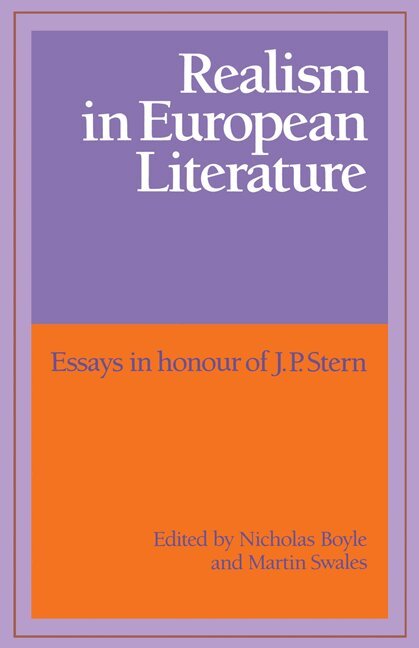
The essays in this collection, which was originally published in 1986, address fundamental issues of literary realism that have long been given prominence by J. P. Stern, the distinguished writer on German literature and author of the seminal study On Realism. In the prevailing theoretical climate problems associated with literary realism assumed great urgency. Such problems are the notion of literary 'truth to life', the survival of the concept of 'realism' in the light of modern hermeneutical theory, the perspective adopted by the contemporaries of Barthes and inheritors of Nietzsche on the canonical prose writers of the nineteenth century, and the future for an exegetical tradition represented in the work of Erich Auerbach.
370 kr
Skickas inom 7-10 vardagar
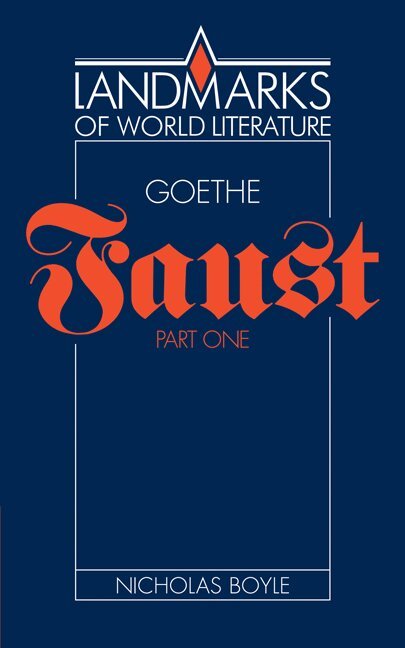
Nicholas Boyle begins with a fascinating survey of earlier versions of the Faust story. He then offers a detailed reading of Faust Part One, emphasising the poetic and dramatic coherence of the work and tracing its links with the thought and culture of Goethe's time. The play emerges as a tragic poem which may, to a certain extent, be read independently of Faust Part Two.
1 254 kr
Skickas inom 5-8 vardagar
Theology can no longer exist in isolation from politics, philosophy and literature. This is Nicholas Boyle's basis for an examination of personal and cultural identity in today's world. His exploration of the global mind reveals the continuing importance of a Christian perspective in a secular world. He shows that modern trends towards greater diversity and pluralism and simultaneous trends towards greater unification can be reconciled within the Catholic humanist tradition of theology, philosophy and literature. He identifies Postmodernism as 'the pessimism of an obsolescent class - the salaried official intelligentsia - whose fate is closely bound up with that of the declining nation-state'. In this brilliant book, Dr Boyle gives new grounds for optimism about the emerging new world order
Del 1 - Studies in German Literature Linguistics and Culture
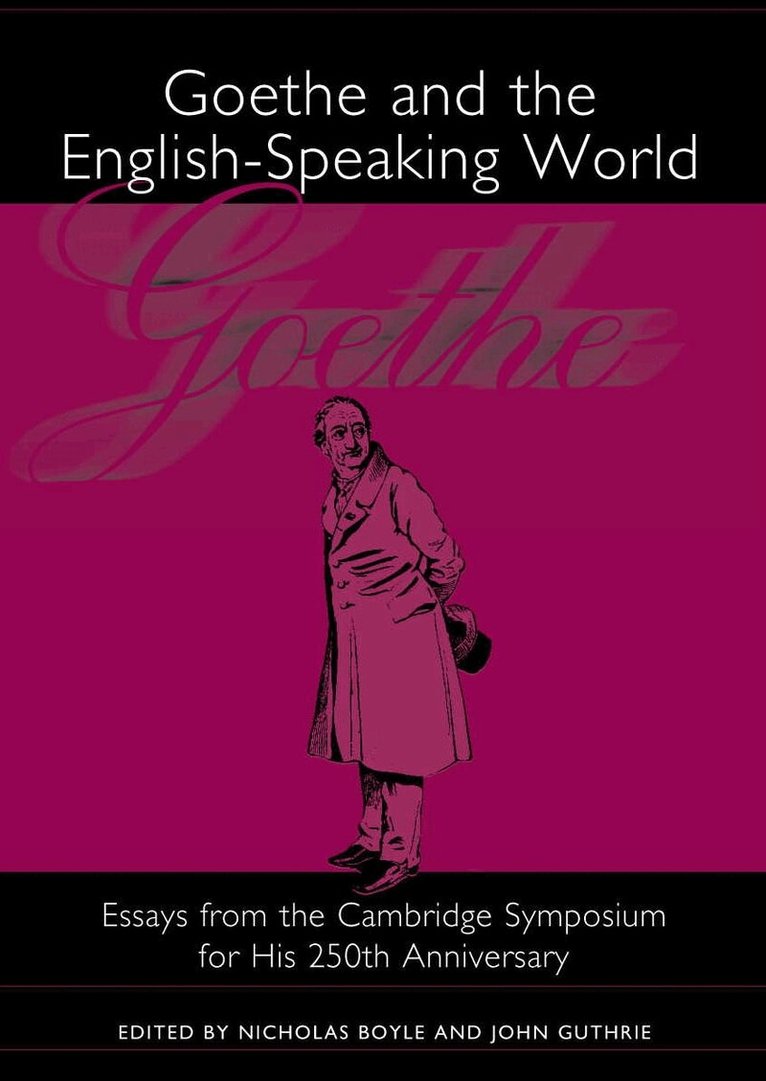
Goethe and the English-Speaking World
A Cambridge Symposium for His 250th Anniversary
Inbunden, Engelska, 2001
983 kr
Tillfälligt slut
New studies of both Goethe's relationship to the English-speaking world and its perception of Goethe and his works.Goethe's relations with the English-speaking world have been the subject of scholarly investigation ever since his lifetime. This volume brings together eighteen articles that provide new points of view, a broad range of approaches, and new and original findings on this relationship. These range from the discussion of applications of recent critical approaches such as chaos theory and Edward Said's Orientalism to Goethean texts, through other more empirical contributions that bring to light new material, some of it deriving from archives in Weimar relating to Goethe's contact with English culture. Other essays involve the reassessment of questions of influence, from both sides: inthe case of Cooper and Goethe some standard assumptions are revised, while in the case of Goethe and Edith Wharton and Goethe and George Eliot, new comparative ground is broken. Close readings of portions of well-known texts suchas Faust and Wilhelm Meister challenge standard assumptions. The analysis of selected recent translations of Goethe's poetry raises perennial questions of cultural transfer, while the survey of the role played by some of Goethe's texts in one corner of the English-speaking world, Dublin, is long overdue.Nicholas Boyle is Reader in German Literary and Intellectual History, Head of the Department of German in the University of Cambridge and Fellow of Magdalene College. John Guthrie is College Lecturer in German and Director of Studies in Modern Languages at New Hall, Cambridge.
494 kr
Skickas inom 3-6 vardagar
122 kr
Skickas inom 3-6 vardagar