Nicoletta Calzolari - Böcker
Visar alla böcker från författaren Nicoletta Calzolari. Handla med fri frakt och snabb leverans.
5 produkter
5 produkter
3 470 kr
Skickas inom 5-8 vardagar
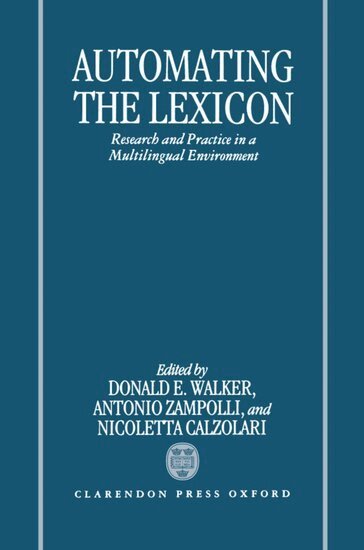
Computational lexicography is a fast-growing field with implications for a wide range of disciplines--theoretical linguistics, computational linguistics, cognitive science, and artificial intelligence--as well as for the construction of dictionaires. The `Grosseto Workshop' was an event which broke new ground. It brought together for the first time an international and interdisciplinary group of researchers concerned with computational lexicography. These papers, selected from the workshop, have provided a baseline and a reference point for further research on problems associated with the lexicon. The collection is not merely of historical interest: it addresses many issues that are still debated today and that guide current research and development.
1 499 kr
Skickas inom 7-10 vardagar
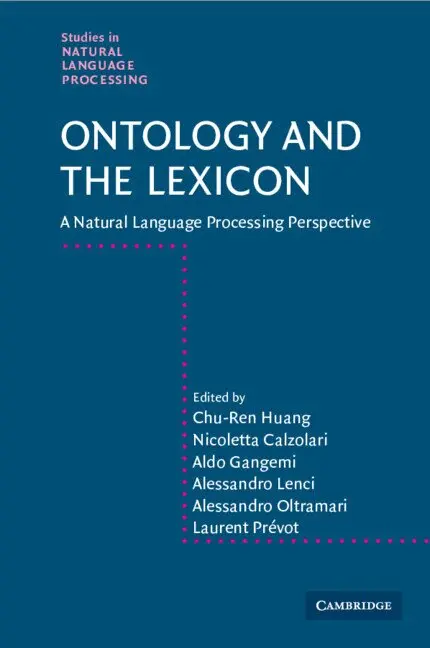
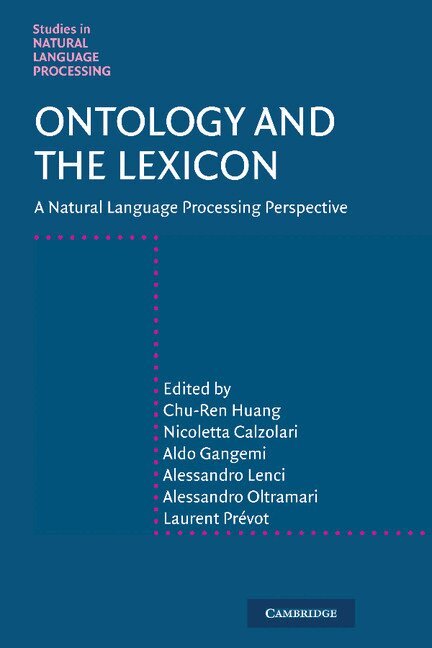
The relation between ontologies and language is currently at the forefront of natural language processing (NLP). Ontologies, as widely used models in semantic technologies, have much in common with the lexicon. A lexicon organizes words as a conventional inventory of concepts, while an ontology formalizes concepts and their logical relations. A shared lexicon is the prerequisite for knowledge-sharing through language, and a shared ontology is the prerequisite for knowledge-sharing through information technology. In building models of language, computational linguists must be able to accurately map the relations between words and the concepts that they can be linked to. This book focuses on the technology involved in enabling integration between lexical resources and semantic technologies. It will be of interest to researchers and graduate students in NLP, computational linguistics, and knowledge engineering, as well as in semantics, psycholinguistics, lexicology and morphology/syntax.
1 099 kr
Skickas inom 10-15 vardagar
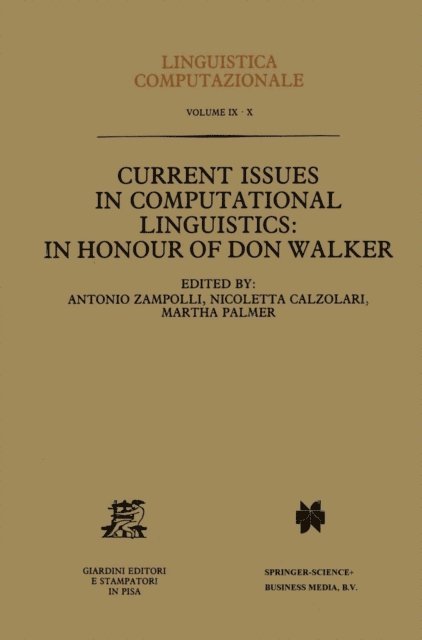
This collection of papers is dedicated to Don Walker. The technical content of these papers reflects his guidance and direction; his understanding of the relevance of the theories from related disciplines such as linguistics, psychology, and philosophy; and his dream of the future availability of electronic documents and the potential of this as a resource for corpus-based analysis. This led him to an interdisciplinary role as a primary mover in the push to standardize the acquisition and tagging of electronic text, an endeavour that brought together people from fields as distinct as publishing, the humanities and computer science. His widespread interests are mirrored in the collection of papers in this volume, which portray different approaches and different styles.
1 099 kr
Skickas inom 10-15 vardagar
This collection of papers is dedicated to Don Walker. The technical content of the papers clearly reflects his guidance and direction; his understanding of the relevance of the theories from related disciplines such as linguistics, psychology, and philosophy; and his dream of the future availability of electronic documents and the potential of this as a resource for corpus-based analysis. This led him to an interdisciplinary role as a primary mover in the push to standardize the acquisition and tagging of electronic text, an endeavour that brought together people from fields as distinct as publishing, the humanities and computer science. His widespread interests are mirrored in the collection of papers in this volume, which portray different approaches and different styles.
387 kr
Skickas inom 7-10 vardagar
The relation between ontologies and language is currently at the forefront of natural language processing (NLP). Ontologies, as widely used models in semantic technologies, have much in common with the lexicon. A lexicon organizes words as a conventional inventory of concepts, while an ontology formalizes concepts and their logical relations. A shared lexicon is the prerequisite for knowledge-sharing through language, and a shared ontology is the prerequisite for knowledge-sharing through information technology. In building models of language, computational linguists must be able to accurately map the relations between words and the concepts that they can be linked to. This book focuses on the technology involved in enabling integration between lexical resources and semantic technologies. It will be of interest to researchers and graduate students in NLP, computational linguistics, and knowledge engineering, as well as in semantics, psycholinguistics, lexicology and morphology/syntax.