Martha Palmer – författare
Visar alla böcker från författaren Martha Palmer. Handla med fri frakt och snabb leverans.
7 produkter
7 produkter
E-bok
PDF, Engelska, 19941 459 kr
Läs direkt efter köp
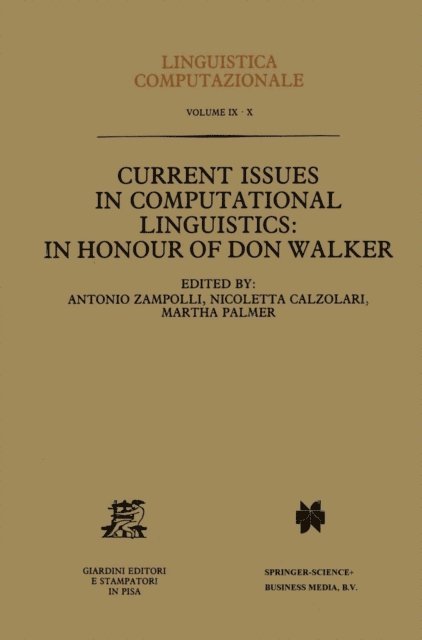
With this volume in honour of Don Walker, Linguistica Computazionale con tinues the series of special issues dedicated to outstanding personalities who have made a significant contribution to the progress of our discipline and maintained a special collaborative relationship with our Institute in Pisa. I take the liberty of quoting in this preface some of the initiatives Pisa and Don Walker have jointly promoted and developed during our collaboration, because I think that they might serve to illustrate some outstanding features of Don''s personality, in particular his capacity for identifying areas of potential convergence among the different scientific communities within our field and establishing concrete forms of coop eration. These initiatives also testify to his continuous and untiring work, dedi cated to putting people into contact and opening up communication between them, collecting and disseminating information, knowledge and resources, and creating shareable basic infrastructures needed for progress in our field. Our collaboration began within the Linguistics in Documentation group of the FID and continued in the framework of the !CCL (International Committee for Computational Linguistics). In 1982 this collaboration was strengthened when, at CO LING in Prague, I was invited by Don to join him in the organization of a series of workshops with participants of the various communities interested in the study, development, and use of computational lexica.
Inbunden, Engelska, 1994
1 119 kr
Skickas inom 10-15 vardagar
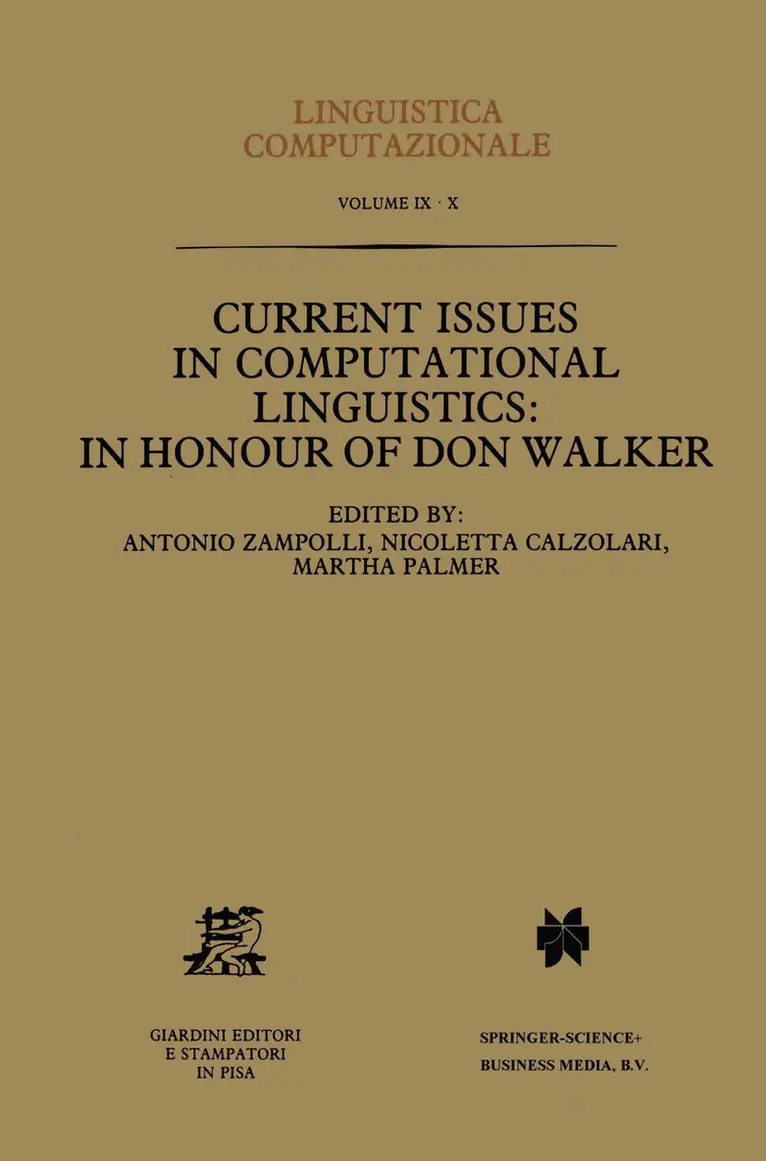
This collection of papers is dedicated to Don Walker. The technical content of these papers reflects his guidance and direction; his understanding of the relevance of the theories from related disciplines such as linguistics, psychology, and philosophy; and his dream of the future availability of electronic documents and the potential of this as a resource for corpus-based analysis. This led him to an interdisciplinary role as a primary mover in the push to standardize the acquisition and tagging of electronic text, an endeavour that brought together people from fields as distinct as publishing, the humanities and computer science. His widespread interests are mirrored in the collection of papers in this volume, which portray different approaches and different styles.
Häftad, Engelska, 1994
1 119 kr
Skickas inom 10-15 vardagar
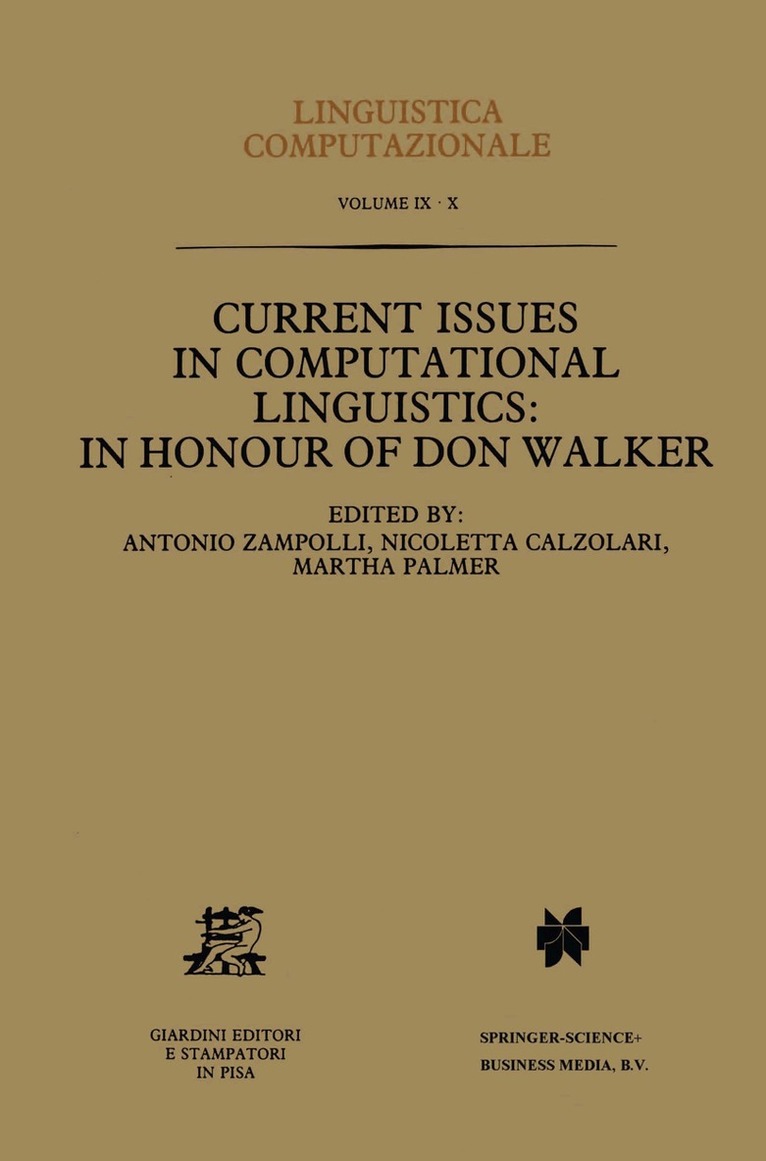
With this volume in honour of Don Walker, Linguistica Computazionale con tinues the series of special issues dedicated to outstanding personalities who have made a significant contribution to the progress of our discipline and maintained a special collaborative relationship with our Institute in Pisa. I take the liberty of quoting in this preface some of the initiatives Pisa and Don Walker have jointly promoted and developed during our collaboration, because I think that they might serve to illustrate some outstanding features of Don's personality, in particular his capacity for identifying areas of potential convergence among the different scientific communities within our field and establishing concrete forms of coop eration. These initiatives also testify to his continuous and untiring work, dedi cated to putting people into contact and opening up communication between them, collecting and disseminating information, knowledge and resources, and creating shareable basic infrastructures needed for progress in our field. Our collaboration began within the Linguistics in Documentation group of the FID and continued in the framework of the !CCL (International Committee for Computational Linguistics). In 1982 this collaboration was strengthened when, at CO LING in Prague, I was invited by Don to join him in the organization of a series of workshops with participants of the various communities interested in the study, development, and use of computational lexica.
Inbunden, Engelska, 2021
933 kr
Skickas inom 7-10 vardagar
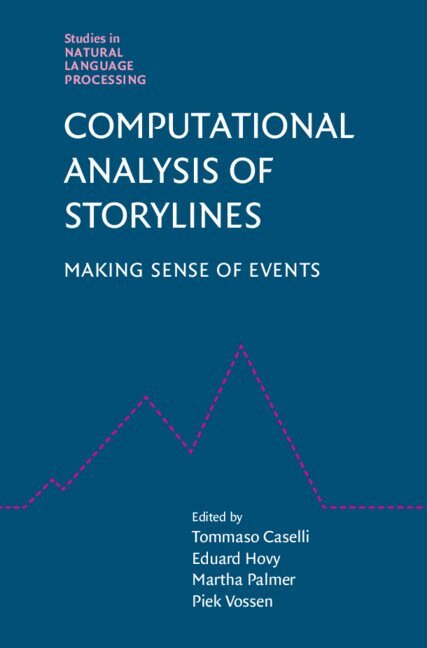
Event structures are central in Linguistics and Artificial Intelligence research: people can easily refer to changes in the world, identify their participants, distinguish relevant information, and have expectations of what can happen next. Part of this process is based on mechanisms similar to narratives, which are at the heart of information sharing. But it remains difficult to automatically detect events or automatically construct stories from such event representations. This book explores how to handle today's massive news streams and provides multidimensional, multimodal, and distributed approaches, like automated deep learning, to capture events and narrative structures involved in a 'story'. This overview of the current state-of-the-art on event extraction, temporal and casual relations, and storyline extraction aims to establish a new multidisciplinary research community with a common terminology and research agenda. Graduate students and researchers in natural language processing, computational linguistics, and media studies will benefit from this book.
E-bok
PDF, Engelska, 20211 011 kr
Läs direkt efter köp
Event structures are central in Linguistics and Artificial Intelligence research: people can easily refer to changes in the world, identify their participants, distinguish relevant information, and have expectations of what can happen next. Part of this process is based on mechanisms similar to narratives, which are at the heart of information sharing. But it remains difficult to automatically detect events or automatically construct stories from such event representations. This book explores how to handle today''s massive news streams and provides multidimensional, multimodal, and distributed approaches, like automated deep learning, to capture events and narrative structures involved in a ''story''. This overview of the current state-of-the-art on event extraction, temporal and casual relations, and storyline extraction aims to establish a new multidisciplinary research community with a common terminology and research agenda. Graduate students and researchers in natural language processing, computational linguistics, and media studies will benefit from this book.
Häftad, Engelska, 2010
375 kr
Skickas inom 10-15 vardagar
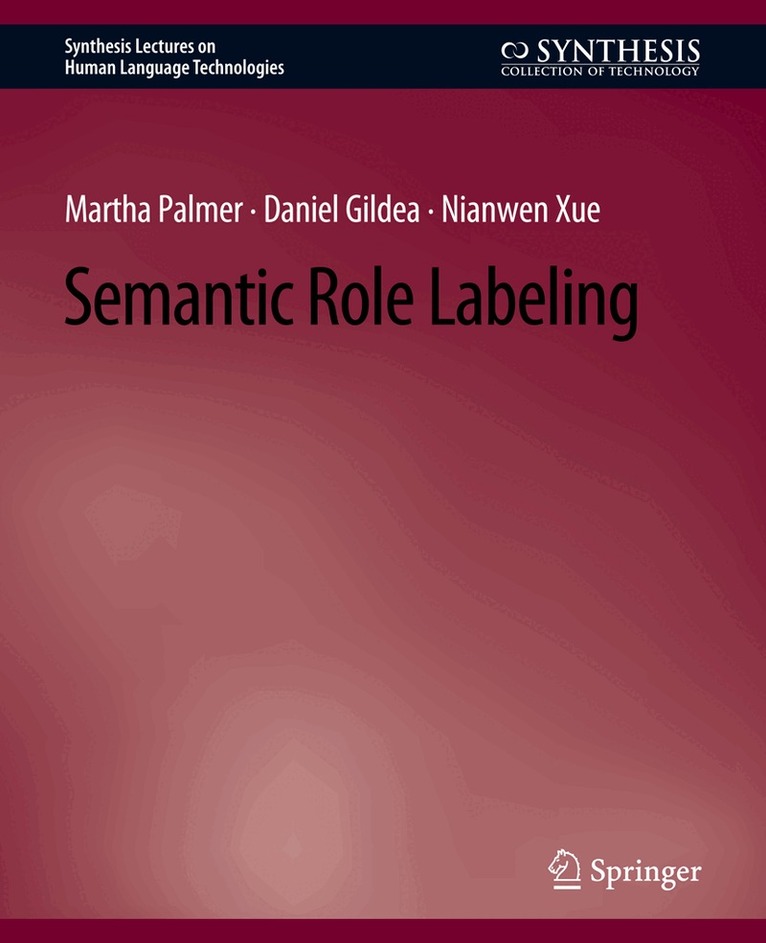
This book is aimed at providing an overview of several aspects of semantic role labeling. Chapter 1 begins with linguistic background on the definition of semantic roles and the controversies surrounding them. Chapter 2 describes how the theories have led to structured lexicons such as FrameNet, VerbNet and the PropBank Frame Files that in turn provide the basis for large scale semantic annotation of corpora. This data has facilitated the development of automatic semantic role labeling systems based on supervised machine learning techniques. Chapter 3 presents the general principles of applying both supervised and unsupervised machine learning to this task, with a description of the standard stages and feature choices, as well as giving details of several specific systems. Recent advances include the use of joint inference to take advantage of context sensitivities, and attempts to improve performance by closer integration of the syntactic parsing task with semantic role labeling. Chapter 3 also discusses the impact the granularity of the semantic roles has on system performance. Having outlined the basic approach with respect to English, Chapter 4 goes on to discuss applying the same techniques to other languages, using Chinese as the primary example. Although substantial training data is available for Chinese, this is not the case for many other languages, and techniques for projecting English role labels onto parallel corpora are also presented. Table of Contents: Preface / Semantic Roles / Available Lexical Resources / Machine Learning for Semantic Role Labeling / A Cross-Lingual Perspective / Summary
E-bok
PDF, Engelska, 2022457 kr
Läs direkt efter köp
This book is aimed at providing an overview of several aspects of semantic role labeling. Chapter 1 begins with linguistic background on the definition of semantic roles and the controversies surrounding them. Chapter 2 describes how the theories have led to structured lexicons such as FrameNet, VerbNet and the PropBank Frame Files that in turn provide the basis for large scale semantic annotation of corpora. This data has facilitated the development of automatic semantic role labeling systems based on supervised machine learning techniques. Chapter 3 presents the general principles of applying both supervised and unsupervised machine learning to this task, with a description of the standard stages and feature choices, as well as giving details of several specific systems. Recent advances include the use of joint inference to take advantage of context sensitivities, and attempts to improve performance by closer integration of the syntactic parsing task with semantic role labeling. Chapter 3 also discusses the impact the granularity of the semantic roles has on system performance. Having outlined the basic approach with respect to English, Chapter 4 goes on to discuss applying the same techniques to other languages, using Chinese as the primary example. Although substantial training data is available for Chinese, this is not the case for many other languages, and techniques for projecting English role labels onto parallel corpora are also presented. Table of Contents: Preface / Semantic Roles / Available Lexical Resources / Machine Learning for Semantic Role Labeling / A Cross-Lingual Perspective / Summary