• Fri frakt över 249 kr
  • •
  • Snabba leveranser
  • •
  • Billiga böcker
Kundservice

Du är på sajten för privatpersoner.

Företag, bibliotek eller offentlig verksamhet?

Du handlar på classic.bokus.com, där alla dina funktioner finns intakta.
Till classic.bokus.com
Bokus logotyp. Gå till startsidan.
  • Erbjudanden
  • Nyheter
  • Student
  • Topplistor
  • Barn & ungdom
  • Bokus Play
  • E-böcker
  • Pocketböcker
  • Spel & pussel

10% rabatt på allt med kod: NYSTART10 →

Sidfot

Mina sidor

    Hjälp

    • Kundservice
    • Vanliga frågor och svar
    • Frakt och leverans
    • Retur vid ångerrätt
    • Reklamera vara
    • Betalning
    • Köpvillkor
    • Allmänna villkor
    • Information om webbplatsens tillgänglighet

    Om Bokus

    • Om oss
    • Pressrum
    • För studenter
    • För företag
    • För bibliotek och offentlig verksamhet
    • För leverantörer
    • Hållbarhet

    Populärt

    • Aktuella erbjudanden
    • Presentkort
    • Studentlitteratur
    • Nya böcker
    • Topplistor
    • Signerade böcker
    • Engelska böcker

    Inspiration

    • Boktips
    • BookTok
    • Populära bokserier
    • Barnbokskaraktärer
    • Populära författare
    Logotyp för Bokus
    Följ oss på Facebook (extern länk)Följ oss på Instagram (extern länk)Följ oss på YouTube (extern länk)Följ oss på TikTok (extern länk)
    bokus @ CookiesAnpassa cookiesIntegritetspolicyKöpvillkor
    Till Citymail hemsida (extern länk)Till Budbee hemsida (extern länk)Till Postnord hemsida (extern länk)Till Schenker hemsida (extern länk)Till Early Bird hemsida (extern länk)Till Walleys hemsida (extern länk)
    1. Data och IT
    2. Systemvetenskap och AI

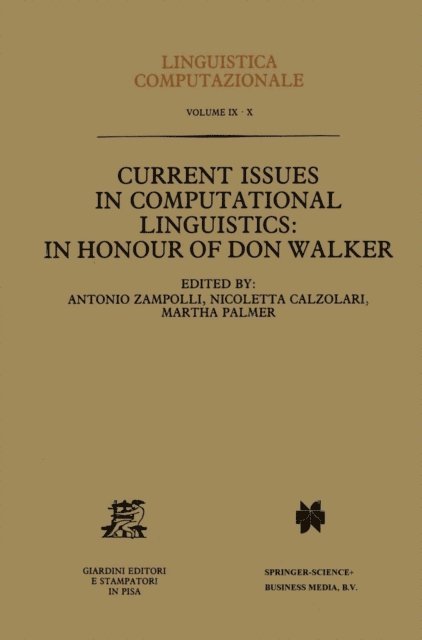
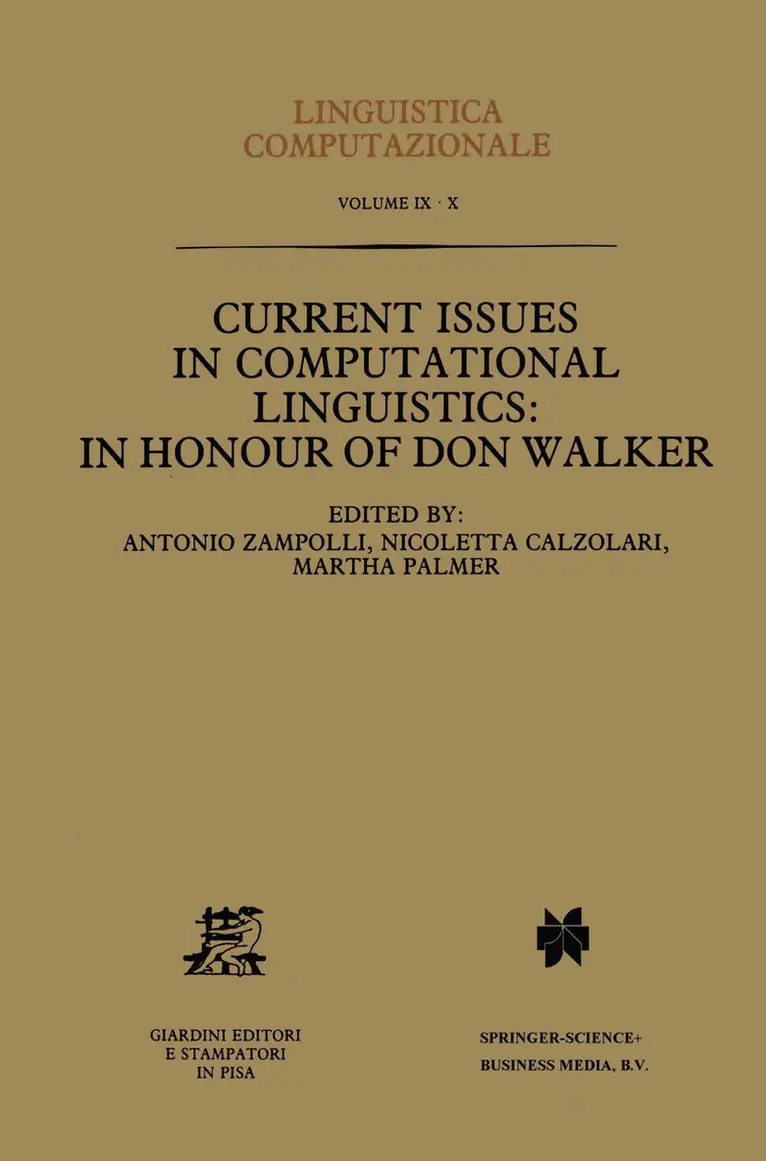
    Current Issues in Computational Linguistics: In Honour of Don Walker

    AvAntonio Zampolli,Nicoletta Calzolari

    Häftad, Engelska, 1994

    Del i serien Linguistica Computazionale

    1 119 kr

    Beställningsvara. Skickas inom 10-15 vardagar. Fri frakt över 249 kr.
    Beskrivning

    With this volume in honour of Don Walker, Linguistica Computazionale con­ tinues the series of special issues dedicated to outstanding personalities who have made a significant contribution to the progress of our discipline and maintained a special collaborative relationship with our Institute in Pisa. I take the liberty of quoting in this preface some of the initiatives Pisa and Don Walker have jointly promoted and developed during our collaboration, because I think that they might serve to illustrate some outstanding features of Don's personality, in particular his capacity for identifying areas of potential convergence among the different scientific communities within our field and establishing concrete forms of coop­ eration. These initiatives also testify to his continuous and untiring work, dedi­ cated to putting people into contact and opening up communication between them, collecting and disseminating information, knowledge and resources, and creating shareable basic infrastructures needed for progress in our field. Our collaboration began within the Linguistics in Documentation group of the FID and continued in the framework of the !CCL (International Committee for Computational Linguistics). In 1982 this collaboration was strengthened when, at CO LING in Prague, I was invited by Don to join him in the organization of a series of workshops with participants of the various communities interested in the study, development, and use of computational lexica.

    Produktinformation

    • Utgivningsdatum:1994-06-30
    • Mått:155 x 235 x 34 mm
    • Vikt:937 g
    • Format:Häftad
    • Språk:Engelska
    • Serie:Linguistica Computazionale
    • Antal sidor:598
    • Upplaga:1994
    • Förlag:Kluwer Academic Publishers
    • ISBN:9780792329985

    Utforska kategorier

    • Systemvetenskap och AI inom Data och IT
    • Språkvetenskap och lingvistik inom Språk och ordböcker

    Innehållsförteckning

    • Introduction. Donald Walker: a Remembrance. Section 1: The Task of Natural Language Processing. Natural Language Processing: an Historical Review; K. Sparck Jones. On Getting a Computer to Listen; J. Robinson. Utterance and Objective: Issues in Natural Language Communication; B. Grosz. On the Proper Place of Semantics in Machine Translation; M. King. Developing a Natural Language Interface to Complex Data; G.G. Hendrix, E.D. Sacerdoti. User-Needs Analysis and Design Methodology for an Automated Document Generator; K. Kukich, K. McKeown, J. Shaw, J. Robin, J. Lim, N. Morgan, J. Philips. Section 2: Building Computational Lexicons. Machine-Readable Dictionaries and Computational Linguistics Research; B. Boguraev. Research Toward the Development of a Lexical Knowledge Base for Natural Language Processing; R.A. Amsler. Discovering Relationships Among Word Senses; R.J. Byrd. Machine Readable Dictionary as a Source of Grammatical Information; E. Hajicová, A. Rosen. The ITT Lexical Database: Dream and Reality; S. Pin-Ngern Conlon. Visions of the Digital Library: Views on Using Computational Linguistics and Semantic Nets in Information Retrieval; J.L. Klavans. Anatomy of a Verb Entry: from Linguistic Theory to Lexicographic Practice; B.T. Atkins, J. Kegl, B. Levin. Issues for Lexicon Building; N. Calzolari. Outline of a Model for Lexical Databases; N. Ide, J. le Maitre, J. Véronts. Construction-Based MT Lexicons; L. Levin, S. Nirenburg. Dependency-Based Grammatical Information in the Lexicon; P. Sgall. Semantics in the Brain's Lexicon -- Some Preliminary Remarks on its Epistemology; H. Schnelle. Section 3: The Acquisition and Use of LargeCorpora. The Ecology of Language; D.E. Walker. Representativeness in Corpus Design; D. Biber. The Text EncodingInitiative; C.M. Sperberg-McQueen. Discrimination Decisions for 100,000 Dimensional; W.A. Gale, K.W. Church, D. Yarowsky. Acquisition and Exploitation of Textual Resources for NLP; S. Armstrong-Warwick. The Center for Electronic Texts in the Humanities; S. Hockey. Design Principles for Electronic Textual Resources: Investigating Users and Uses of Scholarly Information; N.J. Belkin. Section 4: Topics, Methods and Formalisms in Syntax, Semantics and Pragmatics. Evaluating English Sentences in a Logical Model; J. Friedman, D.B. Moran, D.S. Warren. Recovering Implicit Information; M.S. Palmer, D.A. Dahl, R.J. Schiffman, L. Hirschman, M. Linebarger, J. Downing. Flexible Generation: Taking the User into Account; C.L. Paris, V.O. Mittal. Two Principles of Parse Preference; J.R. Hobbs, J. Bear. UD, yet Another Unification Device; R. Johnson, M. Rosner. Varieties of Heuristics in Sentence Parsing; M. Nagao. Some Recent Trends in Natural Language Processing; A.K. Joshi. Stone Soup and the French Room; Y. Wilks.