Nigel DeSouza - Böcker
Visar alla böcker från författaren Nigel DeSouza. Handla med fri frakt och snabb leverans.
2 produkter
2 produkter
1 132 kr
Skickas inom 7-10 vardagar
J. G. Herder is enjoying a renaissance in philosophy and across the humanities. This book offers important new insights into the complexity and depth of his thought. This unprecedented collection fills a gap in the secondary literature, highlighting the genuinely innovative and distinctive nature of Herder's philosophy. Not only does Herder offer highly original answers to important philosophical questions, such as the mind-body problem and the role of sensibility in cognition and ethics, he also opens up rich resources for thinking about the very nature of philosophy itself and its connections to other fields in the humanities and social sciences. Herder: Philosophy and Anthropology brings together a set of original essays that centre on the question at the heart of Herder's philosophical thought: How can philosophy enable an understanding of the human being that does not narrowly focus on its rational and moral capacities, but rather understands these in the context of its existence as a creature of nature that is fundamentally marked by a sensuous and affective openness and responsiveness to the world and other persons.The first part of the volume examines the various dimensions of Herder's philosophical understanding of human nature through which he sought methodologically to delineate a genuinely anthropological philosophy. The second part then examines further aspects of this understanding of human nature and what emerges from it: the human-animal distinction; how human life evolves over space and time on the basis of a natural order; the fundamentally hermeneutic dimension to human existence; and the interrelatedness of language, history, religion, and culture.
1 676 kr
Kommande
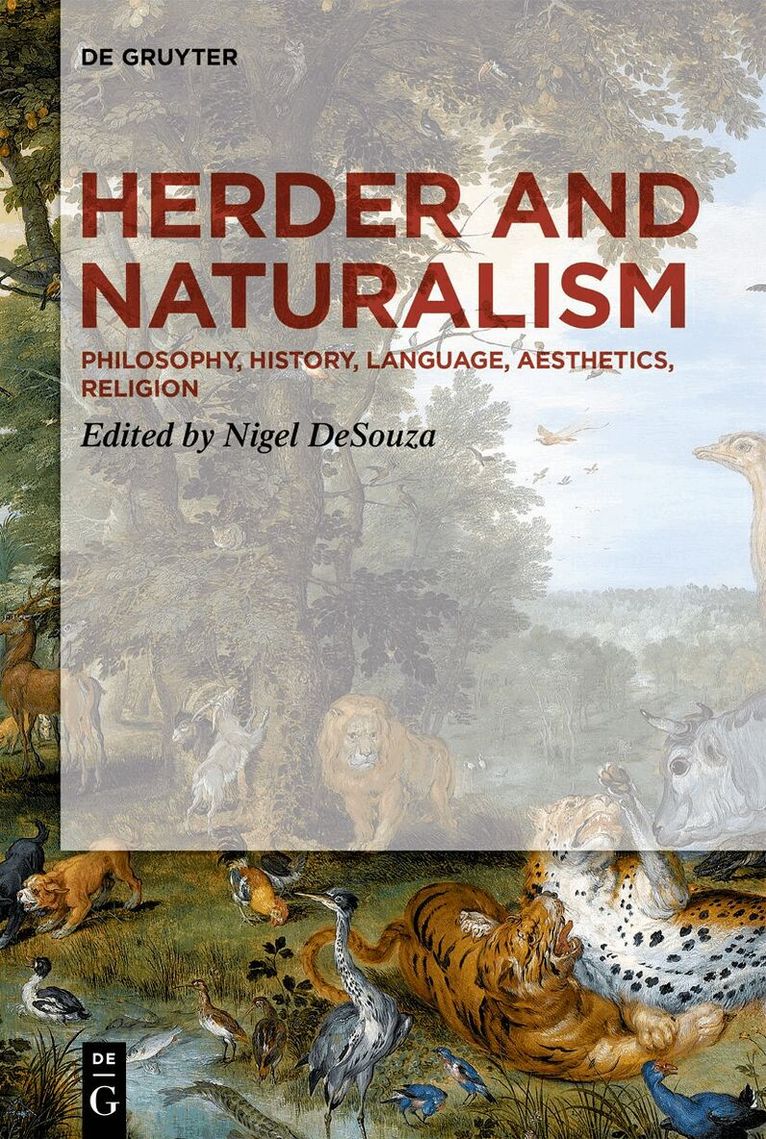
Johann Gottfried Herder did not himself use the term "naturalism", which only appears in the later nineteenth century, but scholars now widely agree that its spirit and intent characterize his thought as a whole. Herder sought to provide an account of human beings that squarely places them in nature. Even though he hastens to clarify that "nature is God in all his works", nature is not to be understood according to divine interventionist principles but rather according to its own immanent principles, such as material and organic forces. The original essays collected here explore the many dimensions of Herder’s naturalism: in philosophy, history, language, aesthetics, and religion. Collectively, they illustrate how Herder sought to show that human beings can only properly be understood when they are situated in their spatio-temporal context as linguistic creatures who, through their interactions with each other and their environment, produce the meanings and values that orient them in art, literature, music, customs and practices, but also in economic and political systems and even in religion. This volume sheds light not only on Herder’s thought, but also on a line of thought that emerged in the Enlightenment but whose importance has only grown.