Noritaka Usami - Böcker
Visar alla böcker från författaren Noritaka Usami. Handla med fri frakt och snabb leverans.
4 produkter
4 produkter
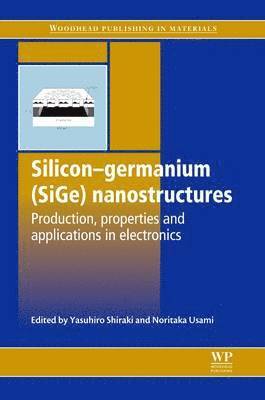
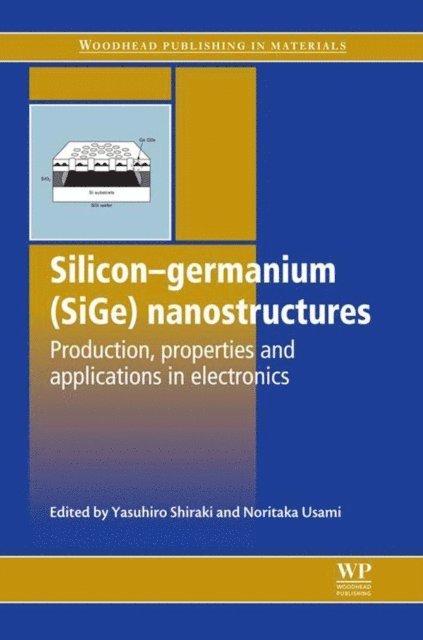
Silicon-Germanium (SiGe) Nanostructures
Production, Properties and Applications in Electronics
Häftad, Engelska, 2016
2 203 kr
Skickas inom 7-10 vardagar
Nanostructured silicon-germanium (SiGe) opens up the prospects of novel and enhanced electronic device performance, especially for semiconductor devices. Silicon-germanium (SiGe) nanostructures reviews the materials science of nanostructures and their properties and applications in different electronic devices.The introductory part one covers the structural properties of SiGe nanostructures, with a further chapter discussing electronic band structures of SiGe alloys. Part two concentrates on the formation of SiGe nanostructures, with chapters on different methods of crystal growth such as molecular beam epitaxy and chemical vapour deposition. This part also includes chapters covering strain engineering and modelling. Part three covers the material properties of SiGe nanostructures, including chapters on such topics as strain-induced defects, transport properties and microcavities and quantum cascade laser structures. In Part four, devices utilising SiGe alloys are discussed. Chapters cover ultra large scale integrated applications, MOSFETs and the use of SiGe in different types of transistors and optical devices.With its distinguished editors and team of international contributors, Silicon-germanium (SiGe) nanostructures is a standard reference for researchers focusing on semiconductor devices and materials in industry and academia, particularly those interested in nanostructures.Reviews the materials science of nanostructures and their properties and applications in different electronic devicesAssesses the structural properties of SiGe nanostructures, discussing electronic band structures of SiGe alloysExplores the formation of SiGe nanostructuresfeaturing different methods of crystal growth such as molecular beam epitaxy and chemical vapour deposition
7 785 kr
Skickas inom 10-15 vardagar
The first two subvolumes III/34Cl and C2 on the Optical Properties of Semiconductor Quantum Structures have been well received by the scientific community. They concentrated on theoretical concepts (chapter 1), experimental methods (chapter 2), III-V semiconductors (chapter 4), I-VII semiconductors (chapter 6), and IV-VI semiconductors (chapter 7) in subvolume Cl. The II-VII materials (chapter 5) have been treated in subvolume C2. The present subvolume III/34C3 finishes the review on optical properties, by adding the chapter 3 on group IV materials. There are exhaustive data on bulk materials including optical properties, starting from diamond C and going over SiC, Si, Ge, to the semimetal grey Sn, and including their alloys—see e.g. Landolt-Börnstein, New Series, Group III, Vol. 41Al 1 and 2, and A2 1 and 2. Silicon is the backbone of the worldwide semiconductor industry. It is an indirect gap material, which seriously hampers its use in light emitting or even laser diodes. There aresome ideas to overcome this problem by forming group IV quantum structures like Si/Ge superlattices or nanocrystals. This hope triggers to a large extend the applied aspects of the research on the optical properties of group IV quantum structures. Though there are also relevant publications on the optical properties of group IV quantum structures involving C or Sn, the by far largest part of work in this field is devoted to the system Si/Ge. Therefore we concentrate here on this system.
1 578 kr
Skickas inom 10-15 vardagar
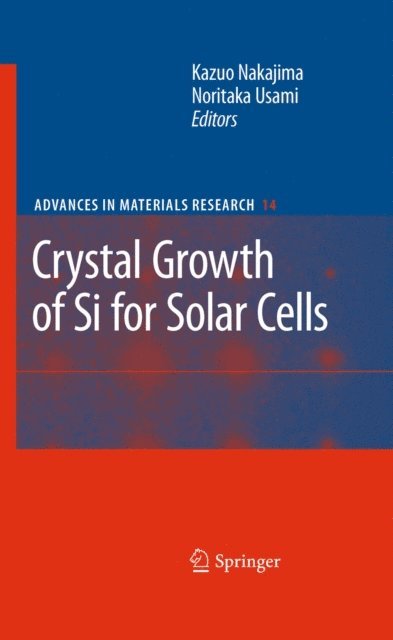
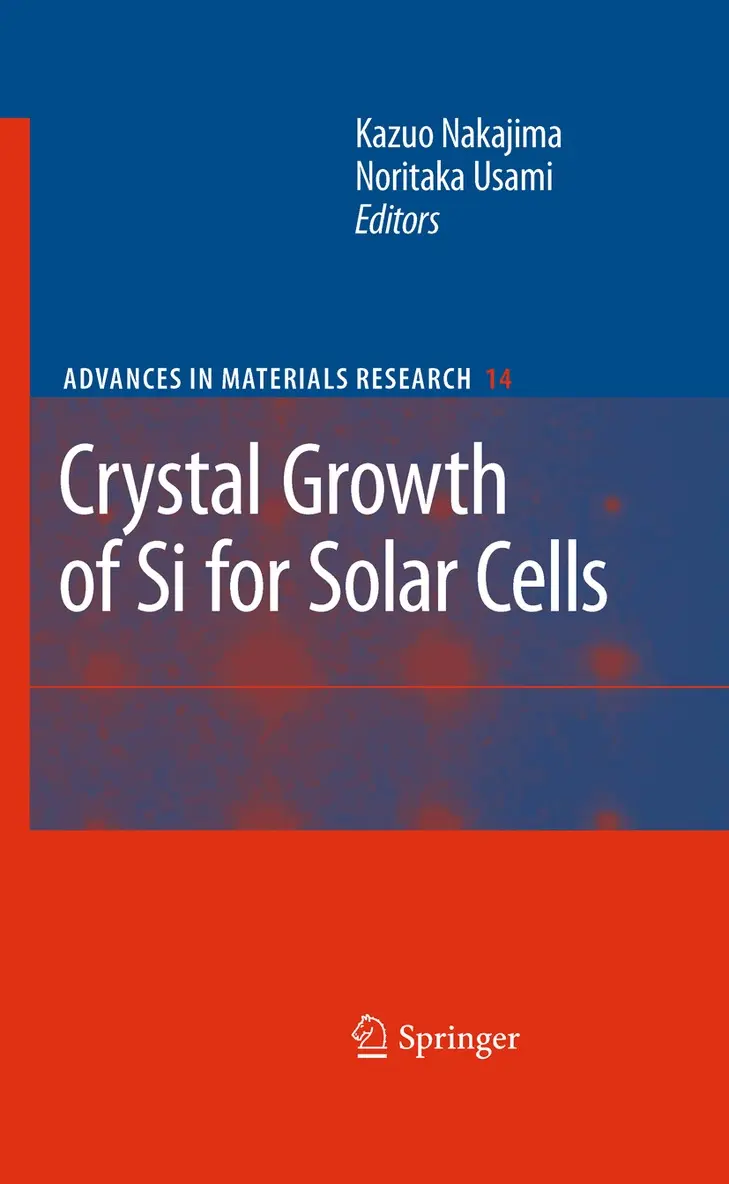
This book, a continuation of the series “Advances in Materials Research,” is intended to provide the general basis of the science and technology of crystal growth of silicon for solar cells. In the face of the destruction of the global environment,the degradationofworld-widenaturalresourcesandtheexha- tion of energy sources in the twenty-?rst century, we all have a sincere desire for a better/safer world in the future. In these days, we strongly believe that it is important for us to rapidly developanewenvironment-friendlycleanenergyconversionsystemusingsolar energyastheultimatenaturalenergysource. Forinstance,mostofournatural resources and energy sources will be exhausted within the next 100 years. Speci?cally, the consumption of oil, natural gas, and uranium is a serious problem. Solar energy is the only ultimate natural energy source. Although 30% of total solar energy is re?ected at the earth’s surface, 70% of total solar energy can be available for us to utilize. The available solar energy amounts to severalthousand times larger than the world’s energy consumption in 2000 of about 9,000 Mtoe (M ton oil equivalent). To manage 10% of the world’s energy consumption at 2050 by solar energy, we must manufacture 40 GW solar cells per year continuously for 40 years. The required silicon feedstock is about 400,000 ton per year. We believe that this is an attainable target, since it can be realized by increasing the world production of silicon feedstock by 12times asmuchasthe presentproductionat2005.
1 578 kr
Skickas inom 10-15 vardagar
This book, a continuation of the series “Advances in Materials Research,” is intended to provide the general basis of the science and technology of crystal growth of silicon for solar cells. In the face of the destruction of the global environment,the degradationofworld-widenaturalresourcesandtheexha- tion of energy sources in the twenty-?rst century, we all have a sincere desire for a better/safer world in the future. In these days, we strongly believe that it is important for us to rapidly developanewenvironment-friendlycleanenergyconversionsystemusingsolar energyastheultimatenaturalenergysource. Forinstance,mostofournatural resources and energy sources will be exhausted within the next 100 years. Speci?cally, the consumption of oil, natural gas, and uranium is a serious problem. Solar energy is the only ultimate natural energy source. Although 30% of total solar energy is re?ected at the earth’s surface, 70% of total solar energy can be available for us to utilize. The available solar energy amounts to severalthousand times larger than the world’s energy consumption in 2000 of about 9,000 Mtoe (M ton oil equivalent). To manage 10% of the world’s energy consumption at 2050 by solar energy, we must manufacture 40 GW solar cells per year continuously for 40 years. The required silicon feedstock is about 400,000 ton per year. We believe that this is an attainable target, since it can be realized by increasing the world production of silicon feedstock by 12times asmuchasthe presentproductionat2005.