Ola Listhaug - Böcker
Visar alla böcker från författaren Ola Listhaug. Handla med fri frakt och snabb leverans.
6 produkter
6 produkter
778 kr
Skickas inom 7-10 vardagar
Democratic elections are designed to create unequal outcomes: for some to win, others have to lose. This book examines the consequences of this inequality for the legitimacy of democratic political institutions and systems. Using survey data collected in democracies around the globe, the authors argue that losing generates ambivalent attitudes towards political authorities. Because the efficacy and ultimately the survival of democratic regimes can be seriously threatened if the losers do not consent to their loss, the central themes of this book focus on losing: how losers respond to their loss and how institutions shape losing. While there tends to be a gap in support for the political system between winners and losers, it is not ubiquitous. The book paints a picture of losers' consent that portrays losers as political actors whose experience and whose incentives to accept defeat are shaped both by who they are as individuals as well as the political environment in which loss is given meaning. Given that the winner-loser gap in legitimacy is a persistent feature of democratic politics, the findings presented in this book contain crucial implications for our understanding of the functioning and stability of democracies. Comparative Politics is a series for students and teachers of political science that deals with contemporary government and politics. The General Editors are Professor Alfio Mastropaolo, University of Turin and Kenneth Newton, University of Southampton and Wissenschaftszentrum Berlin . The series is published in association with the European Consortium for Political Research.
2 324 kr
Skickas inom 5-8 vardagar
Democratic elections are designed to create unequal outcomes: for some to win, others have to lose. This book examines the consequences of this inequality for the legitimacy of democratic political institutions and systems. Using survey data collected in democracies around the globe, the authors argue that losing generates ambivalent attitudes towards political authorities. Because the efficacy and ultimately the survival of democratic regimes can be seriously threatened if the losers do not consent to their loss, the central themes of this book focus on losing: how losers respond to their loss and how institutions shape losing. While there tends to be a gap in support for the political system between winners and losers, it is not ubiquitous. The book paints a picture of losers' consent that portrays losers as political actors whose experience and whose incentives to accept defeat are shaped both by who they are as individuals as well as the political environment in which loss is given meaning. Given that the winner-loser gap in legitimacy is a persistent feature of democratic politics, the findings presented in this book contain crucial implications for our understanding of the functioning and stability of democracies.
Building Democracy in the Yugoslav Successor States
Accomplishments, Setbacks, and Challenges since 1990
Inbunden, Engelska, 2017
1 100 kr
Skickas inom 7-10 vardagar
Building democracy in societies that have known only authoritarian rule for half a century is complicated. Taking the post-Yugoslav region as its case study, this volume shows how success with democratisation depends on various factors, including establishing the rule of law, the consolidation of free media, and society's acceptance of ethnic, religious and sexual minorities. Surveying the seven successor states, the authors argue that Slovenia is in a class by itself as the most successful, with Croatia and Serbia not far behind. The other states - Bosnia-Herzegovina, Macedonia, Montenegro, and Kosovo - are all struggling with problems of corruption, poverty, and unemployment. The authors treat the issue of values as a policy problem in its own right, debating the extent to which values have been transformed by changes in education and the media, how churches and women's organisations have entered into the policy debate, and whether governments have embraced a programme designed to effect changes in values.
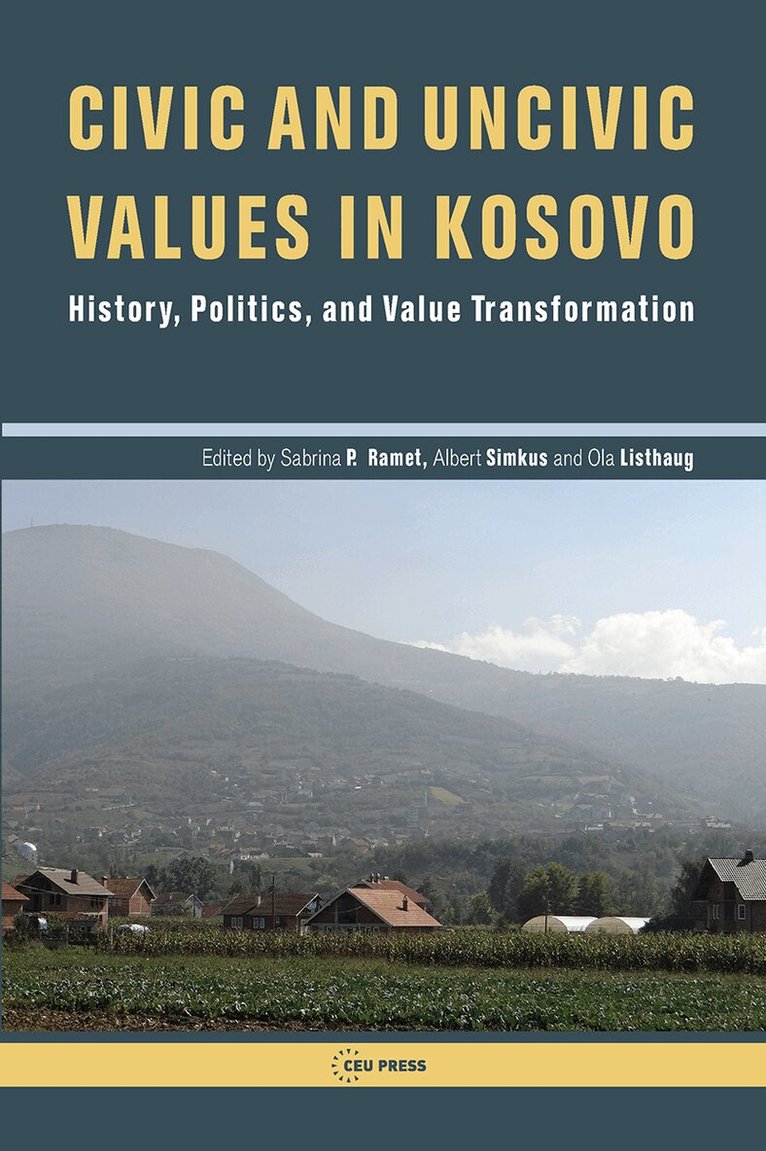
Civic and Uncivic Values in Kosovo
History, Politics, and Value Transformation
Inbunden, Engelska, 2015
2 034 kr
Skickas inom 10-15 vardagar
This volume is based on the conviction that the key to the establishment of stable liberal democracy lies in the completion of three interrelated tasks: The creation of effective political institutions, the implementation of the rule of law, and the promotion of civic values.
1 023 kr
Skickas inom 10-15 vardagar
This volume is driven by the conviction that the key to the establishment of stable liberal democracy anywhere in the world and, in this case, in Kosovo lies in the completion of three interrelated tasks: first, the creation of effective political institutions, based on the principle of the separation of powers (including the independence of the judiciary); second, the promotion of the rule of law; and, third, the promotion of civic values, including tolerance or ethnic/religious/sexual minorities, trust, and respect for the harm principle. In fact, there are problems across all three measures, including with judicial independence, with the rule of law, and with civic values. On the last of these, research findings show that the citizens of Kosovo rank extremely low on trust of other citizens, low on engagement in social organizations, and tolerance of gays, lesbians, and atheists, but high on trust in the political institutions of their country and in pride of their newly independent state.
2 095 kr
Skickas inom 10-15 vardagar
Discusses Serbia’s struggle for democratic values after the fall of the Miloševic regime provoked by the NATO war, and after the trauma caused by the secession of Kosovo. Are the value systems of the post-Miloševic era true stumbling blocks of a delayed transition of this country? Seventeen contributors from Norway, Serbia, Italy, Germany, Poland and some other European countries covered a broad range of topics in order to provide answers to this question. The subjects of their investigations were national myths and symbols, history textbooks, media, film, religion, inter-ethnic dialogue, transitional justice, political party agendas and other related themes. The authors of the essays represent different scholarly disciplines whose theoretical conceptions and frameworks are employed in order to analyze two alternative value systems in Serbia: liberal, cosmopolitan and civic on the one hand, and traditional, provincial, nationalist on the other.