Oliver Zimmer - Böcker
Visar alla böcker från författaren Oliver Zimmer. Handla med fri frakt och snabb leverans.
9 produkter
9 produkter
468 kr
Skickas inom 7-10 vardagar
Across Europe the late nineteenth century marked a period of rapid economic change, increased migration, religious conflict, and inter-state competition. In Germany, these developments were further accentuated by the creation of the imperial state in 1870-1871, and the conflicting hopes and expectations it provoked. Attempting to make sense of this turbulent period of German history, historians have frequently reverted to terms such as industrialization, urbanization, nation-formation, modernity or modernization. Using the prism of comparative urban history, Oliver Zimmer highlights the limitations of these conceptual abstractions and challenges the separation of local and national approaches to the past. He shows how men and women drew on their creative energies to instigate change at various levels.Focusing on conflicts over the local economy and elementary schools, as well as on nationalist and religious processions, Remaking the Rhythms of Life examines how urban residents sought to regain a sense of place in a changing world - less by resisting the novel than by reconfiguring their environments in ways that reflected their sensibilities and aspirations; less by lamenting the decline of civic virtues than by creating surroundings that proved sufficiently meaningful to sustain lives. In their capacity as consumers, citizens, and members of religious or economic associations, people embarked on a multitude of journeys. As they did, larger phenomena such as religion, nationalism, and the state became intertwined with their everyday affairs and concerns.
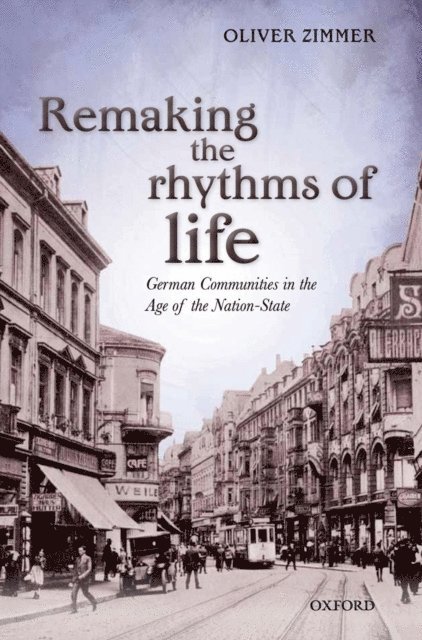
Remaking the Rhythms of Life
German Communities in the Age of the Nation-State
Inbunden, Engelska, 2013
948 kr
Skickas inom 5-8 vardagar
Across Europe the late nineteenth century marked a period of rapid economic change, increased migration, religious conflict, and inter-state competition. In Germany, these developments were further accentuated by the creation of the imperial state in 1870-1871, and the conflicting hopes and expectations it provoked. Attempting to make sense of this turbulent period of German history, historians have frequently reverted to terms such as industrialization, urbanization, nation-formation, modernity or modernization. Using the prism of comparative urban history, Oliver Zimmer highlights the limitations of these conceptual abstractions and challenges the separation of local and national approaches to the past. He shows how men and women drew on their creative energies to instigate change at various levels.Focusing on conflicts over the local economy and elementary schools, as well as on nationalist and religious processions, Remaking the Rhythms of Life examines how urban residents sought to regain a sense of place in a changing world - less by resisting the novel than by reconfiguring their environments in ways that reflected their sensibilities and aspirations; less by lamenting the decline of civic virtues than by creating surroundings that proved sufficiently meaningful to sustain lives. In their capacity as consumers, citizens, and members of religious or economic associations, people embarked on a multitude of journeys. As they did, larger phenomena such as religion, nationalism, and the state became intertwined with their everyday affairs and concerns.
379 kr
Skickas inom 10-15 vardagar
While nationalism had become politically significant well before the late nineteenth century, it was between 1890 and 1940 that it revealed its political explosiveness and destructive potential.Organised around specific themes, many of which are currently hotly debated among experts in the field, Oliver Zimmer's study discusses such key issues as: the modernity of nations and nationalism, the formation of the nationalising state and the significance of national ritual for modern mass-nations, the ways in which nationalism shaped the treatment of minorities, the relationship between nationalism and fascism, and the perception of nationalism by liberals and socialists. Zimmer's account is more explicitly focused on conceptual issues than most textbooks on the subject, and also more historical and historiographical than many of the existing theoretical overviews. The result is an incisive examination of the most powerful ideology of modern times.
712 kr
Skickas inom 7-10 vardagar
This book examines the ways in which the Swiss defined their national identity in the long nineteenth century, in the face of a changing domestic and international background. Its narrative begins in 1761, when the first Swiss patriotic society of national significance was founded, and ends in 1891, when the Swiss celebrated their 600-year existence as a nation in a monumental national festival. While conceding that the creation of a nation-state in 1848 marked a watershed in the history of Swiss nation-formation, the author does not focus one-sidedly - as many others have done - on the activities of the nationalizing state. Instead, he attributes a key role to the competitive and contentious struggles over the shaping of public institutions and over the symbolic representation of the nation. These struggles, to which the nation-state and civil society contributed in equal measure, were framed increasingly along national lines.
550 kr
Skickas inom 7-10 vardagar
Few would doubt the central importance of the nation in the making and unmaking of modern political communities. The long history of 'the nation' as a concept and as a name for various sorts of 'imagined community' likewise commands such acceptance. But when did the nation first become a fundamental political factor? This is a question which has been, and continues to be, far more sharply contested. A deep rift still separates 'modernist' perspectives, which view the political nation as a phenomenon limited to modern, industrialised societies, from the views of scholars concerned with the pre-industrial world who insist, often vehemently, that nations were central to pre-modern political life also. This book engages with these questions by drawing on the expertise of leading medieval, early modern and modern historians.
1 539 kr
Skickas inom 7-10 vardagar
This book examines the ways in which the Swiss defined their national identity in the long nineteenth century, in the face of a changing domestic and international background. Its narrative begins in 1761, when the first Swiss patriotic society of national significance was founded, and ends in 1891, when the Swiss celebrated their 600-year existence as a nation in a monumental national festival. While conceding that the creation of a nation-state in 1848 marked a watershed in the history of Swiss nation-formation, the author does not focus one-sidedly - as many others have done - on the activities of the nationalizing state. Instead, he attributes a key role to the competitive and contentious struggles over the shaping of public institutions and over the symbolic representation of the nation. These struggles, to which the nation-state and civil society contributed in equal measure, were framed increasingly along national lines.
1 485 kr
Skickas inom 7-10 vardagar
Few would doubt the central importance of the nation in the making and unmaking of modern political communities. The long history of 'the nation' as a concept and as a name for various sorts of 'imagined community' likewise commands such acceptance. But when did the nation first become a fundamental political factor? This is a question which has been, and continues to be, far more sharply contested. A deep rift still separates 'modernist' perspectives, which view the political nation as a phenomenon limited to modern, industrialised societies, from the views of scholars concerned with the pre-industrial world who insist, often vehemently, that nations were central to pre-modern political life also. This book engages with these questions by drawing on the expertise of leading medieval, early modern and modern historians.
233 kr
Skickas inom 3-6 vardagar
211 kr
Skickas inom 3-6 vardagar