Omar Prakash – Författare
Visar alla böcker från författaren Omar Prakash. Handla med fri frakt och snabb leverans.
6 produkter
6 produkter
550 kr
Skickas inom 10-15 vardagar
This volume, the second in a series on topics in microcomputers in critical care and pulmonary physiology,' contains the proceedings of the Second International Symposium on Computers in Critical Care and Pulmonary Medicine, held at the University of Lund in 1980 under the.,chairmanship of Prof. B. Jonson, M.D., Department of Clinical Physiology, University of Lund, Sweden. Clinicians and biomedical engineers from many countries parti cipated in a three day deliberation. Of special interest was the introduction of nuclear techniques in pulmonary medicine for the first time in this symposium series. It is the intention of the steering committee that such meetings should take place on an annual basis in the rapidly changing world of the science and technology of computing in clinical care, in prac tice and in pulmonary medicine. Editorial modification of the papers in this volume has been kept to a minimum. Changes have been made to ensure some uniformity in presentation and there has been some alteration of the English to avoid ambiguity, but our intervention has gone no further than that. It is hoped that the contents of this volume will enable those who are interested in the subject matter to be more aware of research developments occurring in so many different disciplines and so many different centres in America and Europe. Finally, I would like to thank Miss Bodil Richardson for her or ganisational and secretarial help. Thanks are also due to Prof. J.P.
3 266 kr
Skickas inom 10-15 vardagar
Del 8 - Developments in Critical Care Medicine and Anaesthesiology
Critical Care of the Child
Häftad, Engelska, 2011
550 kr
Skickas inom 10-15 vardagar
This volume represents a review of recent work presented by eminent scientists at the Second International Symposium on 'Applied Physiology in Critical Care with Emphasis on Children' at Aruba, Netherlands Antilles, November 28 - 2 December, 1983. We are grateful to the keynote speakers who accepted our invitation and completed their chapters in time for the press. I must thank the Government of Aruba, the Tourist Office of Aruba, Mr Frank Croes and Mr Betico Croes for their support and generosity for organizing this symposium. My sincere thanks go to Mr Rory Arends, Lucy Arends, Simon Meij and Norma van Toornburg for their untiring efforts and cooperation. Omar Prakash, MD IX List of contributors Bryan, A.Ch., MB, BS, PhD, FRCP (C), The Hospital for Sick Children, 555 University Avenue, Toronto, Ontario, Canada M5G 1X8 Bryan, H., MD, Department of Pediatrics, Room 1241, Mount Sinai Hospital and The Hospital for Sick Children, University of Toronto, Ontario, Canada M5G 1X5 co-authors: A.L. Campbell, Y. Zarfin, M. Groenveld, P. Duffty Enhorning, G., MD, University of Toronto, Toronto Western Hospital, 399 Bathurst Street, Toronto, Ontario, Canada M5T 2S8 Gross, I., MD, Perinatal Medicine, Yale University School of Medicine, P.O.
Del 5 - Developments in Critical Care Medicine and Anaesthesiology
Computing in Anesthesia and Intensive Care
Häftad, Engelska, 2011
550 kr
Skickas inom 10-15 vardagar
There is a tendency of an increasing number of signals and derived variables to be incorporated in the monitoring of patients during anesthesia and in intensive care units. The addition of new signals hardly ever leads to thedeletion of other signals. This is probably based on a feeling of insecurity. We must realize that each new signal that is being monitored brings along its cost, in terms of risk to the patient, investment and time. It is therefore essential to assess the relative contribution of this new signal to the quality of the monitoring process; i. e. given the set of signals already in use, what is the improvement when a new signal is added? Beyond a certain point the addition of new information leads to new uncertainty and degrades the result (Ream, 1981) In the diagnostic process, it is possible to evaluate "result" in an objective, qualitative way. The changes in the sensitivity and specificity of the diagnosis as a result of the addition or deletion of a certain variable can be calculated on the basis of false negative, false positive, correct negative and false negative scores. Different methods for multiple regression analysis have been implemented on computers (Gelsema, 1981) which can support such decision processes. In monitoring, the situation is much more complex. Many definitions of monitoring have been given; the common denominator is that monitoring is a continuous diagnostic process based upon a (semi)continuous flow of information. This makes simple assessment methods useless.
3 266 kr
Skickas inom 10-15 vardagar
Del 10 - Developments in Critical Care Medicine and Anaesthesiology
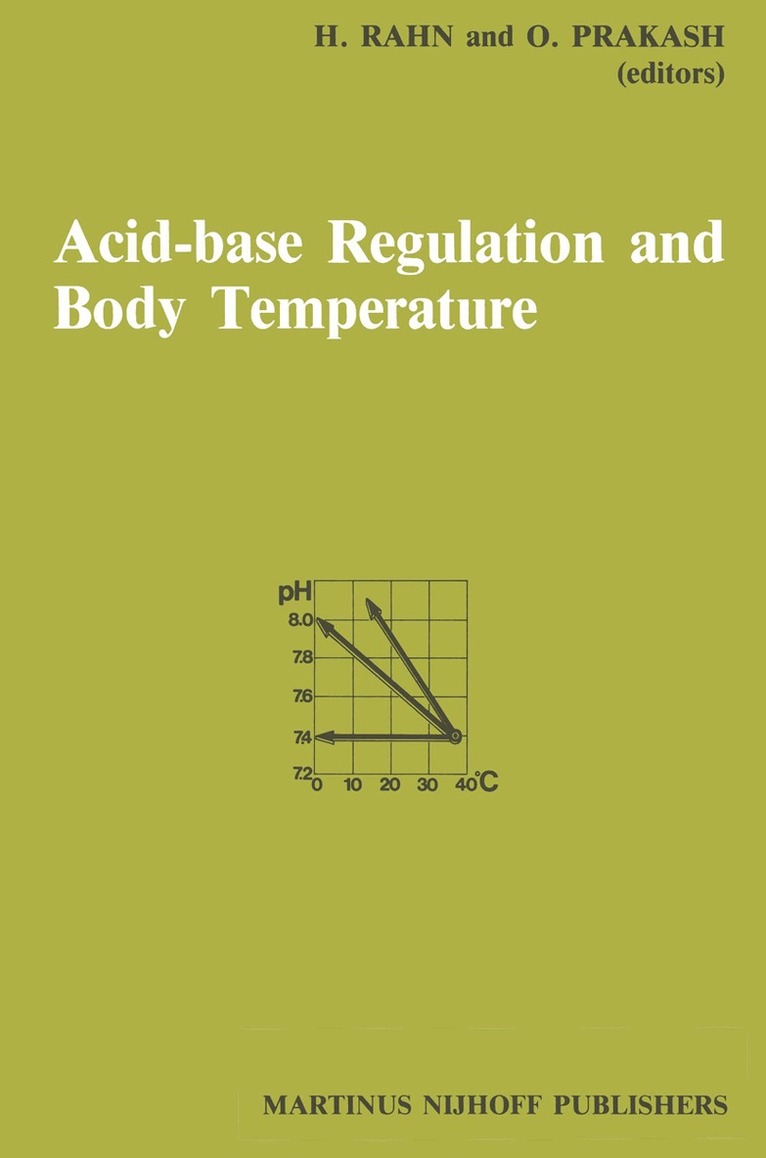
Acid-Base Regulation and Body Temperature
Häftad, Engelska, 2011
550 kr
Skickas inom 10-15 vardagar
During the last 20 years two groups of investigators have concerned themselves with the problem of acid-base regulation at various body temperatures. Each group, in professional isolation, pursued a separate path. Surgeons and anesthe tists developed techniques and tools for hypothermic cardio-pulmonary by-pass operations and based their rationale for acid-base management on in vitro models of blood behavior. Physiologists and biochemists, on the other hand, endeavored to understand acid-base regulation in living organisms naturally subjected to changes in body temperature. Only in the last decade has there been an increasing awareness that each group could benefit from the other's experiences. With this goal in mind members of both groups were invited to present their views and observations in the hope of arriving at a better understanding of acid-base management during hypothermia and gaining a greater insight into the factors which control acid-base regulation during normothermia. This led to the presen tation of the present volume with the aim of providing the clinician with a survey of present theories and the resulting strategies for management of the hypother mic patient. Acknowledgment The editors express their great appreciation to Miss Augusta Dustan for her dedicated effort in the preparation and editing of the manuscripts. Contributors Heinz Becker, M. D. Department of Surgery, University of California Medical Center, Los An geles, Los Angeles, CA 90024, U. S. A. Gerald D. Buckberg, M. D. Department of Surgery, University of California Medical Center, Los An geles, CA 90024, U. S. A.