Owen Gingerich - Böcker
Visar alla böcker från författaren Owen Gingerich. Handla med fri frakt och snabb leverans.
10 produkter
10 produkter
345 kr
Skickas inom 5-8 vardagar
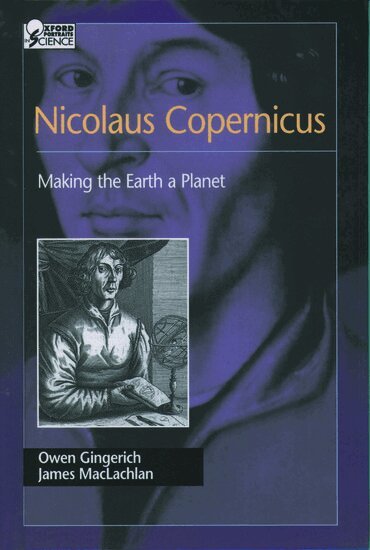
Born in Poland in 1473, Nicolaus Copernicus launched a quiet revolution. No scientist so radically transformed our understanding of our place in the universe as this curious bishop's doctor and church official. In his quest to discover a beautiful and coherent system to describe the motions of the planets, Copernicus placed the sun in the center of the system and made the earth a planet traveling around the sun. Today it is hard to imagine our solar system any other way, but for his time Copernicus's idea was earthshaking. In 1616 the church banned his book Revolutions because it contradicted the accepted notion that God placed Earth in the center of the universe. Even though those who knew of his work considered his idea dangerous, Revolutions remained of interest only to other scientists for many years. It took almost two hundred years for his concept of a sun-centered system to reach the general public. None the less, what Copernicus set out in his remarkable text truly revolutionized science. For this, Copernicus, a quiet doctor who made a tremendous leap of imagination, is considered the father of the Scientific Revolution.
108 kr
Skickas inom 5-8 vardagar
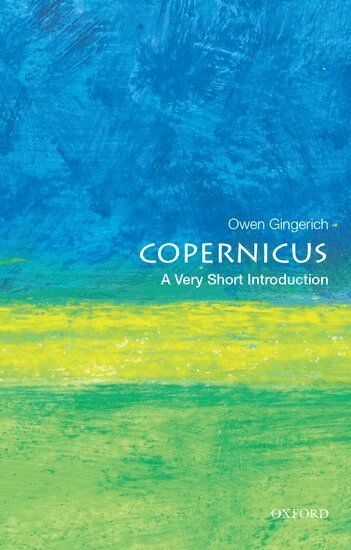
Nicolaus Copernicus (1473-1543) is a pivotal figure in the birth of modern science, the astronomer who "stopped the sun and set the earth in motion." Born in Poland, educated at Cracow and then in Italy, he served all of his adult life as a church administrator. His vision of a sun-centered universe, shocking to many and unbelievable to most, turned out to be the essential blueprint for a physical understanding of celestial motions, thereby triggering what is commonly called "the Copernican revolution." A first edition of his world-changing treatise, De Revolutionibus Orbium Coelestium, has most recently been auctioned for more than $2 million.In this book, leading historian of science Owen Gingerich sets Copernicus in the context of a rapidly changing world, where the recent invention of printing with moveable type not only made sources more readily available to him, but also fueled Martin's Luther's transformation of the religious landscape. In an era of geographical exploration and discovery, new ideas were replacing time-honored concepts about the extent of inhabited continents. Gingerich reveals Copernicus' heliocentric revolution as an aesthetic achievement not dictated by observational "proofs," but another new way of looking at the ancient cosmos.Deftly combining astronomy and history, this Very Short Introduction offers a fascinating portray of the man who launched the modern vision of the universe. Out of Gingerich's engaging biography emerges the image of a scientist, intellectual, patriot, and reformer, who lived in an era when political as well as religious beliefs were shifting.
929 kr
Skickas inom 10-15 vardagar
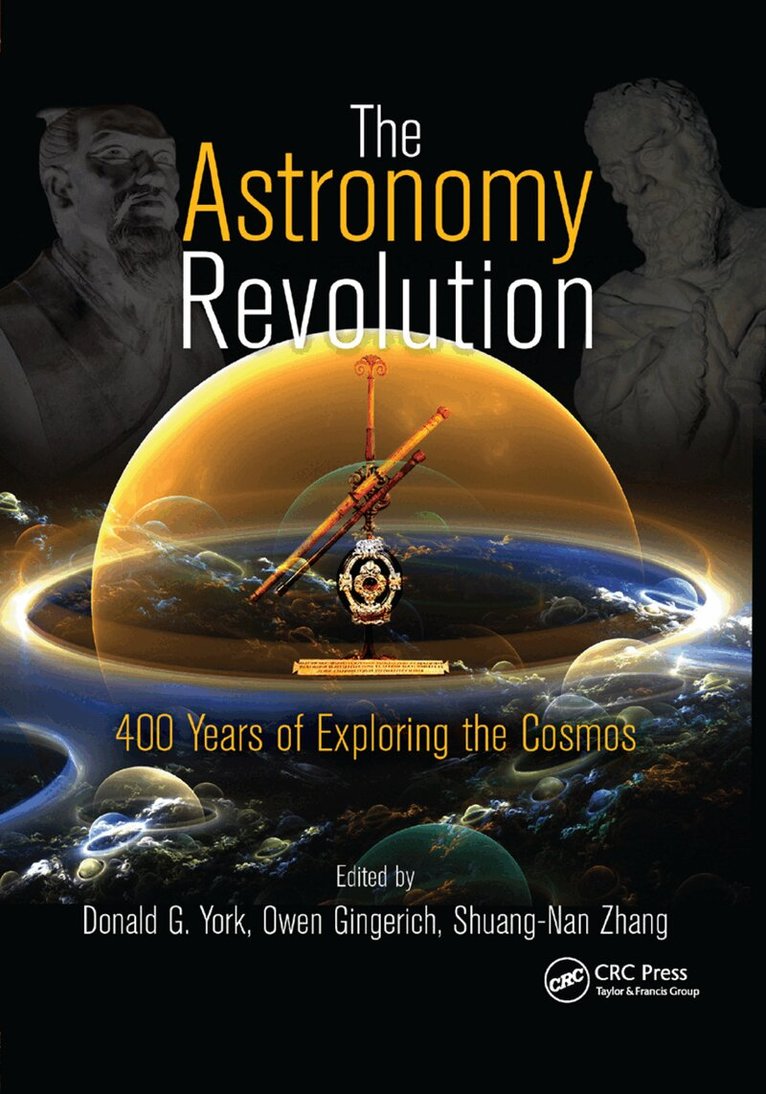
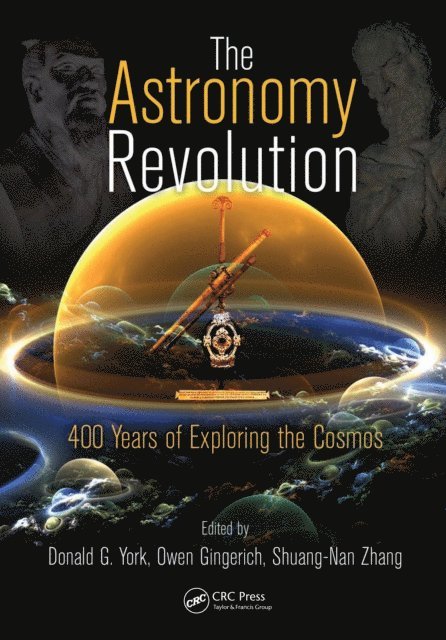
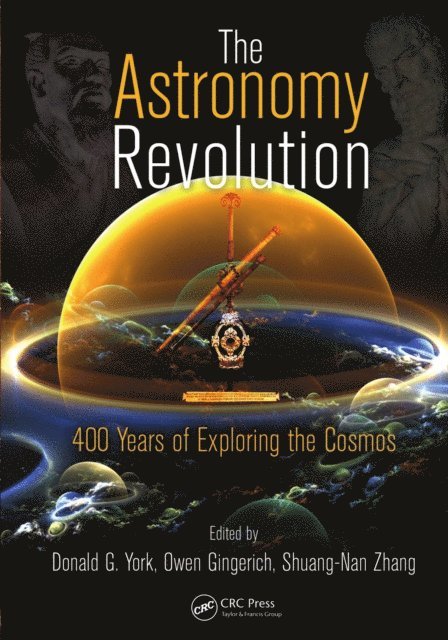
Some 400 years after the first known patent application for a telescope by Hans Lipperhey, The Astronomy Revolution: 400 Years of Exploring the Cosmos surveys the effects of this instrument and explores the questions that have arisen out of scientific research in astronomy and cosmology. Inspired by the international New Vision 400 conference held in Beijing in October 2008, this interdisciplinary volume brings together expanded and updated contributions from 26 esteemed conference speakers and invited others. Looking beyond questions of science to the role of moral responsibility in human civilizations, the book offers the unique vantage points of contributions from both Eastern and Western cultures.Extensively illustrated in full color, this book consists of six parts. Aimed at young scientists, the first part presents perspectives on creativity and technology in scientific discovery. In the second part, contributors examine how the telescope has impacted our knowledge of the Universe—from the formation of galaxies to the death of stars. The third part of the book outlines some of the challenges we face in understanding dark matter, dark energy, black holes, and cosmic rays, and the fourth part discusses new technologies that will be useful in attacking new and unresolved questions. The fifth part of the book examines the intellectual impact that the telescope has had on society in China and in the West.The book concludes with an investigation of "big questions": What is the origin of the laws of physics as we know them? Are these laws the same everywhere? How do these scientific laws relate to the moral laws of society? Does what we know depend on cultural ways of asking the questions? Is there life elsewhere? And what about the questions that science cannot answer? Celebrating the historical significance of the telescope, this unique book seeks to inspire all those involved or interested i
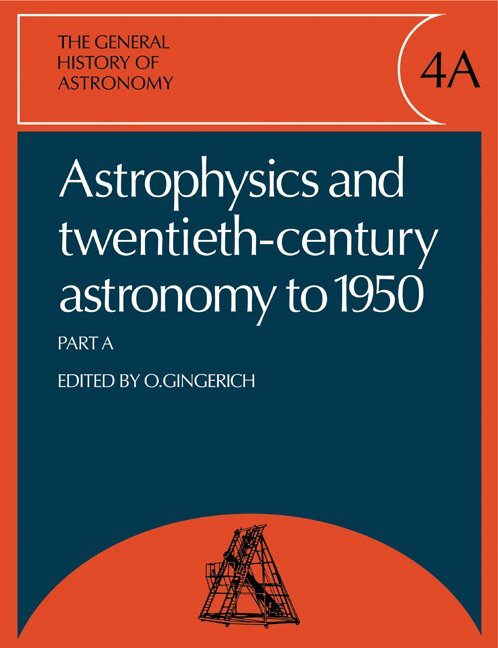
The General History of Astronomy: Volume 4, Astrophysics and Twentieth-Century Astronomy to 1950: Part A
Häftad, Engelska, 2010
507 kr
Skickas inom 7-10 vardagar
Volume 4 of The General History of Astronomy, originally published in 1984, concerns the birth of modern astrophysics in the nineteenth century, the growth of astronomical institutions to around 1920, and the development of instrumentation. The volume commences in the 1850s, with the first astronomical applications of photography and spectral analysis. It closes in the 1950s, before the explosive growth made possible by new electronic devices and computers. In Part A, there are eleven chapters, written by an international panel of eighteen authors, on subjects such as observatories, large telescopes, astronomy in the southern hemisphere, and early radio astronomy. Intended for general readership, this book formed part of an in-depth synthesis of the development of astronomy from the earliest times.
621 kr
Skickas inom 10-15 vardagar
We live in a universe with a very long history, a vast cosmos where things are being worked out over unimaginably long ages. Stars and galaxies have formed, and elements come forth from great stellar cauldrons. The necessary elements are present, the environment is fit for life, and slowly life forms have populated the earth. Are the creative forces purposeful, and in fact divine?Owen Gingerich believes in a universe of intention and purpose. We can at least conjecture that we are part of that purpose and have just enough freedom that conscience and responsibility may be part of the mix. They may even be the reason that pain and suffering are present in the world. The universe might actually be comprehensible.Taking Johannes Kepler as his guide, Gingerich argues that an individual can be both a creative scientist and a believer in divine design—that indeed the very motivation for scientific research can derive from a desire to trace God’s handiwork. The scientist with theistic metaphysics will approach laboratory problems much the same as does his atheistic colleague across the hall. Both are likely to view the astonishing adaptations in nature with a sense of surprise, wonder, and mystery.In God’s Universe Gingerich carves out “a theistic space” from which it is possible to contemplate a universe where God plays an interactive role, unnoticed yet not excluded by science.
394 kr
Skickas inom 10-15 vardagar
With exoplanets being discovered daily, Earth is still the only planet we know of that is home to creatures who seek a coherent explanation for the structure, origins, and fate of the universe, and of humanity’s place within it. Today, science and religion are the two major cultural entities on our planet that share this goal of coherent understanding, though their interpretation of evidence differs dramatically. Many scientists look at the known universe and conclude we are here by chance. The renowned astronomer and historian of science Owen Gingerich looks at the same evidence—along with the fact that the universe is comprehensible to our minds—and sees it as proof for the planning and intentions of a Creator-God. He believes that the idea of a universe without God is an oxymoron, a self-contradiction. God’s Planet exposes the fallacy in thinking that science and religion can be kept apart.Gingerich frames his argument around three questions: Was Copernicus right, in dethroning Earth from its place at the center of the universe? Was Darwin right, in placing humans securely in an evolving animal kingdom? And was Hoyle right, in identifying physical constants in nature that seem singularly tuned to allow the existence of intelligent life on planet Earth? Using these episodes from the history of science, Gingerich demonstrates that cultural attitudes, including religious or antireligious beliefs, play a significant role in what passes as scientific understanding. The more rigorous science becomes over time, the more clearly God’s handiwork can be comprehended.
Planetary, Lunar, and Solar Positions, New and Full Moons, a.D. 1650-1805
Memoirs, American Philosophical Society (vol. 59S)
Inbunden, Engelska, 1983
434 kr
Skickas inom 10-15 vardagar
557 kr
Skickas inom 5-8 vardagar
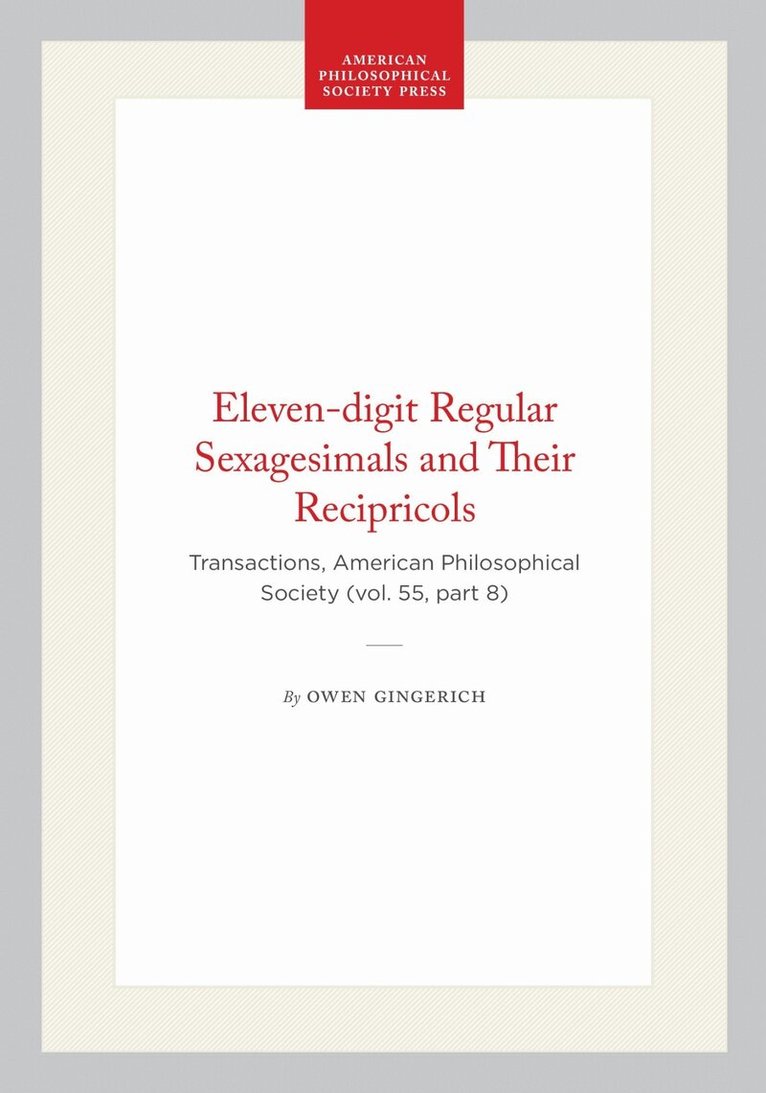
Eleven-digit Regular Sexagesimals and Their Recipricols
Transactions, American Philosophical Society (vol. 55, Part 8)
Häftad, Engelska, 1965
928 kr
Skickas inom 10-15 vardagar
2 558 kr
Skickas inom 10-15 vardagar
Some 400 years after the first known patent application for a telescope by Hans Lipperhey, The Astronomy Revolution: 400 Years of Exploring the Cosmos surveys the effects of this instrument and explores the questions that have arisen out of scientific research in astronomy and cosmology. Inspired by the international New Vision 400 conference held in Beijing in October 2008, this interdisciplinary volume brings together expanded and updated contributions from 26 esteemed conference speakers and invited others. Looking beyond questions of science to the role of moral responsibility in human civilizations, the book offers the unique vantage points of contributions from both Eastern and Western cultures.Extensively illustrated in full color, this book consists of six parts. Aimed at young scientists, the first part presents perspectives on creativity and technology in scientific discovery. In the second part, contributors examine how the telescope has impacted our knowledge of the Universe—from the formation of galaxies to the death of stars. The third part of the book outlines some of the challenges we face in understanding dark matter, dark energy, black holes, and cosmic rays, and the fourth part discusses new technologies that will be useful in attacking new and unresolved questions. The fifth part of the book examines the intellectual impact that the telescope has had on society in China and in the West.The book concludes with an investigation of "big questions": What is the origin of the laws of physics as we know them? Are these laws the same everywhere? How do these scientific laws relate to the moral laws of society? Does what we know depend on cultural ways of asking the questions? Is there life elsewhere? And what about the questions that science cannot answer? Celebrating the historical significance of the telescope, this unique book seeks to inspire all those involved or interested i