Pascale-Anne Brault - Böcker
Visar alla böcker från författaren Pascale-Anne Brault. Handla med fri frakt och snabb leverans.
7 produkter
7 produkter
258 kr
Skickas inom 7-10 vardagar
Jacques Derrida is, in the words of the New York Times, "perhaps the world's most famous philosopher if not the only famous philosopher." He often provokes controversy as soon as his name is mentioned. But he also inspires the respect that comes from an illustrious career, and, among many who were his colleagues and peers, he inspired friendship. The Work of Mourning is a collection that honors those friendships in the wake of passing. Gathered here are texts letters of condolence, memorial essays, eulogies, funeral orations written after the deaths of well-known figures: Roland Barthes, Paul de Man, Michel Foucault, Louis Althusser, Edmond Jab\u00e8s, Louis Marin, Sarah Kofman, Gilles Deleuze, Emmanuel Levinas, Jean-Fran\u00e7ois Lyotard, Max Loreau, Jean-Marie Benoist, Joseph Riddel, and Michel Servi\u00e8re. With his words, Derrida bears witness to the singularity of a friendship and to the absolute uniqueness of each relationship.In each case, he is acutely aware of the questions of tact, taste, and ethical responsibility involved in speaking of the dead the risks of using the occasion for one's own purposes, political calculation, personal vendetta, and the expiation of guilt. More than a collection of memorial addresses, this volume sheds light not only on Derrida's relation to some of the most prominent French thinkers of the past quarter century but also on some of the most important themes of Derrida's entire oeuvre-mourning, the "gift of death," time, memory, and friendship itself. "In his rapt attention to his subjects' work and their influence upon him, the book also offers a hesitant and tangential retelling of Derrida's own life in French philosophical history. There are illuminating and playful anecdotes how Lyotard led Derrida to begin using a word-processor; how Paul de Man talked knowledgeably of jazz with Derrida's son. Anyone who still thinks that Derrida is a facetious punster will find such resentful prejudice unable to survive a reading of this beautiful work."Steven Poole, Guardian "Strikingly simpa meditations on friendship, on shared vocations and avocations and on philosophy and history." Publishers Weekly
392 kr
Skickas inom 7-10 vardagar
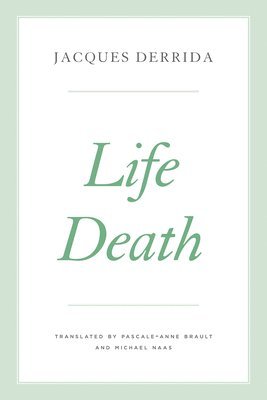
One of Jacques Derrida's richest and most provocative works, Life Death challenges and deconstructs one of the most deeply rooted dichotomies of Western thought: life and death. Here Derrida rethinks the traditional philosophical understanding of the relationship between life and death, undertaking multidisciplinary analyses of a range of topics, including philosophy, linguistics, and the life sciences. In seeking to understand the relationship between life and death, he engages in close readings of Freudian psychoanalysis, the philosophy of Nietzsche and Heidegger, French geneticist Francois Jacob, and epistemologist Georges Canguilhem.Derrida gave his "Life Death" seminar over fourteen sessions between 1975 and 1976 at the Ecole normale superieure in Paris as part of the preparation for students studying for the agregation, a notoriously competitive qualifying exam. The theme for the exam that year was "Life and Death," but Derrida made a critical modification to the title by dropping the coordinating conjunction. The resulting title of Life Death poses a philosophical question about the close relationship between life and death. Derrida argues that death must be considered neither as the opposite of life nor as the truth or fulfillment of it, but rather as that which both limits life and makes it possible. Through these captivating sessions, Derrida thus not only questions traditional understandings of the relationship between life and death, but also ultimately develops a new way of thinking about what he calls "life death."
223 kr
Skickas inom 7-10 vardagar
The seventh in our series of Derrida's seminars, Life Death provides interdisciplinary reflections on the relationship of life and death—now in paperback.One of Jacques Derrida’s most provocative works, Life Death deconstructs a deeply rooted dichotomy of Western thought: life and death. In rethinking the relationship between life and death, Derrida undertakes a multi-disciplinary analysis of a range of topics across philosophy, linguistics, and the life sciences. Derrida gave this seminar over fourteen sessions between 1975 and 1976 at the École normale supérieure in Paris to prepare students for the agrégation, a notoriously competitive exam. The theme for the exam that year was “Life and Death,” but Derrida made a critical modification to the title by dropping the coordinating conjunction. The resulting title of Life Death poses a philosophical question about the close relationship between life and death. Through close readings of Freudian psychoanalysis, the philosophy of Nietzsche and Heidegger, French geneticist François Jacob, and epistemologist Georges Canguilhem, Derrida argues that death must be considered neither as the opposite of life nor as the truth or fulfillment of it, but rather as that which both limits life and makes it possible. Derrida thus not only questions traditional understandings of the relationship between life and death but also ultimately develops a new way of thinking about what he calls “life death.”
361 kr
Skickas inom 7-10 vardagar
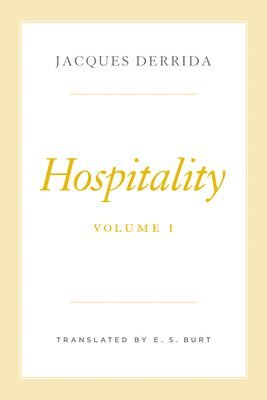
Jacques Derrida explores the ramifications of what we owe to others.Hospitality reproduces a two-year seminar series delivered by Jacques Derrida at the École des hautes études en sciences sociales in Paris between 1995 and 1997. In these lectures, Derrida asks a series of related questions about responsibility and “the foreigner”: How do we welcome or turn away the foreigner? What does the idea of the foreigner reveal about kinship and the state, particularly in relation to friendship, citizenship, migration, asylum, assimilation, and xenophobia? Derrida approaches these questions through readings of several classical texts as well as modern texts by Heidegger, Arendt, Camus, and others. Central to his project is a rigorous distinction between conventional, finite hospitality, with its many conditions, and the aspirational idea of hospitality as something offered unconditionally to the stranger. This volume collects the first year of the seminar.
361 kr
Skickas inom 7-10 vardagar
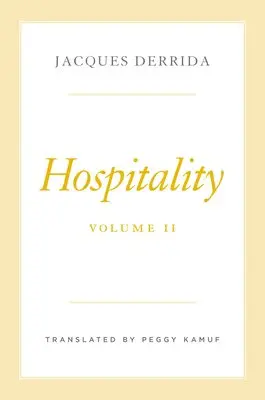
Jacques Derrida explores the ramifications of what we owe to others.Hospitality reproduces a two-year seminar series delivered by Jacques Derrida at the École des hautes études en sciences sociales in Paris between 1995 and 1997. In these lectures, Derrida asks a series of related questions about responsibility and “the foreigner”: How do we welcome or turn away the foreigner? What does the idea of the foreigner reveal about kinship and the state, particularly in relation to friendship, citizenship, migration, asylum, assimilation, and xenophobia? Central to his project is a rigorous distinction between conventional, finite hospitality, with its many conditions, and the aspirational idea of hospitality as something offered unconditionally to the stranger. This volume collects the second year of the seminar, which considers an Islamic problematic of hospitality, the relevance of forgiveness, and the work of Emmanuel Levinas.
691 kr
Skickas inom 7-10 vardagar
For Strasbourg consists of a series of essays and interviews about the city of Strasbourg and the philosophical friendships Jacques Derrida developed there over a period of some forty years.Written just months before his death, the opening essay, "The Place Name(s): Strasbourg," recounts in detail, and in very moving terms, Derrida's deep attachment to this French city on the border between France and Germany. More than just a personal narrative, however, the essay is a profound interrogation of the relationship between philosophy and place, philosophy and language, and philosophy and friendship. As such, it raises a series of philosophical, political, and ethical questions that might all be placed under the aegis of what Derrida once called "philosophical nationalities and nationalism."The other three texts included in the book are long interviews/conversations between Derrida and his two principal interlocutors in Strasbourg, Jean-Luc Nancy and Philippe Lacoue-Labarthe. These interviews are significant both for the themes they focus on (language, politics, friendship, death, life after death, and so on) and for what they reveal about Derrida's relationships to Nancy and Lacoue-Labarthe. Filled with sharp insights into one anothers' work and peppered with personal anecdotes and humor, the interviews bear witness to the decades-long intellectual friendships of these three important contemporary thinkers.This collection thus stands as a reminder of and testimony to Derrida's unique relationship to Strasbourg and to the two thinkers most closely associated with that city.
194 kr
Skickas inom 10-15 vardagar
For Strasbourg consists of a series of essays and interviews about the city of Strasbourg and the philosophical friendships Jacques Derrida developed there over a period of some forty years.Written just months before his death, the opening essay, "The Place Name(s): Strasbourg," recounts in detail, and in very moving terms, Derrida's deep attachment to this French city on the border between France and Germany. More than just a personal narrative, however, the essay is a profound interrogation of the relationship between philosophy and place, philosophy and language, and philosophy and friendship. As such, it raises a series of philosophical, political, and ethical questions that might all be placed under the aegis of what Derrida once called "philosophical nationalities and nationalism."The other three texts included in the book are long interviews/conversations between Derrida and his two principal interlocutors in Strasbourg, Jean-Luc Nancy and Philippe Lacoue-Labarthe. These interviews are significant both for the themes they focus on (language, politics, friendship, death, life after death, and so on) and for what they reveal about Derrida's relationships to Nancy and Lacoue-Labarthe. Filled with sharp insights into one anothers' work and peppered with personal anecdotes and humor, the interviews bear witness to the decades-long intellectual friendships of these three important contemporary thinkers.This collection thus stands as a reminder of and testimony to Derrida's unique relationship to Strasbourg and to the two thinkers most closely associated with that city.