Patricia Sullivan - Böcker
Visar alla böcker från författaren Patricia Sullivan. Handla med fri frakt och snabb leverans.
13 produkter
13 produkter
1 932 kr
Skickas inom 5-8 vardagar
Despite their immense war-fighting capacity, the five most powerful states in the international system have failed to attain their primary political objective in almost 40% of their military operations against weak state and non-state targets since 1945. Why are states with tremendous military might so often unable to attain their objectives when they use force against weaker adversaries? More broadly, under what conditions can states use military force to attain their political objectives and what conditions limit the utility of military force as a policy instrument? Can we predict the outcome of a war before the fighting begins? Scholars and military leaders have argued that poor military strategy choices, domestic political constraints on democratic governments, or failure to commit sufficient resources to the war effort can explain why strong states lose small wars. In contrast, Who Wins? by Patricia L. Sullivan argues that the key to understanding strategic success in war lies in the nature of the political objectives states pursue through the use of military force. Sullvian does not deny the importance of war-fighting capacity, military strategies, or resolve as determinants of war outcomes. But she provides both a coherent argument and substantial empirical evidence that the effects of these factors are dependent on the nature of the belligerents' political objectives.The theory's predictions about the conditions under which states are able to attain their political objectives through the use of military force are tested against the most widely accepted alternative explanations of war outcomes with an abundance of historical data on violent conflicts. The results support Sullivan's argument and challenge both existing theories and conventional wisdom about the impact of factors like military strength, resolve, regime type, and war-fighting strategies on war outcomes.
503 kr
Skickas inom 5-8 vardagar
Despite their immense war-fighting capacity, the five most powerful states in the international system have failed to attain their primary political objective in almost 40% of their military operations against weak state and non-state targets since 1945. Why are states with tremendous military might so often unable to attain their objectives when they use force against weaker adversaries? More broadly, under what conditions can states use military force to attain their political objectives and what conditions limit the utility of military force as a policy instrument? Can we predict the outcome of a war before the fighting begins? Scholars and military leaders have argued that poor military strategy choices, domestic political constraints on democratic governments, or failure to commit sufficient resources to the war effort can explain why strong states lose small wars. In contrast, Who Wins? by Patricia L. Sullivan argues that the key to understanding strategic success in war lies in the nature of the political objectives states pursue through the use of military force. Sullvian does not deny the importance of war-fighting capacity, military strategies, or resolve as determinants of war outcomes. But she provides both a coherent argument and substantial empirical evidence that the effects of these factors are dependent on the nature of the belligerents' political objectives.The theory's predictions about the conditions under which states are able to attain their political objectives through the use of military force are tested against the most widely accepted alternative explanations of war outcomes with an abundance of historical data on violent conflicts. The results support Sullivan's argument and challenge both existing theories and conventional wisdom about the impact of factors like military strength, resolve, regime type, and war-fighting strategies on war outcomes.
199 kr
Skickas inom 7-10 vardagar
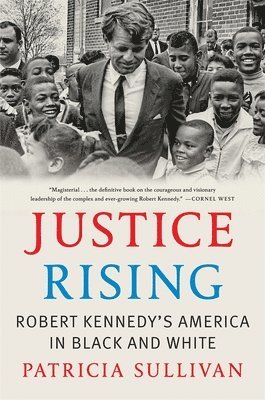
“In most accounts of the tumultuous 1960s, Robert Kennedy plays a supporting role…Sullivan corrects this and puts RFK near the center of the nation’s struggle for racial justice.”—Richard Thompson Ford, Washington Post“A profound and uplifting account of Robert F. Kennedy’s brave crusade for racial equality. This is narrative history at its absolute finest.”—Douglas Brinkley, author of Rosa Parks“A sobering analysis of the forces arrayed against advocates of racial justice. Desegregation suits took years to move through the courts. Ballot access was controlled by local officials…Justice Rising reminds us that although he was assassinated over 50 years ago, Kennedy remains relevant.”—Glenn C. Altschuler, Florida Courier“A groundbreaking book that reorients our understanding of a surprisingly underexplored aspect of Robert Kennedy’s life and career—race and civil rights—and sheds new light on race relations during a pivotal era of American history.”—Kenneth Mack, author of Representing the Race“Brilliant and beautifully written…could hardly be more timely.”—Daniel Geary, Irish TimesRace and politics converged in the 1960s in ways that indelibly changed America. This landmark reconsideration of Robert Kennedy’s life and legacy reveals how, as the nation confronted escalating demands for racial justice, RFK grasped the moment to emerge as a transformational leader.Intertwining Kennedy’s story with the Black freedom struggles of the 1960s, Justice Rising provides a fresh account of the changing political alignments that marked the decade. As Attorney General, Kennedy personally interceded to enforce desegregation rulings and challenge voter restrictions in the South. Morally committed to change, he was instrumental in creating the bipartisan coalition essential to passing the 1964 Civil Rights Act. After his brother’s assassination, his commitment took on a new urgency when cities emerged as the major front in the long fight for racial justice. On the night of Martin Luther King’s assassination, two months before he would himself be killed, his anguished appeal captured the hopes of a turbulent decade: “In this difficult time for the United States, it is perhaps well to ask what kind of nation we are and what direction we want to move in.” It is a question that remains urgent and unanswered.
447 kr
Skickas inom 10-15 vardagar
In the 1930s and 1940s, a loose alliance of blacks and whites, individuals and organizations, came together to offer a radical alternative to southern conservative politics. In Days of Hope , Patricia Sullivan traces the rise and fall of this movement. Using oral interviews with participants in this movement as well as documentary sources, she demonstrates that the New Deal era inspired a coalition of liberals, black activists, labor organizers, and Communist Party workers who sought to secure the New Deal's social and economic reforms by broadening the base of political participation in the South. From its origins in a nationwide campaign to abolish the poll tax, the initiative to expand democracy in the South developed into a regional drive to register voters and elect liberals to Congress. The NAACP, the CIO Political Action Committee, and the Southern Conference for Human Welfare coordinated this effort, which combined local activism with national strategic planning. Although it dramatically increased black voter registration and led to some electoral successes, the movement ultimately faltered, according to Sullivan, because the anti-Communist fervor of the Cold War and a militant backlash from segregationists fractured the coalition and marginalized southern radicals. Nevertheless, the story of this campaign invites a fuller consideration of the possibilities and constraints that have shaped the struggle for racial democracy in America since the 1930s.
120 kr
Skickas
2 256 kr
Skickas inom 10-15 vardagar
Winner of the 2020 CCCC Research Impact AwardLean Technical Communication: Toward Sustainable Program Innovation offers a theoretically and empirically-grounded model for growing and stewarding professional and technical communication programs under diverse conditions. Through case studies of disruptive innovations, this book presents a forward-looking, sustainable vision of program administration that negotiates short-term resource deficits with long-term resilience. It illustrates how to meet many of the newest challenges facing technical communication programs, such as building and maintaining change with limited resources, economic shortfalls, technology deficits, and expanding/reimagining the role of our programs in the 21st century university. Its insights benefit those involved in the development of undergraduate and graduate programs, including majors, service courses, minors, specializations, and certificates.
555 kr
Skickas inom 10-15 vardagar
Winner of the 2020 CCCC Research Impact AwardLean Technical Communication: Toward Sustainable Program Innovation offers a theoretically and empirically-grounded model for growing and stewarding professional and technical communication programs under diverse conditions. Through case studies of disruptive innovations, this book presents a forward-looking, sustainable vision of program administration that negotiates short-term resource deficits with long-term resilience. It illustrates how to meet many of the newest challenges facing technical communication programs, such as building and maintaining change with limited resources, economic shortfalls, technology deficits, and expanding/reimagining the role of our programs in the 21st century university. Its insights benefit those involved in the development of undergraduate and graduate programs, including majors, service courses, minors, specializations, and certificates.
1 039 kr
Skickas inom 10-15 vardagar
489 kr
Skickas inom 10-15 vardagar
941 kr
Skickas inom 10-15 vardagar
This volume addresses several concerns: What labor, workplace, and technology issues should composition as a profession be concerned with in the 21st century? How does technology affect the shape of academic labor? How have working conditions in composition affected the ways technology is used? The authors in this collection have turned their attention to these questions, arguing that composition workers (researchers, scholars, administrators, and teachers) have much to think about in relation to articulation of their professional identity.
378 kr
Skickas inom 10-15 vardagar
This volume addresses several concerns: What labor, workplace, and technology issues should composition as a profession be concerned with in the 21st century? How does technology affect the shape of academic labor? How have working conditions in composition affected the ways technology is used? The authors in this collection have turned their attention to these questions, arguing that composition workers (researchers, scholars, administrators, and teachers) have much to think about in relation to articulation of their professional identity.
231 kr
Skickas inom 5-8 vardagar
The first major history of America's oldest civil rights organisation is destined to become a classic in the field. When it was founded in 1909, The National Association for the Advancement of Colored People was an elite organisation of white reformers. By 1918, it had become a mass organisation with predominantly black members. Sullivan unearths the little-known early decades of NAACP's activism, telling startling stories of personal bravery, legal brilliance and political manoeuvring, before moving on to the critical post-war era.
Writers for Rare: An Anthology of Personal Stories from the Rare Disease Space
Häftad, Engelska, 2025
303 kr
Skickas inom 5-8 vardagar