• Fri frakt över 249 kr
  • •
  • Snabba leveranser
  • •
  • Billiga böcker
Kundservice

Du är på sajten för privatpersoner.

Företag, bibliotek eller offentlig verksamhet?

Du handlar på classic.bokus.com, där alla dina funktioner finns intakta.
Till classic.bokus.com
Bokus logotyp. Gå till startsidan.
  • Erbjudanden
  • Nyheter
  • Student
  • Topplistor
  • Barn & ungdom
  • Bokus Play
  • E-böcker
  • Pocketböcker
  • Spel & pussel

10% rabatt på allt med kod: NYSTART10 →

Sidfot

Mina sidor

    Hjälp

    • Kundservice
    • Vanliga frågor och svar
    • Frakt och leverans
    • Retur vid ångerrätt
    • Reklamera vara
    • Betalning
    • Köpvillkor
    • Allmänna villkor
    • Information om webbplatsens tillgänglighet

    Om Bokus

    • Om oss
    • Pressrum
    • För studenter
    • För företag
    • För bibliotek och offentlig verksamhet
    • För leverantörer
    • Hållbarhet

    Populärt

    • Aktuella erbjudanden
    • Presentkort
    • Studentlitteratur
    • Nya böcker
    • Topplistor
    • Signerade böcker
    • Engelska böcker

    Inspiration

    • Boktips
    • BookTok
    • Populära bokserier
    • Barnbokskaraktärer
    • Populära författare
    Logotyp för Bokus
    Följ oss på Facebook (extern länk)Följ oss på Instagram (extern länk)Följ oss på YouTube (extern länk)Följ oss på TikTok (extern länk)
    bokus @ CookiesAnpassa cookiesIntegritetspolicyKöpvillkor
    Till Citymail hemsida (extern länk)Till Budbee hemsida (extern länk)Till Postnord hemsida (extern länk)Till Schenker hemsida (extern länk)Till Early Bird hemsida (extern länk)Till Walleys hemsida (extern länk)
    1. Samhälle och politik
    2. Krig och försvar
    3. Krigsvetenskap

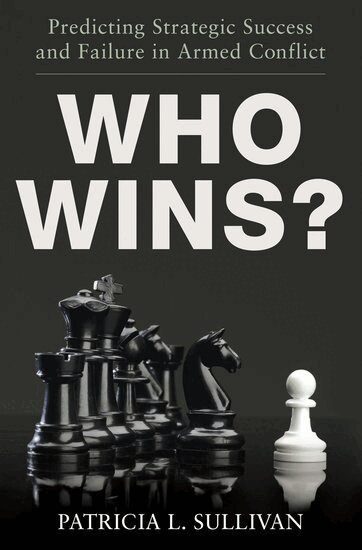
    Who Wins?

    Predicting Strategic Success and Failure in Armed Conflict

    AvPatricia Sullivan

    Häftad, Engelska, 2012

    772 kr

    Beställningsvara. Skickas inom 5-8 vardagar. Fri frakt över 249 kr.

    Fler format och utgåvor

    Inbunden

    2 234 kr

    E-bok

    537 kr

    Beskrivning

    Despite their immense war-fighting capacity, the five most powerful states in the international system have failed to attain their primary political objective in almost 40% of their military operations against weak state and non-state targets since 1945. Why are states with tremendous military might so often unable to attain their objectives when they use force against weaker adversaries? More broadly, under what conditions can states use military force to attain their political objectives and what conditions limit the utility of military force as a policy instrument? Can we predict the outcome of a war before the fighting begins? Scholars and military leaders have argued that poor military strategy choices, domestic political constraints on democratic governments, or failure to commit sufficient resources to the war effort can explain why strong states lose small wars. In contrast, Who Wins? by Patricia L. Sullivan argues that the key to understanding strategic success in war lies in the nature of the political objectives states pursue through the use of military force. Sullvian does not deny the importance of war-fighting capacity, military strategies, or resolve as determinants of war outcomes. But she provides both a coherent argument and substantial empirical evidence that the effects of these factors are dependent on the nature of the belligerents' political objectives.The theory's predictions about the conditions under which states are able to attain their political objectives through the use of military force are tested against the most widely accepted alternative explanations of war outcomes with an abundance of historical data on violent conflicts. The results support Sullivan's argument and challenge both existing theories and conventional wisdom about the impact of factors like military strength, resolve, regime type, and war-fighting strategies on war outcomes.

    Produktinformation

    • Utgivningsdatum:2012-07-26
    • Mått:155 x 231 x 15 mm
    • Vikt:227 g
    • Format:Häftad
    • Språk:Engelska
    • Antal sidor:192
    • Förlag:OUP USA
    • ISBN:9780199878352

    Utforska kategorier

    • Krigsvetenskap inom Samhälle och politik
    • Militär strategi inom Samhälle och politik
    • Internationella relationer inom Samhälle och politik

    Mer om författaren

    Patricia L. Sullivan is Assistant Professor of Political Science and Peace, War, and Defense in the Department of Public Policy at the University of North Carolina, Chapel Hill. She is the recipient of the 2011 SPIA Excellence in Teaching Award, the 2004-2006 Walter Isard Dissertation Award, given every two years by the Peace Science Society International, and the 2005 Dissertation Award from the Committee on the Analysis of Military Operations and Strategy (CAMOS), an affiliated group of the American Political Science Association.

    Recensioner i media

    Sullivan convincingly argues that war aims of interstate-dispute initiators and internal-conflict interveners play a more determinative role in who wins an armed conflict than most factors conventionally considered... Qualitative and quantitative data provide supporting evidence, creating a good example of mixed-methods research. Sullivan writes clearly throughout, making the book accessible beyond scholars and practitioners... Sullivan has written a thought-provoking book that opens new avenues of research.

    Innehållsförteckning

    • Chapter 1: Introduction ; Chapter 2: Strength and Resolve in the Armed Conflicts We Observe ; Chapter 3: War Aims and War Outcomes ; Chapter 4. Testing the Argument ; Chapter 5. Interstate Dispute Outcomes, 1919-2001 ; Chapter 6. Military Interventions by Powerful States: At What Price Victory? ; Chapter 7: Conclusion ; Appendix to Chapter 4 ; Appendix to Chapter 6 ; Notes ; Bibilography ; Index