Patrick L. Courts - Böcker
Visar alla böcker från författaren Patrick L. Courts. Handla med fri frakt och snabb leverans.
4 produkter
4 produkter
980 kr
Skickas inom 10-15 vardagar
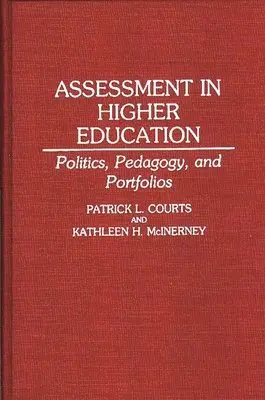
As part of the American school reform movement, administrators are searching for ways of measuring students' skills and progress within the system. Courts and McInerney focus on the qualitative assessment possible through the use of student portfolios, particularly at the college level. The authors are concerned that the teaching and learning process will be subsumed by assessment and will become even more test-driven than it now is. A critical look at multiple-choice, standardized examinations shows how unmindful our educational testing is of psychosocial diversity. The authors warn that in upgrading American education nationwide, more effective and self-confirming measures should be faculty developed and locally controlled. The authors propose a new compact among teachers and students as they take mutual responsibility for the learning process and changing curriculum.
370 kr
Skickas inom 10-15 vardagar
As part of the American school reform movement, administrators are searching for ways of measuring students' skills and progress within the system. Courts and McInerney focus on the qualitative assessment possible through the use of student portfolios, particularly at the college level. The authors are concerned that the teaching and learning process will be subsumed by assessment and will become even more test-driven than it now is. A critical look at multiple-choice, standardized examinations shows how unmindful our educational testing is of psychosocial diversity. The authors warn that in upgrading American education nationwide, more effective and self-confirming measures should be faculty developed and locally controlled. The authors propose a new compact among teachers and students as they take mutual responsibility for the learning process and changing curriculum.
1 039 kr
Skickas inom 10-15 vardagar
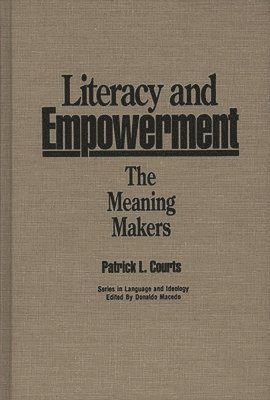
The first volume of the series Language and Ideology, this work explores mature literacy. Patrick L. Courts argues that while by society's standards many people can read well, they are unable to create meaning from the world of oral and written language. His theory derives from psycho- and sociolinguistics, cognitive psychology, philosophy, literary criticism, and whole language theory. Courts criticizes programmed activities, texts, and workbooks--challenging the control that commercial textbook publishers and test-makers exert on education. He shuns overemphasis on methods and offers an alternative approach firmly grounded in theory and aimed at empowering teachers and students.Courts begins with a discussion of liberatory pedagogy, drawing from whole language theory, the social semiotics of Halliday, reader-response theory, and the ideas of Heidegger and Derrida. The subsequent methodological chapters build a case for what Courts calls a conservative revolution in literacy education: teachers combining a sound base of theory with methodologies to tap students' generative, creative powers. Courts's methodology aims to empower people as meaning makers. This book is valuable to teachers and administrators, textbook publishers, and students of education.
379 kr
Skickas inom 10-15 vardagar
The first volume of the series Language and Ideology, this work explores mature literacy. Patrick L. Courts argues that while by society's standards many people can read well, they are unable to create meaning from the world of oral and written language. His theory derives from psycho- and sociolinguistics, cognitive psychology, philosophy, literary criticism, and whole language theory. Courts criticizes programmed activities, texts, and workbooks--challenging the control that commercial textbook publishers and test-makers exert on education. He shuns overemphasis on methods and offers an alternative approach firmly grounded in theory and aimed at empowering teachers and students.Courts begins with a discussion of liberatory pedagogy, drawing from whole language theory, the social semiotics of Halliday, reader-response theory, and the ideas of Heidegger and Derrida. The subsequent methodological chapters build a case for what Courts calls a conservative revolution in literacy education: teachers combining a sound base of theory with methodologies to tap students' generative, creative powers. Courts's methodology aims to empower people as meaning makers. This book is valuable to teachers and administrators, textbook publishers, and students of education.