Patrick Lantschner - Böcker
Visar alla böcker från författaren Patrick Lantschner. Handla med fri frakt och snabb leverans.
3 produkter
3 produkter
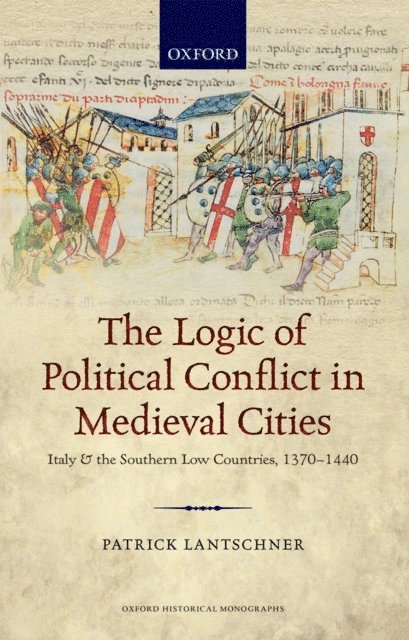
The Logic of Political Conflict in Medieval Cities
Italy and the Southern Low Countries, 1370-1440
Inbunden, Engelska, 2015
2 213 kr
Skickas inom 5-8 vardagar
This volume traces the logic of urban political conflict in late medieval Europe's most heavily urbanized regions, Italy and the Southern Low Countries. The fourteenth and fifteenth centuries are often associated with the increasing consolidation of states, but at the same time they also saw high levels of political conflict and revolt in cities that themselves were a lasting heritage of this period. In often radically different ways, conflict constituted a crucial part of political life in the six cities studied for this book: Bologna, Florence, and Verona, as well as Liège, Lille, and Tournai. The Logic of Political Conflict in Medieval Cities argues that such conflicts, rather than subverting ordinary political life, were essential features of the political systems that developed in cities. Conflicts were embedded in a polycentric political order characterized by multiple political units and bases of organization, ranging from guilds to external agencies.In this multi-faceted and shifting context, late medieval city dwellers developed particular strategies of legitimating conflict, diverse modes of behaviour, and various forms of association through which conflict could be addressed. At the same time, different configurations of these political units gave rise to specific systems of conflict which varied from city to city. Across all these cities, conflict lay at the basis of a distinct form of political organization-and represents the nodal point around which this political and social history of cities is written.
The Cambridge Urban History of Europe: Volume 2, Medieval and Early Modern Europe
Inbunden, Engelska, 2025
1 961 kr
Skickas inom 7-10 vardagar
Volume II charts European urbanism between 700-1850, the millennium during which Europe became the world's most urbanised region. Featuring thirty-six chapters from leading scholars working on all the major linguistic areas of Europe, the volume offers a state-of-the-art survey that explores and explains this transformation, how similar or different such processes were across Europe, and how far it is possible to discern traits that characterise European urbanism in this period. The first half of the volume offers overviews on the urban history of Mediterranean Europe, Atlantic and North Sea Europe, Central and Eastern Europe, and European urbanisms around the world. The second half explores major themes, from the conceptualisation of cities and their material fabric to continuities and changes in the social, political, economic, religious, and cultural histories of cities and towns.
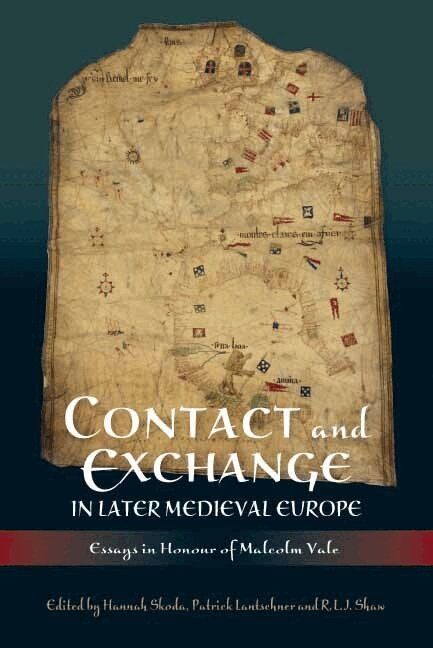
Contact and Exchange in Later Medieval Europe
Essays in Honour of Malcolm Vale
Inbunden, Engelska, 2012
1 192 kr
Skickas inom 7-10 vardagar
The complexity of the interplay and relationships over various borders in medieval Europe is here fully teased out.The processes by which ideas, objects, texts and political thought and experience moved across boundaries in the Middle Ages form the focus of this book, which also seeks to reassess the nature of the boundaries themselves; it thus appropriately reflects a major theme of Dr Malcolm Vale's work, which the essays collected here honour. They suggest ways of breaking down established historiographical paradigms of Europe as a set of distinct polities, achieving a more nuanced picture in which people and objects were constantly moving, and challenging previous conceptions of units and borders.The first section examines the construction of boundaries and units in the later Middle Ages, via topics ranging from linguistic units to social stratifications, and geographically from the Netherlands and Scotland to Gascony and the Iberian peninsula; it reveals how much the relationship between exchange and boundaries was reciprocal. The second section considers the mechanisms by which it took place, from West Africa to Italy and Flanders, and discusses the actual exchange of people, texts, and unusual artefacts. Overall, the essays bear witness to the constant interplay and interconnections throughout medieval Europe and beyond. Contributors: Paul Booth, Maria João Violante Branco, Rita Costa-Gomes, Mario Damen, Jan Dumolyn, Jean Dunbabin, Jean-PhilippeGenet, Michael Jones, Maurice Keen, Frédérique Lachaud, Patrick Lantschner, Guilhem Pépin, R.L.J. Shaw, Hannah Skoda, Erik Spindler, John Watts.