Paul A. Soukup - Böcker
Visar alla böcker från författaren Paul A. Soukup. Handla med fri frakt och snabb leverans.
5 produkter
5 produkter
863 kr
Skickas inom 10-15 vardagar
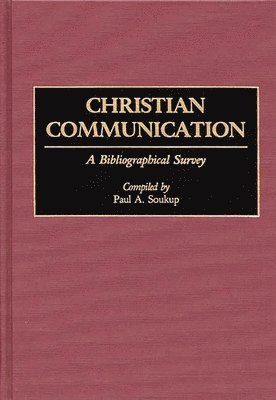
The rise of the fundamental religious broadcasters in the United States has triggered an intense popular interest in mediated Christianity and prompted the traditional churches to reexamine their own policies toward mass communication. The ensuing dramatic increase in the number of studies on the subject has prompted a corresponding need for a comprehensive index of valuable materials. Christian Communication is the first wide-ranging annotated bibliography of available books, articles, theses, and dissertations in English, French, German, Spanish, and Italian that deals with all forms and aspects of Christian communication, even comic books and the computer. The bibliographies for this collection were drawn from several sources including the Library of Congress; several important computerized databases; manual searches of such institutions as the Billy Graham Center and the Graduate Theological Union, among others; and references in dissertations. Most importantly, only accessible items which could be checked and reviewed by Soukup and his research staff have been included here.The volume is arranged to maximize ease of access and use and is based on the general academic division of communication studies. The first chapter contains an introduction, cross-referenced to the bibliographies, that reviews the history of church communication, the major issues that characterize it, and suggests possibilities for future study. Next, a resource chapter lists periodicals which address specific areas of religious communication or frequently published articles of interest; cites bibliographic guides to the material and surveys directories of both personnel working in the field of Christian communication and of catalogs of relevant materials. The following seven chapters contain the major bibliographical sections that review communication theory, history, rhetoric, interpersonal communication, mass communication, intercultural communication, and other media. The volume closes with helpful name, title, and subject indexes that make this guide thoroughly user-friendly and an important research tool for church communicators, theological students, and communications scholars working in philosophical or qualitative areas.
1 895 kr
Skickas inom 7-10 vardagar
Provides a contemporary view of the intertwined relationship of communication and religion The Handbook of Religion and Communication presents a detailed investigation of the complex interaction between media and religion, offering diverse perspectives on how both traditional and new media sources continue to impact religious belief and practice across multiple faiths around the globe. Contributions from leading international scholars address key themes such as the changing role of religious authority in the digital age, the role of media in cultural shifts away from religious institutions, and the ways modern technologies have transformed how religion is communicated and portrayed.Divided into five parts, the Handbook opens with a state-of-the-art overview of the subject’s intellectual landscape, introducing the historical background, theoretical foundations, and major academic approaches to communication, media, and religion. Subsequent sections focus on institutional and functional perspectives, theological and cultural approaches, and new approaches in digital technologies. The essays provide insight into a wide range of topics, including religious use of media, religious identity, audience gratification, religious broadcasting, religious content in entertainment, films and religion, news reporting about religion, race and gender, the sex-religion matrix, religious crisis communication, public relations and advertising, televangelism, pastoral ministry, death and the media, online religion, future directions in religious communication, and more. Explores the increasing role of media in creating religious identity and communicating religious experienceDiscusses the development and evolution of the communication practices of various religious bodiesCovers all major media sources including radio, television, film, press, digital online content, and social media platformsPresents key empirical research, real-world case studies, and illustrative examples throughoutEncompasses a variety of perspectives, including individual and institutional actors, academic and theoretical areas, and different forms of communication mediaExplores media and religion in Judeo-Christian traditions, Islam, Buddhism, Hinduism, religions of Africa, Atheism, and othersThe Handbook of Religion and Communication is an essential resource for scholars, academic researchers, practical theologians, seminarians, mass communication researchers, and undergraduate and graduate students taking courses on media and religion.
481 kr
Kommande
Provides a contemporary view of the intertwined relationship of communication and religion The Handbook of Religion and Communication presents a detailed investigation of the complex interaction between media and religion, offering diverse perspectives on how both traditional and new media sources continue to impact religious belief and practice across multiple faiths around the globe. Contributions from leading international scholars address key themes such as the changing role of religious authority in the digital age, the role of media in cultural shifts away from religious institutions, and the ways modern technologies have transformed how religion is communicated and portrayed.Divided into five parts, the Handbook opens with a state-of-the-art overview of the subject’s intellectual landscape, introducing the historical background, theoretical foundations, and major academic approaches to communication, media, and religion. Subsequent sections focus on institutional and functional perspectives, theological and cultural approaches, and new approaches in digital technologies. The essays provide insight into a wide range of topics, including religious use of media, religious identity, audience gratification, religious broadcasting, religious content in entertainment, films and religion, news reporting about religion, race and gender, the sex-religion matrix, religious crisis communication, public relations and advertising, televangelism, pastoral ministry, death and the media, online religion, future directions in religious communication, and more. Explores the increasing role of media in creating religious identity and communicating religious experienceDiscusses the development and evolution of the communication practices of various religious bodiesCovers all major media sources including radio, television, film, press, digital online content, and social media platformsPresents key empirical research, real-world case studies, and illustrative examples throughoutEncompasses a variety of perspectives, including individual and institutional actors, academic and theoretical areas, and different forms of communication mediaExplores media and religion in Judeo-Christian traditions, Islam, Buddhism, Hinduism, religions of Africa, Atheism, and othersThe Handbook of Religion and Communication is an essential resource for scholars, academic researchers, practical theologians, seminarians, mass communication researchers, and undergraduate and graduate students taking courses on media and religion.
Media Ecology of Theology
Communicating Faith Throughout the Christian Tradition
Häftad, Engelska, 2022
420 kr
Skickas inom 10-15 vardagar
In the Christian tradition, the faithful do theology—defined in Anselm's phrase as "faith seeking understanding"—in different media. The contemporary emphasis on written or academic theology obscures the long history in which people sought to understand and express their faith by way of various outlets and formats. Because historical Christianity has embraced every communication medium, the media ecology approach to communication study offers a powerful tool to examine that history and the affordances of the media for theological expression. Just so, the history of theology offers a variety of test cases to illustrate media ecology at work.In A Media Ecology of Theology Paul Soukup invites us to explore the interaction between communication media, broadly defined, and the Christian theological heritage. Soukup follows a media ecology methodology, moving from a description of a communication medium to an examination of its affordances to a discussion of how those affordances shape the faith-seeking-understanding practiced in each. He shows that, in some cases, different media support different theological conclusions, and different theological stances shape the media. The case studies range from the first to the twenty-first centuries, with a limitation imposed by selection, language, and culture.As an interdisciplinary and introductory work, A Media Ecology of Theology addresses communication scholars and students, theological scholars and students (primarily those interested in the history of theology or in practical theology), and those with an interest in various media (art, architecture, etc.). With its interdisciplinary focus and its willingness to argue for a wider theological ecosystem—one in which the medium influences both content and selection of ideas—Soukup creates new vistas for understanding the life of faith, and how societies and communities express their most cherished ideas.
Of Ong and Media Ecology
Essays in Communication, Composition and Literary Studies
Inbunden, Engelska, 2012
901 kr
Skickas inom 10-15 vardagar
Each of the essays in this collection builds on the scholarship or ideas of Walter J. Ong, S.J., and, in so doing, suggests fruitful avenues of exploration for contemporary scholars. Taken as a whole, these essays call attention to human expression and expressiveness—orality, writing, print, decoration: the whole variety of human communication. Grounded is disciplines ranging from anthropology to literature, the essays both show the increasing value of Ong’s thought and the wonderful contribution it makes to understanding human life.