Paul Boghossian - Böcker
Visar alla böcker från författaren Paul Boghossian. Handla med fri frakt och snabb leverans.
11 produkter
11 produkter
332 kr
Skickas inom 7-10 vardagar
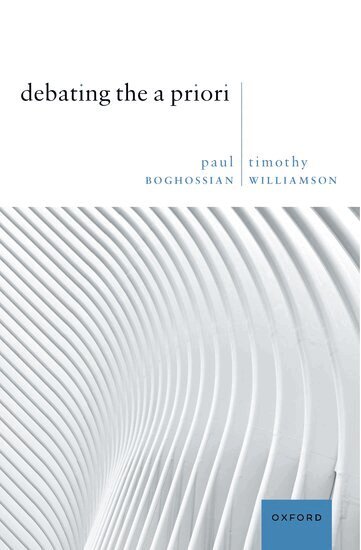
What kind of knowledge could be obtainable just by thinking? Debating the A Priori presents a series of exchanges between two leading philosophers on how to answer this question. In this extended debate, Boghossian and Williamson contribute alternating chapters which develop radically contrasting views and present detailed replies to each other's arguments. A central case is the nature of basic logical knowledge and the justification for basic deductive inferences, but the arguments range widely across epistemology, the philosophy of language, and metaphilosophy. The debate takes in the status of the distinctions between analytic and synthetic and between a priori and a posteriori, as well as problems concerning the conditions for linguistic understanding and competence, and the question of what it might be to grasp a concept or to have an intuition. Both authors explore implications for how philosophy itself works, or should work. The result vividly exposes some of the main fault lines in contemporary philosophy, concerning the relation between reason and experience, the status of basic beliefs, the nature of concepts and intuitions, the role of language in our understanding of the world, how to study knowledge, and what it is to do philosophy. Both authors provide conclusions which sum up their positions and place the arguments in context. Their lively and engaging exchanges allow the reader to follow up-close how a philosophical debatte evolves.
610 kr
Skickas inom 5-8 vardagar
What kind of knowledge could be obtainable just by thinking? Debating the A Priori presents a series of exchanges between two leading philosophers on how to answer this question. In this extended debate, Boghossian and Williamson contribute alternating chapters which develop radically contrasting views and present detailed replies to each other's arguments. A central case is the nature of basic logical knowledge and the justification for basic deductive inferences, but the arguments range widely across epistemology, the philosophy of language, and metaphilosophy. The debate takes in the status of the distinctions between analytic and synthetic and between a priori and a posteriori, as well as problems concerning the conditions for linguistic understanding and competence, and the question of what it might be to grasp a concept or to have an intuition. Both authors explore implications for how philosophy itself works, or should work. The result vividly exposes some of the main fault lines in contemporary philosophy, concerning the relation between reason and experience, the status of basic beliefs, the nature of concepts and intuitions, the role of language in our understanding of the world, how to study knowledge, and what it is to do philosophy. Both authors provide conclusions which sum up their positions and place the arguments in context. Their lively and engaging exchanges allow the reader to follow up-close how a philosophical debatte evolves.
2 511 kr
Skickas inom 3-6 vardagar
It's difficult to explain the point of normative judgments--judgments like 'You ought to donate to charity,' or 'You ought to believe that smoking is bad for you, given the evidence'--without assuming that such judgments express objective truths. And yet philosophers have always been puzzled by such a 'realism' about the normative, for an array of conceptual, epistemological, and metaphysical reasons. This book gathers together a collection of essays on this classic philosophical problem, authored by a mix of senior and junior contributors. Taken together, they illustrate the great progress that has been made on these fundamental but thorny issues. They also introduce some new puzzles about normative realism which had not been previously appreciated. The topics covered include the objectivity, epistemology, and metaphysics of normative judgments; the possibility of alternative normative conceptual schemes; and the way in which normative issues arise in such disparate areas as arithmetic and aesthetics. The volume opens with a substantial Introduction by the editors which provides a contemporary overview of the landscape of issues facing a realism about the normative and situates the authors' contributions within it.
471 kr
Skickas inom 3-6 vardagar
It's difficult to explain the point of normative judgments--judgments like 'You ought to donate to charity,' or 'You ought to believe that smoking is bad for you, given the evidence'--without assuming that such judgments express objective truths. And yet philosophers have always been puzzled by such a 'realism' about the normative, for an array of conceptual, epistemological, and metaphysical reasons. This book gathers together a collection of essays on this classic philosophical problem, authored by a mix of senior and junior contributors. Taken together, they illustrate the great progress that has been made on these fundamental but thorny issues. They also introduce some new puzzles about normative realism which had not been previously appreciated. The topics covered include the objectivity, epistemology, and metaphysics of normative judgments; the possibility of alternative normative conceptual schemes; and the way in which normative issues arise in such disparate areas as arithmetic and aesthetics. The volume opens with a substantial Introduction by the editors which provides a contemporary overview of the landscape of issues facing a realism about the normative and situates the authors' contributions within it.
355 kr
Skickas
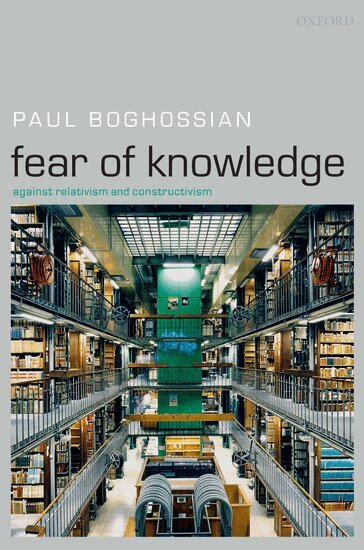
The academic world has been plagued in recent years by scepticism about truth and knowledge. Paul Boghossian, in his long-awaited first book, sweeps away relativist claims that there is no such thing as objective truth or knowledge, but only truth or knowledge from a particular perspective. He demonstrates clearly that such claims don't even make sense. Boghossian focuses on three different ways of reading the claim that knowledge is socially constructed - one as a thesis about truth and two about justification. And he rejects all three. The intuitive, common-sense view is that there is a way things are that is independent of human opinion, and that we are capable of arriving at belief about how things are that is objectively reasonable, binding on anyone capable of appreciating the relevant evidence regardless of their social or cultural perspective. Difficult as these notions may be, it is a mistake to think that recent philosophy has uncovered powerful reasons for rejecting them. This short, lucid, witty book shows that philosophy provides rock-solid support for common sense against the relativists; it will prove provocative reading throughout the discipline and beyond.
1 081 kr
Skickas inom 3-6 vardagar
The topics of a priori knowledge and a priori justification have long played a prominent part in epistemology and the theory of meaning. Recently there has been a surge of interest in the proper explication of these notions. These newly commissioned essays, by a distinguished, international group of philosophers, is likely to have a substantial influence on later work in this area. They discuss the relations of the a priori to meaning, justification, definition and ontology; they consider the role of the notion in Leibniz, Kant, Frege and Wittgenstein; and they address its role in recent discussions in the philosophy of mind. Particular attention is also paid to the a priori in logic, science and mathematics. The authors exhibit a wide variety of approaches, some remaining sceptical of the notion itself, some proposing that it receive a non-factualist treatment, and others proposing novel ways of explicating and defending it. The editors' Introduction provides a helpful route into the issues.
790 kr
Skickas inom 5-8 vardagar
The topics of a priori knowledge and a priori justification have long played a prominent part in epistemology and the theory of meaning. Recently there has been a surge of interest in the proper explication of these notions. These newly commissioned essays, by a distinguished, international group of philosophers, will have a substantial influence on later work in this area. They discuss the relations of the a priori to meaning, justification, definition and ontology; they consider the role of the notion in Leibniz, Kant, Frege and Wittgenstein; and they address its role in recent discussions in the philosophy of mind. Particular attention is also paid to the a priori in logic, science and mathematics. The authors exhibit a wide variety of approaches, some remaining sceptical of the notion itself, some proposing that it receive a non-factualist treatment, and others proposing novel ways of explicating and defending it. The editors' Introduction provides a helpful route into the issues.
816 kr
Skickas inom 5-8 vardagar
Relativist and constructivist conceptions of truth and knowledge have become orthodoxy in vast stretches of the academic world in recent times. In his long-awaited first book, Paul Boghossian critically examines such views and exposes their fundamental flaws. Boghossian focuses on three different ways of reading the claim that knowledge is socially constructed - one as a thesis about truth and two about justification. And he rejects all three. The intuitive, common-sense view is that there is a way the world is that is independent of human opinion; and that we are capable of arriving at beliefs about how it is that are objectively reasonable, binding on anyone capable of appreciating the relevant evidence regardless of their social or cultural perspective. Difficult as these notions may be, it is a mistake to think that philosophy has uncovered powerful reasons for rejecting them. This short, lucid, witty book shows that philosophy provides rock-solid support for common sense against the relativists. It will prove provocative reading throughout the discipline and beyond.
391 kr
Skickas inom 5-8 vardagar
573 kr
Skickas inom 5-8 vardagar
190 kr
Skickas inom 3-6 vardagar