Christopher Peacocke - Böcker
Visar alla böcker från författaren Christopher Peacocke. Handla med fri frakt och snabb leverans.
17 produkter
17 produkter
380 kr
Skickas inom 5-8 vardagar
This volume presents a new view of the relationship between metaphysics and the theory of meaning.What is the relation between the nature of the things you think about, on the one hand, and the ways you think about them on the other? Is the nature of the world prior to the nature of thought and meaning, or not? Christopher Peacocke argues that the nature of the world - its metaphysics - is always involved in thought and meaning. Meaning is never prior to the nature of the world.Peacocke develops a general claim that metaphysics is always involved, either as explanatorily prior, or in a no-priority relationship, to the theory of meaning and content. Meaning and intentional content are never explanatorily prior to the metaphysics. He aims to show, in successive chapters of The Primacy of Metaphysics how the general view holds for magnitudes, time, the self, and abstract objects. For each of these cases, the metaphysics of the entities involved is explanatorily prior to an account of the nature of our language and thought about them. Peacocke makes original contributions to the metaphysics of these topics, and offers consequential new treatments of analogue computation and representation. In the final chapter, he argues that his approach generates a new account of the limits of intelligibility, and locates his account in relation to other treatments of this classical conundrum.
659 kr
Skickas inom 5-8 vardagar
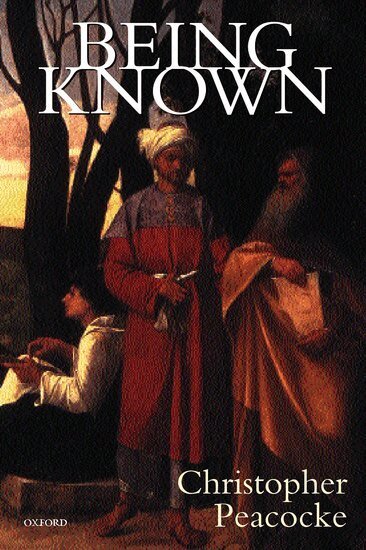
Being Known is a response to a philosophical challenge which arises for every area of thought. The challenge is one of reconciling our conception of truth in an area with the means by which we think we come to know truth about that area. Meeting the challenge may require a revision of our conception of truth in that area; or a revision of our theory of knowledge for that area; or a revision in our conception of the relations between the two. Christopher Peacocke presents a framework for addressing the challenge, a framework which links both the theory of knowledge and the theory of truth with the theory of concept-possession. It formulates a set of constraints and a general form of solution for a wide range of topics. He goes on to propose specific solutions within this general form for a series of classically problematic subjects: the past; metaphysical necessity; the intentional contents of our own mental states; the self; and freedom of the will. Being Known will interest anyone concerned with those individual topics, as well as those concerned more generally with meaning and understanding, metaphysics and epistemology, and their interrelations.
1 252 kr
Skickas inom 5-8 vardagar
Holistic Explanation Action, Space, Interpretation
668 kr
Skickas inom 5-8 vardagar
Peacocke argues that the propositional content of mental states can only be understood in relation to perceptual experience and shows that not all experience is representational.
720 kr
Skickas inom 7-10 vardagar
The topics of this book lie in the intersection of three areas: the philosophy of mind, the theory of meaning and content, and the philosophy of psychology. The book grew out of a desire to treat the nature of the content of psychological states in much greater detail than was attempted in Holistic Explanation. The present work is based on material presented in classes at Oxford University in the years 1979 to 1982.
583 kr
Skickas
Christopher Peacocke presents a philosophical theory of subjects of consciousness, together with a theory of the nature of first person representation of such a subject of consciousness. He develops a new treatment of subjects, distinct from previous theories, under which subjects were regarded either as constructs from mental events, or fundamentally embodied, or Cartesian egos. In contrast, his theory of the first person integrates with the positive treatment of subjects—and it contributes to the explanation of various distinctive first person phenomena in the theory of thought and knowledge. These are issues on which contributions have been made by some of the greatest philosophers, and Peacocke brings his points to bear on the contributions to these issues made by Hume, Kant, Frege, Wittgenstein, and Strawson. He also relates his position to the recent literature in the philosophy of mind, and then goes on to distinguish and characterize three varieties of self-consciousness. Perspectival self-consciousness involves the subject's capacity to appreciate that she is of the same kind as things given in a third personal way, and attributes the subject to a certain kind of objective thought about herself. Reflective self-consciousness involves awareness of the subject's own mental states, reached in a distinctive way. Interpersonal self-consciousness is awareness that one features, as a subject, in some other person's mental states. These varieties, and the relations and the forms of co-operation between them, are important in explaining features of our knowledge, our social relations, and our emotional lives. The theses of The Mirror of the World are of importance not only for philosophy, but also for psychology, the arts, and anywhere else that the self and self-representation loom large. The Context and Content series is a forum for outstanding original research at the intersection of philosophy, linguistics, and cognitive science. The general editor is François Recanati (Institut Jean-Nicod, Paris).
510 kr
Skickas inom 5-8 vardagar
This book presents a new view of the relation between metaphysics and the theory of meaning, broadly construed. Christopher Peacocke develops a general claim that metaphysics is always involved, either as explanatorily prior, or in a no-priority relationship, to the theory of meaning and content. Meaning and intentional content are never explanatorily prior to the metaphysics. He aims to show, in successive chapters of The Primacy of Metaphysics, how the general view holds for magnitudes, time, the self, and abstract objects. For each of these cases, the metaphysics of the entities involved is explanatorily prior to an account of the nature of our language and thought about them. Peacocke makes original contributions to the metaphysics of these topics, and offers consequential new treatments of analogue computation and representation. In the final chapter, he argues that his approach generates a new account of the limits of intelligibility, and locates his account in relation to other treatments of this classical conundrum.
2 511 kr
Skickas inom 3-6 vardagar
It's difficult to explain the point of normative judgments--judgments like 'You ought to donate to charity,' or 'You ought to believe that smoking is bad for you, given the evidence'--without assuming that such judgments express objective truths. And yet philosophers have always been puzzled by such a 'realism' about the normative, for an array of conceptual, epistemological, and metaphysical reasons. This book gathers together a collection of essays on this classic philosophical problem, authored by a mix of senior and junior contributors. Taken together, they illustrate the great progress that has been made on these fundamental but thorny issues. They also introduce some new puzzles about normative realism which had not been previously appreciated. The topics covered include the objectivity, epistemology, and metaphysics of normative judgments; the possibility of alternative normative conceptual schemes; and the way in which normative issues arise in such disparate areas as arithmetic and aesthetics. The volume opens with a substantial Introduction by the editors which provides a contemporary overview of the landscape of issues facing a realism about the normative and situates the authors' contributions within it.
471 kr
Skickas inom 3-6 vardagar
It's difficult to explain the point of normative judgments--judgments like 'You ought to donate to charity,' or 'You ought to believe that smoking is bad for you, given the evidence'--without assuming that such judgments express objective truths. And yet philosophers have always been puzzled by such a 'realism' about the normative, for an array of conceptual, epistemological, and metaphysical reasons. This book gathers together a collection of essays on this classic philosophical problem, authored by a mix of senior and junior contributors. Taken together, they illustrate the great progress that has been made on these fundamental but thorny issues. They also introduce some new puzzles about normative realism which had not been previously appreciated. The topics covered include the objectivity, epistemology, and metaphysics of normative judgments; the possibility of alternative normative conceptual schemes; and the way in which normative issues arise in such disparate areas as arithmetic and aesthetics. The volume opens with a substantial Introduction by the editors which provides a contemporary overview of the landscape of issues facing a realism about the normative and situates the authors' contributions within it.
858 kr
Skickas inom 3-6 vardagar
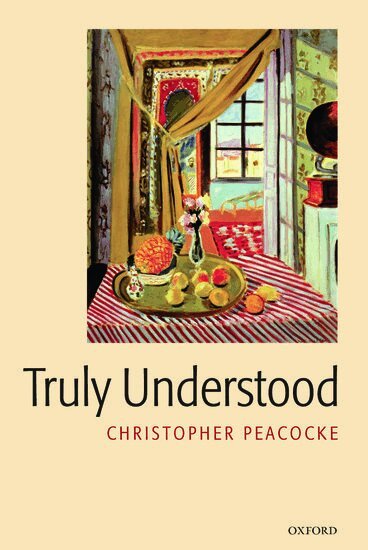
In Truly Understood, Christopher Peacocke argues that truth and reference have a much deeper role in the explanation of meaning and understanding than has hitherto been appreciated. Examination of specific concepts shows that a grasp of these concepts has to be characterized in terms of reference, identity, and relations to the world. Peacocke develops a positive general theory of understanding based on the idea that concepts are individuated by their fundamental reference rules, which contrasts sharply with conceptual-role, inferentialist, and pragmatist approaches to meaning. He treats thought about the material world, about places and times, and about the self within the framework of this general account, and extends the theory to explain the normative dimensions of content, which he believes are founded in the network of connections between concepts and the level of reference and truth. In the second part of the book, Peacocke explores the application of this account to some problematic mental phenomena, including the conception of many subjects of experience, concepts of conscious states, mental action, and our ability to think about the contents of our own and others' mental states.
1 081 kr
Skickas inom 3-6 vardagar
The topics of a priori knowledge and a priori justification have long played a prominent part in epistemology and the theory of meaning. Recently there has been a surge of interest in the proper explication of these notions. These newly commissioned essays, by a distinguished, international group of philosophers, is likely to have a substantial influence on later work in this area. They discuss the relations of the a priori to meaning, justification, definition and ontology; they consider the role of the notion in Leibniz, Kant, Frege and Wittgenstein; and they address its role in recent discussions in the philosophy of mind. Particular attention is also paid to the a priori in logic, science and mathematics. The authors exhibit a wide variety of approaches, some remaining sceptical of the notion itself, some proposing that it receive a non-factualist treatment, and others proposing novel ways of explicating and defending it. The editors' Introduction provides a helpful route into the issues.
790 kr
Skickas inom 5-8 vardagar
The topics of a priori knowledge and a priori justification have long played a prominent part in epistemology and the theory of meaning. Recently there has been a surge of interest in the proper explication of these notions. These newly commissioned essays, by a distinguished, international group of philosophers, will have a substantial influence on later work in this area. They discuss the relations of the a priori to meaning, justification, definition and ontology; they consider the role of the notion in Leibniz, Kant, Frege and Wittgenstein; and they address its role in recent discussions in the philosophy of mind. Particular attention is also paid to the a priori in logic, science and mathematics. The authors exhibit a wide variety of approaches, some remaining sceptical of the notion itself, some proposing that it receive a non-factualist treatment, and others proposing novel ways of explicating and defending it. The editors' Introduction provides a helpful route into the issues.
1 479 kr
Skickas inom 5-8 vardagar
The Realm of Reason develops a new, general theory of what it is for a thinker to be entitled to form a given belief. The theory locates entitlement in the nexus of relations between truth, content, and understanding. Peacocke formulates three principles of rationalism that articulate this conception. The principles imply that all entitlement has a component that is justificationally independent of experience. The resulting position is thus a form of rationalism, generalized to all kinds of content.To show how these principles are realized in specific domains, Peacocke applies the theory in detail to several classical problems of philosophy, including the nature of perceptual entitlement, induction, and the status of moral thought. These discussions involve an elaboration of the structure of entitlement in ways that have applications in many other areas of philosophy. He also relates the theory to classical and recent rationalist thought, and to current issues in the theory of meaning, reference and explanation. In the course of these discussions, he proposes a general theory of the a priori.The focus of the work lies in the intersection of epistemology, metaphysics, and the theory of meaning, and will be of interest both to students and researchers in these areas, and to anyone concerned with the idea of rationality.
625 kr
Skickas inom 5-8 vardagar
The Realm of Reason develops a new, general theory of what it is for a thinker to be entitled to form a given belief. The theory locates entitlement in the nexus of relations between truth, content, and understanding. Peacocke formulates three principles of rationalism that articulate this conception. The principles imply that all entitlement has a component that is justificationally independent of experience. The resulting position is thus a form of rationalism, generalized to all kinds of content.To show how these principles are realized in specific domains, Peacocke applies the theory in detail to several classical problems of philosophy, including the nature of perceptual entitlement, induction, and the status of moral thought. These discussions involve an elaboration of the structure of entitlement in ways that have applications in many other areas of philosophy. He also relates the theory to classical and recent rationalist thought, and to current issues in the theory of meaning, reference and explanation. In the course of these discussions, he proposes a general theory of the a priori.The focus of the work lies in the intersection of epistemology, metaphysics, and the theory of meaning, and will be of interest both to students and researchers in these areas, and to anyone concerned with the idea of rationality.
495 kr
Skickas inom 5-8 vardagar
In Truly Understood, Christopher Peacocke argues that truth and reference have a much deeper role in the explanation of meaning and understanding than has hitherto been appreciated. Examination of specific concepts shows that a grasp of these concepts has to be characterized in terms of reference, identity, and relations to the world. Peacocke develops a positive general theory of understanding based on the idea that concepts are individuated by their fundamental reference rules, which contrasts sharply with conceptual-role, inferentialist, and pragmatist approaches to meaning. He treats thought about the material world, about places and times, and about the self within the framework of this general account, and extends the theory to explain the normative dimensions of content, which he believes are founded in the network of connections between concepts and the level of reference and truth. In the second part of the book, Peacocke explores the application of this account to some problematic mental phenomena, including the conception of many subjects of experience, concepts of conscious states, mental action, and our ability to think about the contents of our own and others' mental states.
1 078 kr
Skickas inom 7-10 vardagar
Christopher Peacocke presents a philosophical theory of subjects of consciousness, together with a theory of the nature of first person representation of such a subject of consciousness. He develops a new treatment of subjects, distinct from previous theories, under which subjects were regarded either as constructs from mental events, or fundamentally embodied, or Cartesian egos. In contrast, his theory of the first person integrates with the positive treatment of subjects--and it contributes to the explanation of various distinctive first person phenomena in the theory of thought and knowledge. These are issues on which contributions have been made by some of the greatest philosophers, and Peacocke brings his points to bear on the contributions to these issues made by Hume, Kant, Frege, Wittgenstein, and Strawson. He also relates his position to the recent literature in the philosophy of mind, and then goes on to distinguish and characterize three varieties of self-consciousness. Perspectival self-consciousness involves the subject's capacity to appreciate that she is of the same kind as things given in a third personal way, and attributes the subject to a certain kind of objective thought about herself. Reflective self-consciousness involves awareness of the subject's own mental states, reached in a distinctive way. Interpersonal self-consciousness is awareness that one features, as a subject, in some other person's mental states. These varieties, and the relations and the forms of co-operation between them, are important in explaining features of our knowledge, our social relations, and our emotional lives. The theses of The Mirror of the World are of importance not only for philosophy, but also for psychology, the arts, and anywhere else that the self and self-representation loom large.The Context and Content series is a forum for outstanding original research at the intersection of philosophy, linguistics, and cognitive science. The general editor is François Recanati (Institut Jean-Nicod, Paris).
564 kr
Skickas inom 5-8 vardagar